


Bajrang Dal activists parade man for converting 3, making them eat beef

January 30, 2016

Kanpur, Jan 30: A man was on Friday tonsured, garlanded with shoes, and paraded on the streets of Orai in Uttar Pradesh, allegedly by Bajrang Dal activists who accused him of converting three Hindu men to Christianity and forcibly making them consume beef.

Deputy inspector general (DIG), Jhansi range, Sharad Sachan said three FIRs had been lodged in connection with the incident, including two against Bajrang Dal members, who have not been named, and one against the alleged victim, Awdhesh Savita. bd
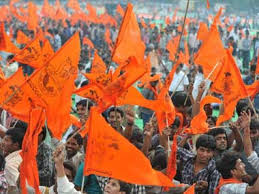
"On Friday afternoon, a mob of nearly 200 men, allegedly comprising Bajrang Dal activists, reached the house of Awdhesh at Randar in Jalaun district, brought him out forcibly, and took him to Orai (district headquarters)," a police source said.

"He was paraded through the town after his hair, eyebrows and moustache were shaved off, and garlanded with shoes," the source added.

When police reached the spot and tried to take Awdhesh to the police post, the crowd refused to let him go. Subsequently, senior officers arrived with reinforcements, including police and PAC personnel. He was then taken to Orai Kotwali police station, the source said.

The mob reportedly accused Awdhesh of luring three Hindu men to a church in Kachwaha village of Mirzapur district on the pretext of attending a satsang and converting them to Christianity.

Police said a local Bajrang Dal member brought forward one of the three alleged converts, identified as Sangam Jatav, at Orai, and asked him to narrate the entire story in public on Friday. Jatav was reportedly "the only person who managed to escape the clutches of the men in Mirzapur".

The Bajrang Dal member also claimed that all the three were forced to consume beef against their will. Not only this, Sangam has also alleged that pictures of Hindu gods and goddesses were thrown on the floor and they were made to walk on them, reports said.

"Prima facie, Sangam's allegations appear suspicious, but we are investigating the matter," Jalaun SP N Kolanchi said.

Comments

Zahoor Ahmed
 - 
Saturday, 30 Jan 2016

Sangh parivar always finding reason to create communal tension in the society if not find create the problem. Indians wake up before its too late.

yousef
 - 
Saturday, 30 Jan 2016

No one can change the willings (Heart) of one. the bajrang dal and others looking for opportunity for make the violence.

amjad
 - 
Saturday, 30 Jan 2016

where is law and order in india. r.s.s. bajrang bal is affiliated to Goverment of india. this cancer of india togadia is a jain he was fighting with hindus. now is the only cancer that is spreading against minorities in india. he is the culprit.

AK
 - 
Saturday, 30 Jan 2016

A BIG LIE to create unrest in society..

Ahmed
 - 
Saturday, 30 Jan 2016

Do not covert anybody. Please give them only message. If anybody want to convert, let them do by their own will in a court of law.

Add new comment

  • Coastaldigest.com reserves the right to delete or block any comments.
  • Coastaldigset.com is not responsible for its readers’ comments.
  • Comments that are abusive, incendiary or irrelevant are strictly prohibited.
  • Please use a genuine email ID and provide your name to avoid reject.
News Network
July 25,2020

Bengaluru, Jul 25: The Karnataka government on Saturday announced a waiver of crematorium fees for those who succumb to the COVID-19 infection in Bengaluru and said the city civic body would bear the cost.

It said that from now on, families of the COVID deceased need not pay any fees fixed by the city civic body- Bruhat Bengaluru Mahanagara Palike (BBMP)- across 12 electric crematoriums in the city.

"There were reports in the media about difficulties faced in performing the last rites of those who died due to COVID-19 infections. Aimed at resolving those difficulties, certain decisions have been taken," Revenue Minister R Ashoka said.

He told reporters here that BBMP had fixed Rs 250 as the cremation fee, Rs 100 for the ash collection pot and Rs 900 for the bier (bamboo stretcher on which the body is carried), all of which have been waived for COVID deaths.

"So it will be a waiver of Rs 1,250 per cremation. The BBMP will bear this cost," he added.

Ashoka also announced Rs 500 per body incentive for the personnel who conduct the last rites of COVID victims.

"This is in recognition of their services at a time when family members of the deceased are not ready to touch the body and not ready to take the body in some cases," he said.

Noting that the government has identified 23 acres of land at five places around Bengaluru for burial or cremation of COVID victims, Ashoka locals in all these areas are protesting against it.

Appealing to the people for cooperation during these difficult times, he said the government's intention was to ensure respectful burial or cremation for the deceased.

"Obstructing it is not right, it is not Indian tradition," he said.

Pointing out that it takes almost a day's time for a COVID victim's body to be handed over for burial or cremation, he said "scientifically, according to experts and doctors, the virus will not remain alive for more than three hours.

...Also, bodies are either burnt or buried eight feet below. So there will not be any problem for those living in nearby areas and it will not spread infection. Cooperate with humanity," he said.

"These lands identified are for all religions and communities and once the pandemic subsides, can be used for other deaths as well," he said.

Comments

Add new comment

  • Coastaldigest.com reserves the right to delete or block any comments.
  • Coastaldigset.com is not responsible for its readers’ comments.
  • Comments that are abusive, incendiary or irrelevant are strictly prohibited.
  • Please use a genuine email ID and provide your name to avoid reject.
Agencies
May 8,2020

Washington D.C., May 8: The prime time for brain development in a child's life is the first year, where the infant spends most of the time asleep. It is the time when neural connections form and sensory memories are encoded.

However, when sleep is disrupted, as occurs more often among children with autism, brain development may be affected, too.

New research led by the University of Washington finds that sleep problems in a baby's first 12 months may not only precede an autism diagnosis but also may be associated with altered growth trajectory in a key part of the brain, the hippocampus.

The study, which was published in the American Journal of Psychiatry, researchers report that in a sample of more than 400 taken of 6- to 12-month-old infants, those who were later diagnosed with autism were more likely to have had difficulty falling asleep.

It also states that this sleep difficulty was associated with altered growth trajectories in the hippocampus.

"The hippocampus is critical for learning and memory, and changes in the size of the hippocampus have been associated with poor sleep in adults and older children.

As many as 80 per cent of the children with autism spectrum disorder have sleep problems," said Annette Estes, director of the UW Autism Center and senior author of the study.

"In our clinical experience, parents have a lot of concerns about their children's sleep, and in our work on early autism intervention, we observed that sleep problems were holding children and families back," added Estes, who is also a UW professor of speech and hearing sciences.

"It could be that altered sleep is part-and-parcel of autism for some children. One clue is that behavioural interventions to improve sleep don't work for all children with autism, even when their parents are doing everything just right. This suggests that there may be a biological component to sleep problems for some children with autism," said Estes.

To consider links among sleep, brain development, and autism, researchers at the IBIS Network looked at MRI scans of 432 infants, surveyed parents about sleep patterns, and measured cognitive functioning using a standardized assessment.

At the outset of the study, infants were classified according to their risk for developing autism: Those who were at higher risk of developing autism -- about two-thirds of the study sample -- had an older sibling who had already been diagnosed.

Infant siblings of children with autism have a 20 per cent chance of developing autism spectrum disorder -- a much higher risk than children in the general population.

In the current study, 127 of the 432 infants were identified as "low risk" at the time the MRI scans were taken because they had no family history of autism.

They later evaluated all the participants at 24 months of age to determine whether they had developed autism. Of the roughly 300 children originally considered "high familial risk," 71 were diagnosed with autism spectrum disorder at that age.

Problems with sleep were more common among the infants later diagnosed with an autism spectrum disorder, as were larger hippocampi. No other subcortical brain structures were affected, including the amygdala, which is responsible for certain emotions and aspects of memory, or the thalamus, a signal transmitter from the spinal cord to the cerebral cortex.

The authors note that while parents reported more sleep difficulties among infants who developed autism compared to those who did not, the differences were very subtle and only observed when looking at group averages across hundreds of infants.

Sleep patterns in the first years of life change rapidly as infants transition from sleeping around the clock to a more adult-like sleep/wake cycle. Until further research is completed, Estes said, it is not possible to interpret challenges with sleep as an early sign of increased risk for autism.

Comments

Add new comment

  • Coastaldigest.com reserves the right to delete or block any comments.
  • Coastaldigset.com is not responsible for its readers’ comments.
  • Comments that are abusive, incendiary or irrelevant are strictly prohibited.
  • Please use a genuine email ID and provide your name to avoid reject.
coastaldigest.com news network
May 19,2020

Mangaluru, May 19: With lockdown 4.0 coming into force, the Karnataka State Road Transport Corporation (KSRTC) started bus services from Mangaluru to various destinations today.

According to officials, buses started plying from Mangaluru to Bengaluru, Mysuru, Shivamogga, Hubballi and other areas with limited passengers. A bus, which left for Bengaluru from Mangaluru had less than 30 passengers on board.

“Depending on the demand, the buses will be operated with 50% of the capacity. Measures have been taken to ensure that social distancing norms are adhered to while purchasing tickets from the counter,” said S N Arun, KSRTC Divisional Controller.

However, the KSRTC is yet to take a decision on operating Nagarasarige buses in the city. 

“Only those destinations, which can be reached by 7 pm has been considered by the KSRTC while operating the buses. As a result, after 11 am, no buses will travel to Bengaluru from Mangaluru. Further, permission will not be accorded for the travelling of pregnant women, children below 10 years old and senior citizens above 60 years old. Thermal scanning is used for checking the temperature of the passengers before boarding the buses. All the buses are sanitised after each trip,” he said.

Further, he said the contact number, name and address of the passengers are collected by the officials during the travel.

Comments

Add new comment

  • Coastaldigest.com reserves the right to delete or block any comments.
  • Coastaldigset.com is not responsible for its readers’ comments.
  • Comments that are abusive, incendiary or irrelevant are strictly prohibited.
  • Please use a genuine email ID and provide your name to avoid reject.