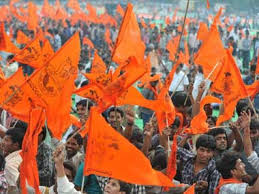
Bajrang Dal activists parade man for converting 3, making them eat beef

January 30, 2016

Kanpur, Jan 30: A man was on Friday tonsured, garlanded with shoes, and paraded on the streets of Orai in Uttar Pradesh, allegedly by Bajrang Dal activists who accused him of converting three Hindu men to Christianity and forcibly making them consume beef.

Deputy inspector general (DIG), Jhansi range, Sharad Sachan said three FIRs had been lodged in connection with the incident, including two against Bajrang Dal members, who have not been named, and one against the alleged victim, Awdhesh Savita. bd

"On Friday afternoon, a mob of nearly 200 men, allegedly comprising Bajrang Dal activists, reached the house of Awdhesh at Randar in Jalaun district, brought him out forcibly, and took him to Orai (district headquarters)," a police source said.

"He was paraded through the town after his hair, eyebrows and moustache were shaved off, and garlanded with shoes," the source added.

When police reached the spot and tried to take Awdhesh to the police post, the crowd refused to let him go. Subsequently, senior officers arrived with reinforcements, including police and PAC personnel. He was then taken to Orai Kotwali police station, the source said.

The mob reportedly accused Awdhesh of luring three Hindu men to a church in Kachwaha village of Mirzapur district on the pretext of attending a satsang and converting them to Christianity.

Police said a local Bajrang Dal member brought forward one of the three alleged converts, identified as Sangam Jatav, at Orai, and asked him to narrate the entire story in public on Friday. Jatav was reportedly "the only person who managed to escape the clutches of the men in Mirzapur".

The Bajrang Dal member also claimed that all the three were forced to consume beef against their will. Not only this, Sangam has also alleged that pictures of Hindu gods and goddesses were thrown on the floor and they were made to walk on them, reports said.

"Prima facie, Sangam's allegations appear suspicious, but we are investigating the matter," Jalaun SP N Kolanchi said.

Comments

Zahoor Ahmed
 - 
Saturday, 30 Jan 2016

Sangh parivar always finding reason to create communal tension in the society if not find create the problem. Indians wake up before its too late.

yousef
 - 
Saturday, 30 Jan 2016

No one can change the willings (Heart) of one. the bajrang dal and others looking for opportunity for make the violence.

amjad
 - 
Saturday, 30 Jan 2016

where is law and order in india. r.s.s. bajrang bal is affiliated to Goverment of india. this cancer of india togadia is a jain he was fighting with hindus. now is the only cancer that is spreading against minorities in india. he is the culprit.

AK
 - 
Saturday, 30 Jan 2016

A BIG LIE to create unrest in society..

Ahmed
 - 
Saturday, 30 Jan 2016

Do not covert anybody. Please give them only message. If anybody want to convert, let them do by their own will in a court of law.

Add new comment

  • Coastaldigest.com reserves the right to delete or block any comments.
  • Coastaldigset.com is not responsible for its readers’ comments.
  • Comments that are abusive, incendiary or irrelevant are strictly prohibited.
  • Please use a genuine email ID and provide your name to avoid reject.
News Network
February 5,2020

Bengaluru, Feb 5: Despite installing a BJP government in Karnataka through disguised operation Kamala, the Prime Minister Narendra Modi-led union government has continued its step motherly attitude towards this south Indian state.

Under the new formula adopted to share central taxes among states Karnataka will be the worst-affected. Though the 15th Finance Commission has recommended a special grant of Rs 5,495 crore for the state for 2020-21, the Centre appears reluctant to pay up and instead has asked for the proposal to be reviewed.

During the Union budget, the report of the 14th Finance Commission headed by NK Singh for 2020-21 was tabled in Lok Sabha. It shows besides Karnataka, Telangana, Mizoram and Kerala saw their central tax share decrease, while Uttar Pradesh, Bihar and Maharashtra were top gainers.

Karnataka's share has decreased from 4.7% provided by the previous finance commission, to 3.6%. Acknowledging there is a steep decline in Karnataka's share from 2019-20, the finance commission has recommended a special grant of Rs 5,495 crore for the state.

Its share in 2019-20 was Rs 36,675 crore, but under the new formula, Karnataka will get only Rs 31,180 crore in 2020-21 from the divisible pool of Rs 8.5 lakh crore - a decline of 22.5%.

Also, the decrease for Karnataka comes on the back of a shortfall in 2019-20. While the state was entitled to Rs 39,806 crore from the divisible pool, it got only Rs 36,675 crore as the Centre suffered a tax revenue shortfall of Rs 1.5 lakh crore.

What is more disheartening though is the Centre's refusal to pay the special grant. Instead, the Union finance ministry has asked the finance commission to reconsider the recommendation. This has prompted the state to take up the issue with the Centre.

"The decline in central taxes devolution comes at a time when the state is going through a tough financial situation. Steps are being taken to ensure Karnataka gets justice," said chief secretary TM Vijay Bhaskar.

Officials said besides corrective measures for 2020-21, the focus will be on ensuring a fair share in subsequent years. However, Karnataka has little chance of getting its dues as the Centre is known to be prudent when distributing tax proceeds among states.

"The Centre has certain views on devolution. We have done our duty by submitting the interim report. It's up to the states to convince the Centre," said Ravi Kota, joint secretary of 15th Finance Commission.

Under the new formula, the commission changed the weightage for some of the six criteria it considers - population, area, forest cover, income distance, demographic performance and tax effort.

Comments

Add new comment

  • Coastaldigest.com reserves the right to delete or block any comments.
  • Coastaldigset.com is not responsible for its readers’ comments.
  • Comments that are abusive, incendiary or irrelevant are strictly prohibited.
  • Please use a genuine email ID and provide your name to avoid reject.
News Network
April 22,2020

Mangaluru, Apr 22: A team of officials raided the Big Bags International Pvt Ltd premises here on Tuesday following the apprehensions expressed by locals that the company has violated lockdown rules by resuming operations on April 20.

On Monday several workers of the firm from Kerala, Tumakuru and Bengaluru were reported to be at the premises to resume operations.

The raiding team asked the management to temporarily shut down operations and asked the workers to leave the place.

Comments

Add new comment

  • Coastaldigest.com reserves the right to delete or block any comments.
  • Coastaldigset.com is not responsible for its readers’ comments.
  • Comments that are abusive, incendiary or irrelevant are strictly prohibited.
  • Please use a genuine email ID and provide your name to avoid reject.
Ram Puniyani
January 14,2020

In the beginning of January 2020 two very disturbing events were reported from Pakistan. One was the attack on Nankana Sahib, the holy shrine where Sant Guru Nanak was born. While one report said that the place has been desecrated, the other stated that it was a fight between two Muslim groups. Prime Minister of Pakistan Imran Khan condemned the incident and the main accused Imran Chisti was arrested. The matter related to abduction and conversion of a Sikh girl Jagjit Kaur, daughter of Pathi (One who reads Holy Guru Granth Sahib in Gurudwara) of the Gurudwara. In another incident one Sikh youth Ravinder Singh, who was out on shopping for his marriage, was shot dead in Peshawar.

While these condemnable attacks took place on the Sikh minority in Pakistan, BJP was quick enough to jump to state that it is events like this which justify the Citizenship Amendment Act (CAA). Incidentally CAA is the Act which is discriminatory and relates to citizenship with Religion, which is not as per the norms of Indian constitution. There are constant debates and propaganda that population of Hindus has come down drastically in Pakistan and Bangla Desh. Amit Shah, the Home minister stated that in Pakistan the population of Hindus has come down from 23% at the time of partition to 3.7% at present. And in Bangla Desh it has come down from 22% to present 8%.

While not denying the fact that the religious minorities are getting a rough deal in both these countries, the figures which are presented are totally off the mark. These figures don’t take into consideration the painful migrations, which took place at the time of partition and formation of Bangla Desh later. Pakistan census figures tell a different tale. Their first census was held in 1951. As per this census the overall percentage of Non Muslim in Pakistan (East and West together) was 14.2%, of this in West Pakistan (Now Pakistan) it was 3.44 and in Eat Pakistan it was 23.2. In the census held in Pakistan 1998 it became 3.72%. As far as Bangla Desh is concerned the share of Non Muslims has gone down from 23.2 (1951) to 9.6% in 2011.

The largest minority of Pakistan is Ahmadis, (https://minorityrights.org/country/pakistan/) who are close to 4 Million and are not recognised as Muslims in Pakistan. In Bangla Desh the major migrations of Hindus from Bangla Desh took place in the backdrop of Pakistan army’s atrocities in the then East Pakistan.

As far as UN data on refugees in India it went up by 17% between 2016-2019 and largest numbers were from Tibet and Sri Lanka.  (https://www.un.org/en/development/desa/population/migration/publication…)

The state of minorities is in a way the index of strength of democracy. Most South Asian Countries have not been able to sustain democratic values properly. In Pakistan, the Republic began with Jinnah’s classic speech where secularism was to be central credo of Pakistan. This 11th August speech was in a way what the state policy should be, as per which people of all faiths are free to practice their religion. Soon enough the logic of ‘Two Nation theory” and formation of Pakistan, a separate state for Muslim took over. Army stepped in and dictatorship was to reign there intermittently. Democratic elements were suppressed and the worst came when Zia Ul Haq Islamized the state in collusion with Maulanas. The army was already a strong presence in Pakistan. The popular formulation for Pakistan was that it is ruled by three A’s, Army, America and Allah (Mullah).

Bangla Desh had a different trajectory. Its very formation was a nail in the coffin of ‘two nation theory’; that religion can be the basis of a state. Bangla Desh did begin as a secular republic but communal forces and secular forces kept struggling for their dominance and in 1988 it also became Islamic republic. At another level Myanmar, in the grip of military dictatorship, with democratic elements trying to retain their presence is also seeing a hard battle. Democracy or not, the army and Sanghas (Buddhist Sang has) are strong, in Myanmar as well. The most visible result is persecution of Rohingya Muslims.

Similar phenomenon is dominating in Sri Lanka also where Budhhist Sanghas and army have strong say in the political affairs, irrespective of which Government is ruling. Muslim and Christian minorities are a big victim there, while Tamils (Hindus, Christians etc.) suffered the biggest damage as ethnic and religious minorities. India had the best prospect of democracy, pluralism and secularism flourishing here. The secular constitution, the outcome of India’s freedom struggle, the leadership of Gandhi and Nehru did ensure the rooting of democracy and secularism in a strong way.

India so far had best democratic credentials amongst all the south Asian countries. Despite that though the population of minorities rose mainly due to poverty and illiteracy, their overall marginalisation was order of the day, it went on worsening with the rise of communal forces, with communal forces resorting to identity issues, and indulging in propaganda against minorities.

While other South Asian countries should had followed India to focus more on infrastructure and political culture of liberalism, today India is following the footsteps of Pakistan. The retrograde march of India is most visible in the issues which have dominated the political space during last few years. Issues like Ram Temple, Ghar Wapasi, Love Jihad, Beef-Cow are now finding their peak in CAA.

India’s reversal towards a polity with religion’s identity dominating the political scene was nicely presented by the late Pakistani poetess Fahmida Riaz in her poem, Tum bhi Hum Jaise Nikle (You also turned out to be like us). While trying to resist communal forces has been an arduous task, it is becoming more difficult by the day. This phenomenon has been variously called, Fundamentalism, Communalism or religious nationalism among others. Surely it has nothing to do with the religion as practiced by the great Saint and Sufi traditions of India; it resorts mainly to political mobilization by using religion as a tool.


Comments

Ashi
 - 
Tuesday, 14 Jan 2020

If Malaysia implement similar NRC/CAA, India and China are the loser.

Add new comment

  • Coastaldigest.com reserves the right to delete or block any comments.
  • Coastaldigset.com is not responsible for its readers’ comments.
  • Comments that are abusive, incendiary or irrelevant are strictly prohibited.
  • Please use a genuine email ID and provide your name to avoid reject.