Banks asked to search and seize B R Shetty’s accounts in UAE

News Network
April 26, 2020

Dubai, Apr 26: The Central Bank of the UAE (CBUAE) has instructed financial institutions in the country to search and freeze all bank accounts of Indian billionaire BR Shetty and his family along with those of companies where he has a stake.

The apex bank has also blacklisted several firms associated with Shetty along with their entire senior management.

In an advisory issued last week, CBUAE cited decisions of the Federal Attorney General and asked financial institutions to search and freeze any bank accounts, deposits or investments in the name of Shetty or his family members.

Financial institutions have been directed to stop transfers from these accounts and deny access to deposit boxes.

Currently in India and facing a string of charges, Shetty is the founder of NMC Health.

The heathcare provider was placed into administration by a UK court recently following an application by the Abu Dhabi Commercial Bank (ADCB) which alone has an exposure of $981 million (Dh3.6 billion).

Overall, UAE banks have a combined exposure of more than Dh8bn to NMC which owes money to Oman-based banks and financial institutions as well.

Probing credit facilities
The Central Bank has sought information about credit facilites extended to the Shettys along with details of their safe deposit boxes and the financial transfers they have made till date.

A similar advisory has been issued for NMC Healthcare and NMC Holding, based on the decision of the Head of Plenary Fund Prosecution.

The Central Bank has also blacklisted several companies associated with Shetty. Key staff members of these firms have been similarly blacklisted.

Comments

Angry Indian
 - 
Monday, 27 Apr 2020

when you make money with good country you should not make doka to that country, first of all we indian have bad name in GCC now this will make more dought on indian hindus..


after BJP come to power in india,our country is acting like maron, this will only end with final WAR.

Add new comment

  • Coastaldigest.com reserves the right to delete or block any comments.
  • Coastaldigset.com is not responsible for its readers’ comments.
  • Comments that are abusive, incendiary or irrelevant are strictly prohibited.
  • Please use a genuine email ID and provide your name to avoid reject.
Agencies
July 29,2020

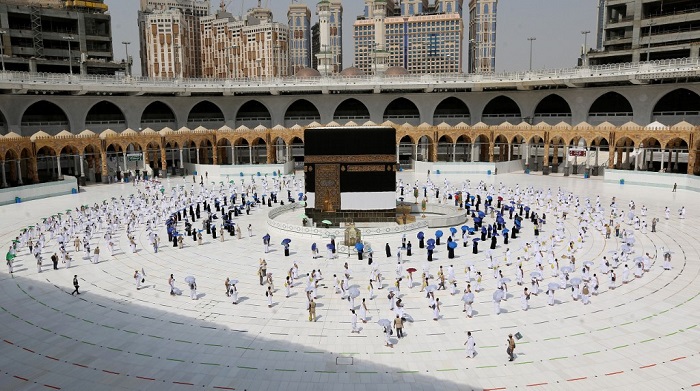
Dubai, Jul 29: Muslim pilgrims on Wednesday begin the annual Haj, downsized this year as the Saudi hosts strive to prevent a coronavirus outbreak during the five-day pilgrimage.

The Haj, one of the five pillars of Islam and a must for able-bodied Muslims at least once in their lifetime, is usually one of the world's largest religious gatherings.

But this year only up to 10,000 people already residing in the Kingdom will participate in the ritual, a tiny fraction of the 2.5 million pilgrims from around the world that attended last year.

"There are no security-related concerns in this pilgrimage, but (downsizing) is to protect pilgrims from the danger of the pandemic," said Khalid bin Qarar Al Harbi, Saudi Arabia's director of public security.

Pilgrims will be required to wear masks and observe social distancing during a series of religious rites that are completed over five days in the holy city of Makkah and its surroundings in western Saudi Arabia.

Those selected to take part in the Haj were subject to temperature checks and placed in quarantine as they began trickling into Makkah at the weekend.

State media showed health workers sanitising their luggage, and some pilgrims reported being given electronic wristbands to allow authorities to monitor their whereabouts.

Workers, clutching brooms and disinfectant, were seen cleaning the area around the Kaaba, the structure at the centre of the Grand Mosque draped in gold-embroidered cloth towards which Muslims around the world pray.

Haj authorities have cordoned off the Holy Kaaba this year, saying pilgrims will not be allowed to touch it, to limit the chances of infection.

They also reported setting up multiple health facilities, mobile clinics and ambulances to cater to the pilgrims.

Saudi authorities said only around 1,000 pilgrims residing in the Kingdom would be permitted for the Haj. Some 70 per cent of the pilgrims are foreigners residing in the Kingdom, while the rest will be Saudi citizens, authorities said.

All worshippers were required to be tested for coronavirus before arriving in the holy city of Makkah and will also have to quarantine after the pilgrimage as the number of cases in the Kingdom nears 270,000.

They were given elaborate amenity kits that include sterilised pebbles for a stoning ritual, disinfectants, masks, a prayer rug and the Ihram, a seamless white garment worn by pilgrims, according to a Haj ministry programme document.

"I did not expect, among millions of Muslims, to be blessed with approval," Emirati pilgrim Abdullah Al Kathiri said in a video released by the Saudi media ministry.

"It is an indescribable feeling... especially since it is my first pilgrimage."

The Haj ministry said non-Saudi residents of the Kingdom from around 160 countries competed in the online selection process but it did not say how many people applied.

Despite the pandemic, many pilgrims consider it safer to participate in this year's ritual without the usual colossal crowds cramming into tiny religious sites, which make it a logistical nightmare and a health hazard.

Comments

Add new comment

  • Coastaldigest.com reserves the right to delete or block any comments.
  • Coastaldigset.com is not responsible for its readers’ comments.
  • Comments that are abusive, incendiary or irrelevant are strictly prohibited.
  • Please use a genuine email ID and provide your name to avoid reject.
News Network
May 17,2020

New Delhi, May 17: Spelling out the government’s fourth tranche of initiatives towards achieving Prime Minister Narendra Modi’s vision of ‘Atmanirbhar Bharat’, Union Finance Minister Nirmala Sitharaman on Saturday announced significant structural reforms in eight sectors of the economy — coal, minerals, defense production, aviation, power distribution in Union territories, space and atomic energy.

Addressing her fourth and the second-last press conference, Sitharaman said crucial sectors such as coal production and exploration, defence production and space would see an increased participation from private entities.

Coal sector:

In the realm of coal exploration, the government has decided to liberalise the entry norms for private entities, which would mean that any interested party could bid for a coal block and sell it in the open market. The minister said that the government would do away with all the eligibility conditions at the time of bidding for a coal block, except requiring an “upfront payment with a ceiling.”

Nearly 50 coal blocks would be offered to private players immediately, revealed Sitharaman.

She further said that Rs 50,000 crore would be spent by Centre in creating ‘coal evacuation’ infrastructure, which would expedite the transport of mined product to the destination.

Defence sector:

In defence production, Sitharaman revealed that the government would raise the foreign direct investment (FDI) limit in the sector from current 49 per cent to 74 per cent. Further, the government would also work towards corporatising the ordnance factory boards. “Corporatising doesn’t amount to privatization,” added Sitharaman.

In a bid to boost indigenous production of defence products and gave an impetus to Make in India, Sitharaman said that the government was in a process of notifying a list of weapons/platforms for an import ban with year-wise timelines.

These decisions would also help in reducing huge import bills, the finance minister said.

Privatisation of electricity:

In another announcement that could have an effect on electricity charges in the union territories, Union Finance Minister Nirmala Sitharaman announced on Saturday that power departments and utilities in all the centrally administered territories would be privatised.

Sitharaman said that the proposed move would lead to better service to consumers and improvement in operational and financial efficiency in distribution.

The finance minister said that decision was guided by 'sub-optimal' utilisation of performance of power distribution and supply'.

She said that the move to that effect would provide a model for emulation by other utilities across the country, in what could be an indicator of what's in the pipeline for utilities in other states as well.

Sitharaman said that the privation reform was in line with the tariff policy reforms and would help in enhancing consumer rights, promote industry and improve the overall sustainability of the sector.

Space sector:

Sitharaman also announced the opening up of the space exploration sector for private players. Till date, the government-run Indian Space Research Organisation (ISRO) has held a monopoly on all activities concerning space exploration and satellite launches.

The Indian private sector will be a co-traveller in India's space sector journey, said Sitharaman, while announcing a series of structural reforms in eight crucial areas of the economy. The Union Finance Minister was addressing her fourth press conference in as many days, as a follow-up towards realising Prime Minister Narendra Modi's vision of 'atmanirbhar Bharat', which was spelled out in his video address on May 12.

Sitharaman said that the reforms in the space sector will provide a level-playing field for private companies in satellite launches and space-based services.

She said that the private sector would be allowed to use ISRO facilities and other assets to improve their capacities. Stating that the government would provide predictable policy and regulatory environment to private players, Sitharaman also disclosed that future projects for planetary exploration and outer space travel among others would be opened up for private entities.


Comments

Add new comment

  • Coastaldigest.com reserves the right to delete or block any comments.
  • Coastaldigset.com is not responsible for its readers’ comments.
  • Comments that are abusive, incendiary or irrelevant are strictly prohibited.
  • Please use a genuine email ID and provide your name to avoid reject.
Agencies
May 18,2020

Jeddah, May 18: Saudi Arabia’s Grand Mufti and head of the Council of Senior Scholars and the Department of Scientific Research and Ifta Sheikh Abdul Aziz Al Asheikh ruled that it is permissible to perform Eid Al-Fitr prayer at home under exceptional circumstances similar to the current pandemic situation. The prayer consists of two rakats with reciting more numbers of takbeer and without a sermon.

Speaking to Okaz/Saudi Gazette, he said that Zakat Al-Fitr could be distributed through charitable societies if they are reliable ones, with the condition that it should be distributed before the day of Eid. The Grand Mufti urged parents to bring joy and happiness to their children and their families by spending more on them.

Meanwhile, Sheikh Abdul Salam Abdullah Al-Sulaiman, member of the Council of Senior Scholars and the Standing Committee of Fatwa, said that Eid prayer could be performed individually or in congregation.

Speaking to Okaz/Saudi Gazette, he said that the worshiper will recite takbeer to start salat and then follow it with six more takbeer in the first rakat before reciting Fatiha loudly and then it is ideal to recite Surah Al-Qaf.

In the second rakat, there will be five takbeer after the takbeer at the start of the rakat before starting to recite Surah Fatiha and then Surah Al-Qamar, following the example of the Prophet (peace be upon him). It is also ideal to recite Surah Al-A’la and Al-Ghashiya instead of Al-Qaf and Al-Qamar in each rakat respectively.

Sheikh Al-Sulaiman also cited the example of Anas Bin Malik, a prominent companion of the Prophet (pbuh). When Anas (May Allah be pleased with him), was at his home in Zawiya, a place near Basra, he did not find any Eid congregation prayer and therefore he performed prayer along with his family members and his aide Abdullah Bin Abi Otba.

The scholar said that the time for Eid prayer begins after sunrise and the best time is after the sun rises by the height of one or two spears as agreed by most scholars. This means 15 or 30 minutes after sunrise and its time continues until the end of the time of the Duha prayer; that is before the Zuhr prayer begins.

The prayer is forbidden at the moment when the sun rises, and the majority of jurists, including the schools of thought of Shafi, Maliki, and Hanbali opposed prayer at sunrise and favored to perform the prayer only after the sun rises by the height of one or two spears in the sky.

Regarding the recitation of takbeer on the occasion of Eid Al-Fitr, Sheikh Al-Suleiman said that it should begin during the night of the Eid and continue until the beginning of the Eid prayer.

Comments

Add new comment

  • Coastaldigest.com reserves the right to delete or block any comments.
  • Coastaldigset.com is not responsible for its readers’ comments.
  • Comments that are abusive, incendiary or irrelevant are strictly prohibited.
  • Please use a genuine email ID and provide your name to avoid reject.