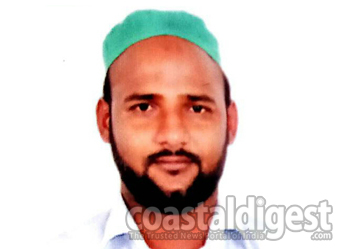
Bantwal: Police tight-lipped on ‘arrest’ of accused in SDPI activist murder case

CD Network
June 24, 2017

Mangaluru, Jun 24: Several media reports claimed that at least five of the accused in connection with the murder case of SDPI activist Ashraf Kalai were arrested yesterday by the police.ashrafkalai

Ashraf (33), president SDPI’s Ammunje zonal unit, was hacked to death by a gang of miscreants at Benjanapadavu in Bantwal taluk in broad daylight on June 21. The SDPI has called the murder a handiwork of Sangh Parivar.

According to media reports, the police have arrested Divyaraj, Abhin, Pavan, Santosh and Shivaprasad, all said to be local residents. However, the local police neither rejected the report, nor confirmed it so far.

Inspector-General of Police (Western Range) P. Harishekaran, who is overseeing the investigation of the murder, earlier said that the police are questioning some suspects. “We will shortly have a breakthrough in the case. All those involved in the murder and those who have conspired will be arrested,” he said.

Sources privy to the investigation said that police may formally announce the arrest at a press meet after nabbing all the accused in connection with the case soon.

Also Read: Bantwal: Cops question many over SDPI activist’s murder; vigil stepped up

Comments

Salman sheikh
 - 
Saturday, 24 Jun 2017

Must n should HANG THEM Bloody goons..

Mr. Surathal
 - 
Saturday, 24 Jun 2017

Look at their faces.. ganja peddlers... I am sure they walk out securing bail in couple of month for lack of evidence..since they were masked during the crime.. but No mercy from god.. killed the person who was on fast..

Muhammed Rafique
 - 
Sunday, 25 Jun 2017

Why the big fish is not caught?

Add new comment

  • Coastaldigest.com reserves the right to delete or block any comments.
  • Coastaldigset.com is not responsible for its readers’ comments.
  • Comments that are abusive, incendiary or irrelevant are strictly prohibited.
  • Please use a genuine email ID and provide your name to avoid reject.
Ram Puniyani
March 8,2020

They say ‘history repeats itself first as a tragedy and then as a farce’. In case of India, communal violence not only keeps repeating itself, the pattern of the tragedy keeps changing every next time. Some features of the violence are constant, but they are under the wraps mostly. The same can be said about the Delhi violence (February 2020). The interpretations, the causative factors are very discernible, but those who are generally the perpetrators have a knack of shifting the blame on the victim community or those who stand for the victims.

As the carnage began presumably in the aftermath of statement of Kapil Mishra of BJP, which was given in front of a top police official, in which he threatened to get the roads emptied. The roots of violence were sown earlier. The interpretations given by the Hindu Nationalist camp is that the riot is due to the changing demographic profile of the area with Muslims increasing in number in those areas, and coming up of Shaheen Bagh which was presented was like ‘Mini Pakistan’. As per them the policies of BJP in matters of triple talaq, Article 370 and CAA, NPR, NRC has unnerved the ‘radical’ elements and so this violence.

As such before coming to the observations of the activists and scholars of communal violence in India, we can in brief say that violence, in which nearly 46 people have died, include one from police and another from intelligence. Majority victims are Muslims. The violence started right under the nose of the police and the ruling party. From the videos and other eye accounts, police not only looked the other way around, at places it assisted those attacking the innocent victims and burning and looting selective shops. Home minister, Amit Shah, was nowhere on the scene. For first three days the rioters had free run. After the paramilitary force was brought in; the violence simmered and slowly reduced in intensity. The state AAP Government, which in a way is the byproduct of RSS supported Anna Hazare movement, was busy reading Hanuman Chalisa and praying at Rajghat with eyes closed to the mayhem going in parts of Delhi.

Communal violence is the sore point of Indian society. It did begin during colonial period due to British policy of ‘Divide and Rule’. At root cause was the communal view of looking at history and pro active British acts to sow the seeds of Hindu-Muslim divide. At other level the administrative and police the British were fairly neutral. On one hand was the national movement, uniting the people and creating and strengthening the fraternal feeling among all Indians. On the other were Muslim Communalists (Muslim League) and Hindu Communalists (Hindu Mahasabha, RSS) who assisted the British goal of ‘divide and rule’ promoting hatred between the communities. After partition the first major change was the change in attitude of police and administration which started tilting against Muslims. Major studies by Dr. Asghar Ali Engineer, Paul Brass and Omar Khalidi demonstrated that anti Muslim bias is discernible in during and after the riots.

Now the partisan role of police has been visible all through. Sri Krishna Commission report brought forth this fact; as did the research of the Ex DIG of UP police Dr. V.N.Rai. Dr. Rai’s studies also concluded that no communal violence can go on beyond 24 hours unless state administration is complicit in the carnage. In one of the violence, investigation of which was done by concerned Citizen’s team (Dhule, 2013) this author observed that police itself went on to undertake the rampage against Muslims and Muslim properties.

General observation about riots is that violence sounds to be spontaneous, as the Home Minister is pointing out, but as such it is well planned act. Again the violence is orchestrated in such a way that it seems Muslims have begun the riots. Who casts the First stone? To this scholars point out that the carnage is so organized that the encircled community is forced to throw the first stone. At places the pretext is made that ‘they’ (minorities) have thrown the first stone.

The pretexts against minorities are propagated, in Gujarat violence Godhra train burning, in Kandhamal the murder of Swami Laxamannand and now Shaheen bagh! The Hindu Muslim violence began as riots. But it is no more a riot, two sides are not involved. It is plain and simple anti Minority violence, in which some from the majority are also the victims.

This violence is possible as the ‘Hate against this minority’ is now more or less structural. The deeper Hate against Muslims and partly against Christians; has been cultivated since long and Hindu nationalist politics, right from its Shakhas to the social media have been put to use for spreading Hatred. The prevalent deeper hate has been supplanted this time by multiple utterances from BJP leaders, Modi (Can be recognized by clothes), Shah (press EVM machine button so hard that current is felt in Shaheen Bagh), Anurag Thakur (Goli (bullet) Maro) Yogi Aditya Nath (If Boli (Words)Do not work Goli will) and Parvesh Varma (They will be out to rape).

The incidental observation of the whole tragedy is the coming to surface of true colors of AAP, which not only kept mum as the carnage was peaking but also went on to praise the role of police in the whole episode. With Delhi carnage “Goli Maro” seems to be becoming the central slogan of Hindu nationalists. Delhi’s this violence has been the first one in which those getting killed are more due to bullets than by swords or knifes! Leader’s slogans do not go in vain! Courts the protectors of our Constitution seem to be of little help as if one of them like Murlidhar Rao gives the verdict to file against hate mongers, he is immediately transferred.

And lastly let’s recall the academic study of Yale University. It concludes; BJP gains in electoral strength after every riot’. In India the grip of communalism is increasing frighteningly. Efforts are needed to combat Hate and Hate mongers.

Comments

Add new comment

  • Coastaldigest.com reserves the right to delete or block any comments.
  • Coastaldigset.com is not responsible for its readers’ comments.
  • Comments that are abusive, incendiary or irrelevant are strictly prohibited.
  • Please use a genuine email ID and provide your name to avoid reject.
Media Release
March 8,2020

Mangaluru, Mar 8: The Saraswat Co-operative Bank Ltd., celebrated International Women’s Day with a special seminar on Financial Planning for the banks’ women customers. The programme was held on Friday, March 6, 2020 from 4.00 to 6.00 p.m. at Hotel Ocean Pearl Inn, Bejai, Mangalore. Dr. Sukanya Rao, academician and financial planner, was the chief guest and resource person for the seminar. Mr. Srinivas C., Karnataka State Head, Future Generali India Insurance Company Ltd., was the guest of honour.  Mrs. Vimala Anchan, Senior Manager and Branch Head of M. G. Road Branch of Saraswat Bank presided over the function.

In her chief guest’s address, Dr. Sukanya Rao defined empowerment of women as the ability of take one’s own decisions and utilize resources. Quoting global rankings, she said India enjoys a high ranking of being 9th in the world in political empowerment of women, whereas in other sectors we stand abysmally low. In social empowerment of women, India ranks at 120th, in economic empowerment at 124th and health and survival at 135th.

She suggested that the best tool for enhancing these empowerment rankings is education, which will lead to earning potential and result in enhancing social status. “Every year spent in school boosts girl’s wages by 10-20%,” she said “When a girl receives 7+ years of education, marriage gets postponed by four years and she has 2.2 less children.” She advised women to learn to take one’s own decisions. “Learn to take decisions, especially financial decisions, on your own instead of depending on significant others to do the decision making,” she said.

She followed up her talk with an interactive session on personal financial planning. She enlightened the audience on factors influencing our financial decision making and gave different perspectives on prioritizing savings, spending and investment. 

Srinivas C., Karnataka State Head, Future Generali India Insurance Company Ltd., along with Deepak enlightened the women regarding financial safeguards available under Married Women's Property Act (1874).

Established in 1918, Saraswat Bank was the first co-operative bank to provide merchant banking services after it was recognized as a scheduled bank by RBI in 1988. The bank enjoys high proportion of women employees (nearly 75%) and it is a recipient of Best Cooperative Bank Award in 2016.

Fun games were conducted and prizes were distributed to the winners. Bhavanthi Street Branch Head Karthik Shetty welcomed the gathering. Prithvi Pai and Aishwarya rendered the invocation. Naina Shenoy expressed the bank’s Women’s Day greetings. Chilimbi Branch Head Kishore Shetty gave a vote of thanks. Mahesh Nayak compered the programme. Past Branch Head Mamtha Rao was present.

Comments

Add new comment

  • Coastaldigest.com reserves the right to delete or block any comments.
  • Coastaldigset.com is not responsible for its readers’ comments.
  • Comments that are abusive, incendiary or irrelevant are strictly prohibited.
  • Please use a genuine email ID and provide your name to avoid reject.
News Network
January 15,2020

Davangere, Jan 15: Karnataka Chief Minister B S Yediyurappa on January 14 threatened to resign when the seer of 'Panchamasali Guru Peetha' warned that the community will leave him, if a BJP MLA from the community is not made the minister during the upcoming cabinet expansion.

The chief minister, who is awaiting the BJP high command's nod to expand his cabinet, amid intense lobbying by the aspirants, wanted the seer Vachanananda swamiji and the 'Panchamasali' community to understand his "situation." Yediyurappa pointed out that he has come to power because of the Congress-JD(S) legislators who rebelled against the then coalition government.

The incident took place when Vachanananda swamiji, while addressing an event at Harihara, near here, said "chief minister, you are a good person, Murugesh Nirani (BJP MLA)has helped you a lot, he has stood by you..if you leave his hands this time, the united Panchamasali community will leave your hands." As the swamiji was making this statement, Yediyurappa, who was seated next to him, rose and threatened to leave the stage.

"If you speak like this I will go away...what are you speaking...kindly pardon me, I will leave, you should not speak like this, if you speak like this I can't work..you can give me suggestions, you cannot threaten me," he said, as the swamiji tried to convince Yediyurappa and asked him to take his seat.

As Yediyurappa acceded to his request, the seer said he was not threatening him but was putting forward the rights of the community. The chief minister, who was visibly upset, was seen talking to Home minister Basavaraj Bommai next to him, who even tried to convince the seer not to continue with the topic. Nirani, a MLA from Bilgi who was Industries minister in the previous Yediyurappa government, was seated on the stage when the incident occurred.

Later addressing the event, Yediyurappa said he was not "selfish" and was even ready to resign.

"Vachanananda swamiji has spoken, through you I request him to understand my situation also. If 17 legislators (Congress-JDS), few even as ministers, had not resigned and stayed away, Yediyurappa could not have occupied this Chief Minister position.

You (swamiji) need not make people raise their hands on any demand, if you tell me, I'm ready to listen to you," he said.

Stating that he was ready to take suggestions from the swamiji on all issues, including on how to run the administration for the next 3 years, Yediyurappa said "I'm ready to bow my head and listen to it, if you don't want I'm even ready to resign and go home, I'm not someone who wants to stick to the chair."

Further noting that if he says that the financial condition of the state is not good it will become headline in papers tomorrow, he said he will have to wait till March for the situation to improve.

"I dont have selfishness, I'm aware that if the Panchamasali-Lingayat community had not stood by me, I could have not sat on this chair (CM)... but kindly understand my situation also," he added.

Yediyurappa is expected to expand his ministry later this month after discussing with BJP national president Amit Shah during his visit to the state on January 18.

As the chief minister has already made it clear that 11 of the disqualified JDS-Congress MLAs who got re-elected in the bypolls on BJP tickets will be made ministers, lobbying has been on within the party for the remaining ministerial berths.

Currently there are 18 Ministers, including the chief minister in the cabinet that has a sanctioned strength of 34.

The cabinet expansion will not be an easy task for the chief minister as he will have to strike a balance by accommodating the victorious disqualified legislators as promised and also make place for the old guard, upset at being "neglected" in the first round of the induction exercise.

He also has to give adequate representation to various castes and regions in his cabinet and also deal with allocation of key portfolios.

Comments

Add new comment

  • Coastaldigest.com reserves the right to delete or block any comments.
  • Coastaldigset.com is not responsible for its readers’ comments.
  • Comments that are abusive, incendiary or irrelevant are strictly prohibited.
  • Please use a genuine email ID and provide your name to avoid reject.