Bantwal remains on the edge as slain RSS worker’s body taken out in procession

coastaldigest.com news network
July 8, 2017

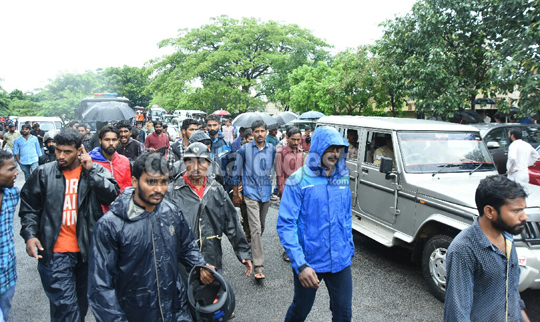
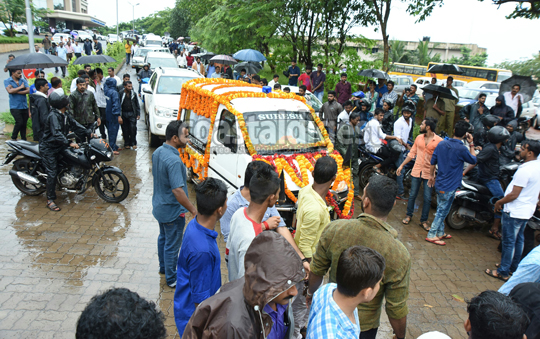
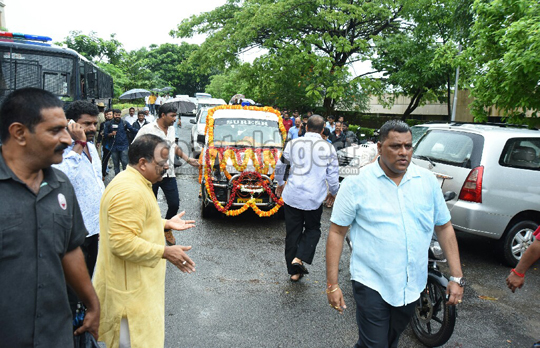
Mangaluru, Jul 8: A tense atmosphere prevailed across the coastal district of Dakshina Kannada on Saturday as the saffron activists chose to take the mortal remains of stab victim to his hometown in Bantwal taluk through a procession.

procession 6

Bantwal taluk remained on tenterhooks for the second day running as thousands of activists of Sangh Parivar are taking part in the funeral of Sharath Madivala, a 28-year-old RSS activist, who breathed his last at a hospital in Mangaluru last evening three days after he was stabbed by unidentified miscreants in B C Road.

However, no untoward incident reported in Mangaluru or Bantwal so far today. Earlier in the day hundreds of mourners had gathered in front of AJ Hspital from where the mortal remains of Sharath were taken in a procession to Bntwal.

The administration has extended prohibitory orders across Dakshina Kannada. Security has been tightened across the district. All shops have been closed in Farangipet and BC Road as part of precautionary measures.

CM Siddaramaiah, who was in Mangaluru yesterday, has warned of stringent action against people who disrupt communal harmony. "Some anti-social elements are bent on trying to disturb peace. We will see that no such organisation takes the law into their hands. I have asked the police to tackle the situation with an iron hand," he said.

procession 1

procession 2

procession 4

procession 5

procession 7

procession 8

sharath copy

Comments

Abdullah
 - 
Monday, 10 Jul 2017

Nithish is a big Cunning person.

Add new comment

  • Coastaldigest.com reserves the right to delete or block any comments.
  • Coastaldigset.com is not responsible for its readers’ comments.
  • Comments that are abusive, incendiary or irrelevant are strictly prohibited.
  • Please use a genuine email ID and provide your name to avoid reject.
News Network
May 16,2020

Kalaburagi, May 16: Former Karnataka Minister Dr Sharanprakash Patil, who was booked for violating COVID-19 imposed lockdown guidelines said on Friday that it was "politically motivated".

"It's politically motivated, the officer who filed the case was forced by MLA or some other people. As elected representatives, we're going in the constituencies, listening to people as they're apprehensive about the return of migrants. We had not conducted any meeting. Wherever we have gone we have followed social distancing," Patil said.

Patil said, "When I had gone there people came to discuss about a local problem and I was talking to an official concerned. In the meantime, some officer gave a complaint that we have violated the lockdown or something."

"They are trying to curb the voice of opposition because there are a lot of lacunae. We hear complaints about quarantine centres that there is no proper facility for food, or stay, or bathrooms," the Congress leader said.

The FIR was registered on Thursday against 23 persons, including the former MLA and 21 local Congress leaders, under Section 188 (disobedience to order duly promulgated by a public servant) of the Indian Penal Code (IPC).

Congress leader Patil and his followers had conducted a meeting at a convention hall in Sulpeth town on May 13, following which sectoral magistrate Muneer Ahmed lodged a complaint.

Comments

Add new comment

  • Coastaldigest.com reserves the right to delete or block any comments.
  • Coastaldigset.com is not responsible for its readers’ comments.
  • Comments that are abusive, incendiary or irrelevant are strictly prohibited.
  • Please use a genuine email ID and provide your name to avoid reject.
News Network
February 3,2020

Feb 3: The Karnataka government is probably the only state to have so many nodal agencies to deal with investment proposals. There is the KIADB, Karnataka Udyoga Mitra, State High Level Clearance Committee (SHLCC), State Level Single Window Clearance Committee (SLSWCC) and District Level Single Window Clearance Committee.

While the government claims these have been created to speed up the process of setting up industries, they’re only delaying it. “A four-to-five year delay in acquiring land has become the norm,’’ say industry sources.

“These entities are only adding layers of obstacles to investors and is not really helping industries,” said a senior IAS officer.

While DLSWCCs are headed by deputy commissioners are empowered to clear investment proposals up to Rs 15 crore, SLSWCC, headed by the industries minister, clears proposals more than Rs 15 crore and up to Rs 500 crore. Proposals worth more than Rs 500 crore have to be cleared by SHLCC chaired by the CM. These entities have to meet regularly and clear proposals. But often, these meetings don’t happen as scheduled. “The delay starts from here,” said Vasant Ladava, industrialist and member of Karnataka Industries and Commerce, Bengaluru.

The single-window agencies involving representatives of departments like industries, revenue, pollution control board and forest are supposed to collectively give necessary clearances required for industries. “But, of late, they have become only project approvers without other responsibilities, leaving investors in the lurch,” said Ladava.

Comments

Add new comment

  • Coastaldigest.com reserves the right to delete or block any comments.
  • Coastaldigset.com is not responsible for its readers’ comments.
  • Comments that are abusive, incendiary or irrelevant are strictly prohibited.
  • Please use a genuine email ID and provide your name to avoid reject.
Agencies
May 8,2020

Washington D.C., May 8: The prime time for brain development in a child's life is the first year, where the infant spends most of the time asleep. It is the time when neural connections form and sensory memories are encoded.

However, when sleep is disrupted, as occurs more often among children with autism, brain development may be affected, too.

New research led by the University of Washington finds that sleep problems in a baby's first 12 months may not only precede an autism diagnosis but also may be associated with altered growth trajectory in a key part of the brain, the hippocampus.

The study, which was published in the American Journal of Psychiatry, researchers report that in a sample of more than 400 taken of 6- to 12-month-old infants, those who were later diagnosed with autism were more likely to have had difficulty falling asleep.

It also states that this sleep difficulty was associated with altered growth trajectories in the hippocampus.

"The hippocampus is critical for learning and memory, and changes in the size of the hippocampus have been associated with poor sleep in adults and older children.

As many as 80 per cent of the children with autism spectrum disorder have sleep problems," said Annette Estes, director of the UW Autism Center and senior author of the study.

"In our clinical experience, parents have a lot of concerns about their children's sleep, and in our work on early autism intervention, we observed that sleep problems were holding children and families back," added Estes, who is also a UW professor of speech and hearing sciences.

"It could be that altered sleep is part-and-parcel of autism for some children. One clue is that behavioural interventions to improve sleep don't work for all children with autism, even when their parents are doing everything just right. This suggests that there may be a biological component to sleep problems for some children with autism," said Estes.

To consider links among sleep, brain development, and autism, researchers at the IBIS Network looked at MRI scans of 432 infants, surveyed parents about sleep patterns, and measured cognitive functioning using a standardized assessment.

At the outset of the study, infants were classified according to their risk for developing autism: Those who were at higher risk of developing autism -- about two-thirds of the study sample -- had an older sibling who had already been diagnosed.

Infant siblings of children with autism have a 20 per cent chance of developing autism spectrum disorder -- a much higher risk than children in the general population.

In the current study, 127 of the 432 infants were identified as "low risk" at the time the MRI scans were taken because they had no family history of autism.

They later evaluated all the participants at 24 months of age to determine whether they had developed autism. Of the roughly 300 children originally considered "high familial risk," 71 were diagnosed with autism spectrum disorder at that age.

Problems with sleep were more common among the infants later diagnosed with an autism spectrum disorder, as were larger hippocampi. No other subcortical brain structures were affected, including the amygdala, which is responsible for certain emotions and aspects of memory, or the thalamus, a signal transmitter from the spinal cord to the cerebral cortex.

The authors note that while parents reported more sleep difficulties among infants who developed autism compared to those who did not, the differences were very subtle and only observed when looking at group averages across hundreds of infants.

Sleep patterns in the first years of life change rapidly as infants transition from sleeping around the clock to a more adult-like sleep/wake cycle. Until further research is completed, Estes said, it is not possible to interpret challenges with sleep as an early sign of increased risk for autism.


Comments

Add new comment

  • Coastaldigest.com reserves the right to delete or block any comments.
  • Coastaldigset.com is not responsible for its readers’ comments.
  • Comments that are abusive, incendiary or irrelevant are strictly prohibited.
  • Please use a genuine email ID and provide your name to avoid reject.