Bantwal remains on the edge as slain RSS worker’s body taken out in procession

coastaldigest.com news network
July 8, 2017

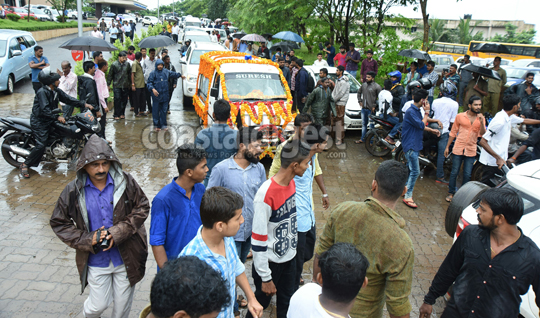
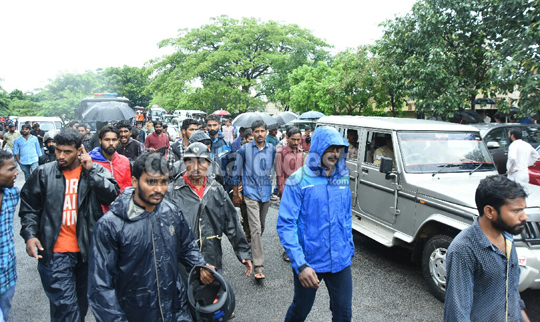
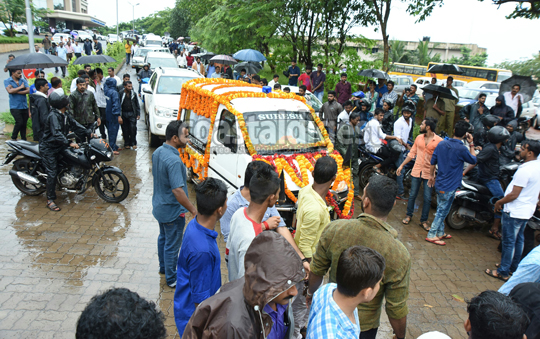
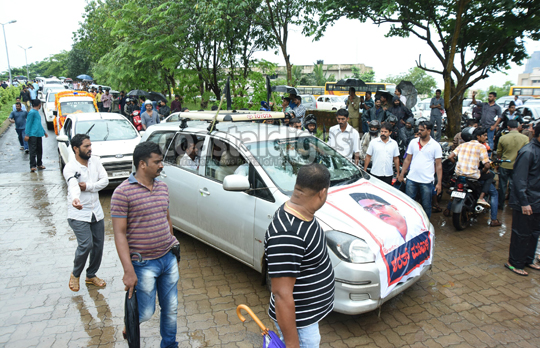
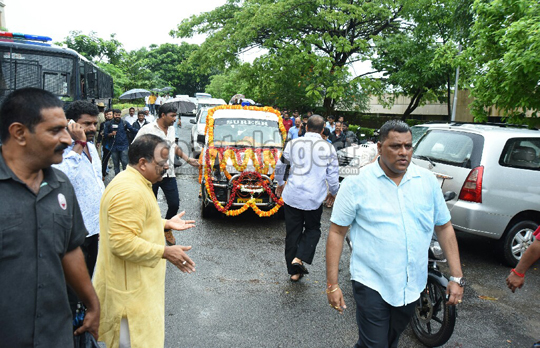
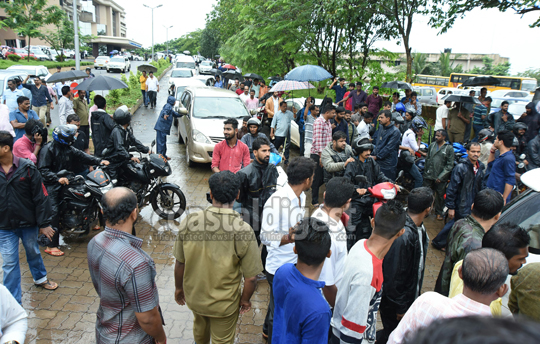
Mangaluru, Jul 8: A tense atmosphere prevailed across the coastal district of Dakshina Kannada on Saturday as the saffron activists chose to take the mortal remains of stab victim to his hometown in Bantwal taluk through a procession.

procession 6

Bantwal taluk remained on tenterhooks for the second day running as thousands of activists of Sangh Parivar are taking part in the funeral of Sharath Madivala, a 28-year-old RSS activist, who breathed his last at a hospital in Mangaluru last evening three days after he was stabbed by unidentified miscreants in B C Road.

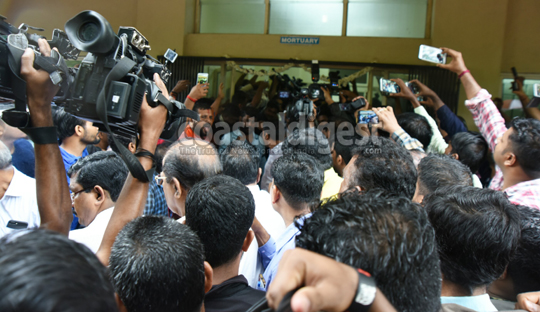
However, no untoward incident reported in Mangaluru or Bantwal so far today. Earlier in the day hundreds of mourners had gathered in front of AJ Hspital from where the mortal remains of Sharath were taken in a procession to Bntwal.

The administration has extended prohibitory orders across Dakshina Kannada. Security has been tightened across the district. All shops have been closed in Farangipet and BC Road as part of precautionary measures.

CM Siddaramaiah, who was in Mangaluru yesterday, has warned of stringent action against people who disrupt communal harmony. "Some anti-social elements are bent on trying to disturb peace. We will see that no such organisation takes the law into their hands. I have asked the police to tackle the situation with an iron hand," he said.

procession 1

procession 2

procession 4

procession 5

procession 7

procession 8

sharath copy

Comments

Abdullah
 - 
Monday, 10 Jul 2017

Nithish is a big Cunning person.

Add new comment

  • Coastaldigest.com reserves the right to delete or block any comments.
  • Coastaldigset.com is not responsible for its readers’ comments.
  • Comments that are abusive, incendiary or irrelevant are strictly prohibited.
  • Please use a genuine email ID and provide your name to avoid reject.
News Network
March 6,2020

Bengaluru, Mar 6: In the face of unprecedented economic difficulties, Chief Minister B S Yediyurappa has chosen to hike the prices of fuel and liquor to fund development in his 2020-21 Budget, which tries to offer something for everybody with the available resources.

Yediyurappa announced a 3% hike in the rate of tax on petrol and diesel. This will result in the prices of petrol going up by Rs 1.60 per litre and diesel by Rs 1.59 per litre. This is expected to fetch the government Rs 1,500 crore.

By hiking additional excise duty on Indian Made Liquor (IML) by 6%, the government hopes to mop up Rs 1,200 crore.

In essence, Yediyurappa, the finance minister, pointed fingers at the Centre for the state’s fiscal woes. He said Karnataka’s share in Central taxes has come down this fiscal by Rs 8,887 crore. Plus, Rs 3,000 crore GST compensation will also be reduced as collections from the GST cess are not on expected lines, he said in his Budget speech. 

“It has become difficult to reach the 2019-20 Budget targets due to these reasons. To manage this situation within the bounds of the Karnataka Fiscal Responsibility Act, it has become inevitable this year to cut down the expenditure of many departments,” he said.

Under the 15th Finance Commission, Karnataka will see a reduction of Rs 11,215 crore in the state’s share of central taxes in 2020-21, Yediyurappa said. He also pointed out that expenditure on salaries, pensions and loan interest payments had risen by Rs 10,000 crore. “Serious difficulties are being faced in resource mobilisation efforts of the state. The state never faced economic difficulties of this magnitude in the previous years,” he said.

But in an attempt to please all, Yediyurappa made announcements across sectors and communities. Instead of the usual department-wise announcements, the CM chose to divide the Budget into six sectors: agriculture & allied activities; welfare & inclusive growth; stimulating economic growth; Bengaluru development; culture, heritage & natural resources and administrative reforms & public service delivery.

Farmers will get additional incentives under PM-KISAN costing Rs 2,600 crore and a waiver of interest on loans they have borrowed from cooperative banks worth Rs 466 crore.

The CM has earmarked Rs 500 crore to start work on the Kalasa-Banduri canals under the Mahadayi project. Also, Yediyurappa has given Rs 1,500 crore to commission the Yettinahole drinking water project.

This project will cater to the districts of Hassan, Chikkamagaluru, Tumakuru, Bengaluru Rural, Ramanagara, Chikkaballapur and Kolar.

For Bengaluru, the CM has made an allocation of Rs 8,772 crore. This includes Rs 500 crore for the suburban rail project, an electric bike taxi project and bus priority lanes.

Significantly, Yediyurappa has not made any allocation to mutts. However, the government will spend Rs 100 crore on the Anubhava Mantapa at Basavakalyan, Rs 66 crore for a 100 ft Kempegowda statue in Bengaluru and Rs 20 crore on a 325 ft statue of Basavanna at the Murugha Mutt in Chitradurga.

The CM has given Rs 305 crore for the development of various communities — Christians (Rs 200 crore), Upparas (Rs 10 crore), Vishwakarma (Rs 25 crore), Ambigara Chaudaiah (Rs 50 crore), Arya Vysya (Rs 10 crore) and Kumbara (Rs 10 crore).

Also, nearly 22.5 lakh government employees and their dependents will get cashless treatment facility for surgical treatment procedures at an estimated annual cost of Rs 50 crore under the Jyothi Sanjini scheme, the CM said.

Comments

Add new comment

  • Coastaldigest.com reserves the right to delete or block any comments.
  • Coastaldigset.com is not responsible for its readers’ comments.
  • Comments that are abusive, incendiary or irrelevant are strictly prohibited.
  • Please use a genuine email ID and provide your name to avoid reject.
Agencies
February 20,2020

India ranked 77th on a sustainability index that takes into account per capita carbon emissions and ability of children in a nation to live healthy lives and secures 131st spot on a flourishing ranking that measures the best chance at survival and well-being for children, according to a UN-backed report.

The report was released on Wednesday by a commission of over 40 child and adolescent health experts from around the world. It was commissioned by the World Health Organization (WHO), UN Children's Fund (UNICEF) and The Lancet medical journal.

In the report assessing the capacity of 180 countries to ensure that their youngsters can survive and thrive, India ranks 77th on the Sustainability Index and 131 on the Flourishing Index, it said.

Flourishing is the geometric mean of Surviving and Thriving. For Surviving, the authors selected maternal survival, survival in children younger than 5 years old, suicide, access to maternal and child health services, basic hygiene and sanitation, and lack of extreme poverty.

For Thriving, the domains were educational achievement, growth and nutrition, reproductive freedom, and protection from violence.

Under the Sustainability Index, the authors noted that promoting today's national conditions for children to survive and thrive must not come at the cost of eroding future global conditions for children's ability to flourish.

The Sustainability Index ranks countries on excess carbon emissions compared with the 2030 target. This provides a convenient and available proxy for a country's contribution to sustainability in future.

The report noted that under realistic assumptions about possible trajectories towards sustainable greenhouse gas emissions, models predict that global carbon emissions need to be reduced from 39·7 giga­ tonnes to 22·8 gigatonnes per year by 2030 to maintain even a 66 per cent chance of keeping global warming below 1·5°C.

It said that the world's survival depended on children being able to flourish, but no country is doing enough to give them a sustainable future.

"No country in the world is currently providing the conditions we need to support every child to grow up and have a healthy future," said Anthony Costello, Professor of Global Health and Sustainability at University College London, one of the lead authors of the report.

"Especially, they're under immediate threat from climate change and from commercial marketing, which has grown hugely in the last decade," said Costello – former WHO Director of Mother, Child and Adolescent health.

Norway leads the table for survival, health, education and nutrition rates - followed by South Korea and the Netherlands. Central African Republic, Chad and Somalia come at the bottom.

However, when taking into account per capita CO2 emissions, these top countries trail behind, with Norway 156th, the Republic of Korea 166th and the Netherlands 160th.

Each of the three emits 210 per cent more CO2 per capita than their 2030 target, the data shows, while the US, Australia, and Saudi Arabia are among the 10 worst emitters. The lowest emitters are Burundi, Chad and Somalia.

According to the report, the only countries on track to beat CO2 emission per capita targets by 2030, while also performing fairly – within the top 70 – on child flourishing measures are: Albania, Armenia, Grenada, Jordan, Moldova, Sri Lanka, Tunisia, Uruguay and Vietnam.

"More than 2 billion people live in countries where development is hampered by humanitarian crises, conflicts, and natural disasters, problems increasingly linked with climate change," said Minister Awa Coll-Seck from Senegal, Co-Chair of the commission.

The report also highlights the distinct threat posed to children from harmful marketing.

Evidence suggests that children in some countries see as many as 30,000 advertisements on television alone in a single year, while youth exposure to vaping (e-cigarettes) advertisements increased by more than 250 per cent in the US over two years, reaching more than 24 million young people.

Studies in Australia, Canada, Mexico, New Zealand and the US – among many others – have shown that self-regulation has not hampered commercial ability to advertise to children.

Children's exposure to commercial marketing of junk food and sugary beverages is associated with purchase of unhealthy foods and overweight and obesity, linking predatory marketing to the alarming rise in childhood obesity, it said.

The number of obese children and adolescents increased from 11 million in 1975 to 124 million in 2016 – an 11-fold increase, with dire individual and societal costs, the report said.

To protect children, the authors call for a new global movement driven by and for children.

Specific recommendations include stopping CO2 emissions with the utmost urgency, to ensure children have a future on this planet; placing children and adolescents at the centre of global efforts to achieve sustainable development, the report said.

New policies and investment in all sectors to work towards child health and rights; incorporating children's voices into policy decisions and tightening national regulation of harmful commercial marketing, supported by a new Optional Protocol to the UN Convention on the Rights of the Child, it said.


Comments

Add new comment

  • Coastaldigest.com reserves the right to delete or block any comments.
  • Coastaldigset.com is not responsible for its readers’ comments.
  • Comments that are abusive, incendiary or irrelevant are strictly prohibited.
  • Please use a genuine email ID and provide your name to avoid reject.
News Network
June 1,2020

New Delhi, Jun 1: Prime Minister Narendra Modi on Monday sought a discussion on advances in telemedicine, the use of "Make in India" products in the healthcare, and the use of IT tools in the medical sector for a healthier society.

Addressing an event at the Rajiv Gandhi Health University in Bengaluru via video conference, he sought a discussion on whether new models can be conceived that make telemedicine popular on a larger scale.

Referring to the "Make in India" program, he said the initial gains made in this field make him optimistic. "Our domestic manufacturers have started production of personal protective equipment and have supplied about one crore PPEs to those in the frontline of fighting COVID-19.

Modi said IT-related tools for healthier societies can be of great help.

"I am sure you have heard of Arogya Setu. Twelve crore health-conscious people have downloaded it. This has been very helpful in the fight against coronavirus," he said.

Comments

Add new comment

  • Coastaldigest.com reserves the right to delete or block any comments.
  • Coastaldigset.com is not responsible for its readers’ comments.
  • Comments that are abusive, incendiary or irrelevant are strictly prohibited.
  • Please use a genuine email ID and provide your name to avoid reject.