



Barack Obama 'Not Optimistic' On Syria As Aleppo Pummelled

November 21, 2016

Damascus/Syria, Nov 21: US President Barack Obama said he is "not optimistic" about Syria's future, as the UN warned time is running out to avoid a humanitarian catastrophe in Aleppo which has been pounded by air strikes for nearly a week.
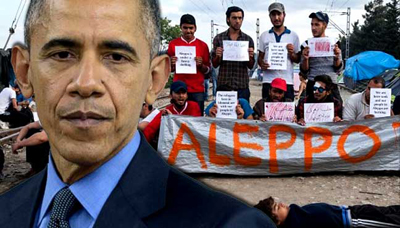
obamaGovernment forces launched a ferocious assault last Tuesday to recapture eastern Aleppo, killing 115 civilians so far. In fresh fighting on Sunday at least eight children died when rebel rocket fire hit their school in the government-controlled west.

Obama warned that Syria's second city was likely to fall, and that Russian and Iranian backing for Syrian leader Bashar al Assad had made the situation untenable for the opposition.

"I am not optimistic about the short-term prospects in Syria," he said Sunday at a summit of Pacific leaders in Lima.

"Once Russia and Iran made a decision to back Assad in a brutal air campaign... it was very hard to see a way in which even a trained and committed moderate opposition could hold its ground for long periods of time."

Obama earlier Sunday urged greater efforts to end the violence when he met Russian President Vladimir Putin at the Asia-Pacific Economic Cooperation forum.

But in Damascus, UN envoy Staffan de Mistura was rebuffed on a truce proposal that would allow the opposition to administer the city's rebel-held east.

"We are running out of time, we are running against time," de Mistura said after meeting Foreign Minister Walid Muallem.

Muallem said he had rejected the proposal, under which jihadist forces would leave and the government would recognise the opposition administration in the east which has been bombarded by air strikes, barrel bombs and artillery.

"How is it possible that the UN wants to reward terrorists?" he asked.

Aid agencies fear that instead of a humanitarian or a political initiative there will be "an acceleration of military activities" in eastern Aleppo and elsewhere, de Mistura told journalists.

"By Christmas... due to military intensification, you will have the virtual collapse of what is left in eastern Aleppo; you may have 200,000 people moving towards Turkey -- that would be a humanitarian catastrophe."

'War crimes'

On Sunday, rebels retaliated with a barrage of rockets into government-held western Aleppo, state media said, hitting a primary school and killing at least eight children.

Syrian television showed bloodied and weeping children being treated in hospital, and an AFP journalist saw pupils being rushed from the school after the attack.

But regime forces broke through into the city's northeastern area of Massaken Hanano, sparking fierce clashes, the Syrian Observatory for Human Rights said.

It also reported heavy fighting as the army sought to gain ground in two eastern neighbourhoods.

The Britain-based monitoring group said at least 19 civilians including five children were killed in the east on Sunday. That brought to 115 the number of civilians killed since the bombardment resumed.

UN chief Ban Ki-moon condemned the indiscriminate shelling, saying it had killed and maimed civilians, destroyed schools and left the city's east without functioning hospitals.

"The Secretary-General reminds all parties to the conflict that targeting civilians and civilian infrastructure is a war crime," his office said in a statement.

"Those responsible for these and other atrocities in Syria, whoever and wherever they are, must one day be brought to account."

On Monday the UN Security Council is scheduled to meet in New York to discuss humanitarian efforts in Syria. Last week it decided to extend for another year a probe into chemical attacks in the country and who is responsible.

The regime offensive on eastern Aleppo has forced hospitals and schools to close and destroyed facilities for hard-pressed rescue workers.

Shelling on Friday destroyed one of the last hospitals there and staff were also forced to evacuate the area's only children's hospital because of repeated attacks.

Russia, which intervened militarily last year, says it is not involved in the current assault on Aleppo, and is instead concentrating its firepower on opposition and jihadist forces in neighbouring Idlib province.

But Damascus and its allies have made clear they want rebels expelled from eastern Aleppo, which fell from regime control in mid-2012.

More than 250,000 people remain in eastern Aleppo, which has been sealed off since government forces surrounded it in mid-July. No aid has entered the east since then and the siege has created food and fuel shortages.

More than 300,000 people have been killed in Syria since the conflict began with anti-government protests in March 2011.

Comments

Add new comment

  • Coastaldigest.com reserves the right to delete or block any comments.
  • Coastaldigset.com is not responsible for its readers’ comments.
  • Comments that are abusive, incendiary or irrelevant are strictly prohibited.
  • Please use a genuine email ID and provide your name to avoid reject.
News Network
May 21,2020

Canberra, May 21: Australian Prime Minister Scott Morrison and his Indian counterpart, Narendra Modi, are looking forward to deepening the countries' strategic relationship, with both sides expected to sign a range of pacts from defence to trade in strategic sectors amid heightened tensions with China over Beijing's response to coronavirus pandemic.

During a virtual summit, scheduled to take place on June 4, both leaders are expected to ramp up efforts to diversify Australia's export markets and find trusted suppliers of vital products and components, a local newspaper, The Australian reported on Tuesday.

The new agreements will focus on reliable supply chains in key strategic sectors, including medical goods, technology and critical minerals, amid heightened tensions with China over Beijing's response to coronavirus pandemic.

The leaders will seal a new defence agreement allowing reciprocal access to bases and co-operation on military technology projects, while a new education partnership will be on the table to help overcome Australian university reliance on Chinese students.

The talks in terms of strategic convergence, now have greater significance as COVID-19 exacerbates the strategic contest between the US and China, and forces like-minded countries to seek out reliable partners.

Australian farmers could also benefit, with talks underway on expanding agricultural exports to India, including barley, as China throws up new trade barriers, media reports stated.

The virtual summit follows the cancellation of Morrison's planned state visit to India in January due to the bushfires.

Morrison said last year, ahead of his planned visit, that India was "a natural partner for Australia", referring to the countries' "shared values" -- a point of differentiation with China.

Former Department of Foreign Affairs and Trade secretary Peter Varghese, who wrote a landmark report on the bilateral relationship in 2018, was quoted by the newspaper as saying that India would be even more important to Australia in the post-COVID world. "If one of the lessons from COVID is that countries need to spread their risk, then finding new markets or building up existing markets is a crucial part of that," he added.

Varghese noted that India, a member of the Quadrilateral Security Dialogue along with Australia, Japan and the US, was a vital strategic partner to Australia in helping "constrain China's ambitions to be the predominant power".

"That shared objective between Australia and India of not wanting to see the region dominated by China is a key component of building up our geopolitical relationship," he told The Australian.

The summit also follows recent talks between Australian Foreign Minister Marise Payne and Indian counterpart Subrahmanyam Jaishankar on the pandemic response and Australia's call for an independent inquiry, which was overwhelmingly backed at the World Health Assembly on Tuesday.

Australia wants to support India to develop a domestic critical minerals processing industry, which would provide Western nations with an alternative to sourcing the materials from China.

Meanwhile, India has strong expertise as a manufacturer of drugs and medical equipment, while Australia is a centre of biomedical research, opening the possibility for closer co-operation in the key sector, the media reported further.

Comments

Add new comment

  • Coastaldigest.com reserves the right to delete or block any comments.
  • Coastaldigset.com is not responsible for its readers’ comments.
  • Comments that are abusive, incendiary or irrelevant are strictly prohibited.
  • Please use a genuine email ID and provide your name to avoid reject.
News Network
July 3,2020

Jul 3: China under President Xi Jinping has stepped up its "aggressive" foreign policy toward India and "resisted" efforts to clarify the Line of Actual Control that prevented a lasting peace from being realised, according to a report released by a US Congress appointed commission.

The armies of India and China have been locked in a bitter standoff at multiple locations in eastern Ladakh for the last seven weeks, and the tension escalated after 20 Indian soldiers were killed in a violent clash in the Galwan Valley on June 15.

“Under General Secretary of the Chinese Communist Party (CCP) Xi Jinping, Beijing has stepped up its aggressive foreign policy toward New Delhi. Since 2013, China has engaged in five major altercations with India along the Line of Actual Control (LAC),” said a brief issued by US-China Economic and Security Review Commission.

"Beijing and New Delhi have signed a series of agreements and committed to confidence-building measures to stabilise their border, but China has resisted efforts to clarify the LAC, preventing a lasting peace from being realised,” said the report and was prepared at the request of the Commission to support its deliberations.

Authored by Will Green, a Policy Analyst on the Security and Foreign Affairs Team at the Commission, the report says that the Chinese government is particularly fearful of India’s growing relationship with the United States and its allies and partners.

“The latest border clash is part of a broader pattern in which Beijing seeks to warn New Delhi against aligning with Washington,” it said.

After Xi assumed power in 2012, there was a significant increase in clashes, despite the fact that he met Prime Minister Narendra Modi several times and Beijing and New Delhi have agreed to a series of confidence-building mechanisms designed to mitigate tensions.

Prior to 2013, the last major border clash was in 1987. The 1950s and 1960s were a particularly tense period, culminating in 1962 with a war that left thousands of soldiers dead on both sides, according to the records of China's People's Liberation Army, the report said.

“The 2020 skirmish is in line with Beijing’s increasingly assertive foreign policy. The clash came as Beijing was aggressively pressing its other expansive sovereignty claims in the Indo-Pacific region, such as over Taiwan and in the South and East China seas,” it said.

China is engaged in hotly contested territorial disputes in both the South China Sea and the East China Sea. Beijing has built up and militarised many of the islands and reefs it controls in the region. Both areas are stated to be rich in minerals, oil and other natural resources and are vital to global trade.

China claims almost all of the South China Sea. Vietnam, the Philippines, Malaysia, Brunei and Taiwan have counter claims over the area.

Several weeks before the clash in the Galwan Valley, Chinese Defence Minister Wei Fenghe called on Beijing to “use fighting to promote stability” as the country’s external security environment worsened, a potential indication of China’s intent to proactively initiate military tensions with its neighbours to project an image of strength, the report said.

Comments

Add new comment

  • Coastaldigest.com reserves the right to delete or block any comments.
  • Coastaldigset.com is not responsible for its readers’ comments.
  • Comments that are abusive, incendiary or irrelevant are strictly prohibited.
  • Please use a genuine email ID and provide your name to avoid reject.
Agencies
July 9,2020

The new visa regulations requiring international students in the US with an F-1 visa to take at least one in-person course or face the prospect of deportation is likely to "cause uncertainties and difficulties" for some students, the Indian Embassy has said.

"These new modifications at a time when many of the US universities and colleges are yet to announce their plans for the new academic year are likely to cause uncertainties and difficulties for some Indian students wishing to pursue their studies in the US," said a spokesperson of the Indian Embassy.

Responding to media queries, the spokesperson said the Indian government has taken up the matter with concerned US officials.

At the India US Foreign Office Consultations held on July 7, Foreign Secretary Harsh Vardhan Shringla conveyed India's concerns on the matter to Under Secretary of State for Political Affairs David Hale.

According to a recent report of Student and Exchange Visitor Program (SEVP), there were 1,94,556 Indian students enrolled in various academic institutions of the US in January this year. Of these 1,26,132 were males and 68,405 were females.

Noting that partnership in higher education is a key component of the strong people-to-people ties between India and the US, the spokesperson said in the last two decades Indian students in American universities and colleges have been the harbingers of a strong partnership between technology and innovation sectors between the two countries.

The spokesperson hoped that the US authorities would provide adequate flexibility in their visa rule, keeping in mind the extraordinary circumstances created by the COVID-19 pandemic for the Indian students community.

We continue to engage all the stakeholders in the matters, including the US administration officials, Congressional leaders, universities and colleges as well as the Indian students community in the US as we move forward towards the 2020-21 academic year to further strengthen our bilateral partnership in higher education, the spokesperson said.

Announced by the SEVP on July 6, the new rules provide temporary exemptions for nonimmigrant students on F-1 and M-1 visas taking online classes due to the COVID-19 pandemic for the fall semester of the 2020 academic year.

While these modifications do provide some flexibility for US universities and colleges to adopt a hybrid model -- that is a mixture of online and in person classes -- they also restrict international students on F-1 and M-1 visas from taking courses entirely online, the spokesperson said.

Comments

Add new comment

  • Coastaldigest.com reserves the right to delete or block any comments.
  • Coastaldigset.com is not responsible for its readers’ comments.
  • Comments that are abusive, incendiary or irrelevant are strictly prohibited.
  • Please use a genuine email ID and provide your name to avoid reject.