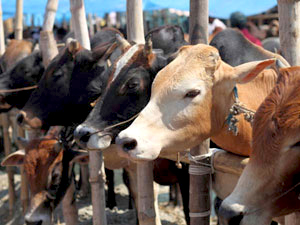
Beef possession not a criminal offence, rules Bombay HC

May 6, 2016

Mumbai, May 6: The Bombay High Court on Friday pronounced the judgement on a bunch of petitions challenging the constitutional validity of the beef ban in Maharashtra.

BeefAccording to news agency, the Bombay HC has passed order, which says that beef ban will continue in Maharashtra.

A ban on cow and bullock slaughtering to continue but beef possession (if brought from outside Maharashtra) is not a criminal offence, ruled the HC.

A division bench of Justices AS Oka and SC Gupte had reserved the ruling in January after hearing the arguments.

In February 2015, the President granted assent to the Maharashtra Animal Preservation (Amendment) Act. While the original 1976 Act banned slaughter of cows, the amendment prohibited, in addition, slaughter of bulls and bullocks and possession and consumption of their meat.

As per the Act, slaughter attracts a five-year jail-term and Rs 10,000 fine while possession of meat of bull or bullock attracts one-year in jail and Rs 2,000 fine.

During the hearing, the HC had refused to grant interim stay to the provisions penalising the possession of beef.

Arif Kapadia, a city resident, and noted lawyer Harish Jagtiani had challenged the provision which says mere possession of beef anywhere in the state is a crime.

This is arbitrary and undermines the cosmopolitan nature of the city which houses people from all religions and communities, they had contended.

Other petitions had been filed by Vishal Sheth, a lawyer, and Shaina Sen, a student, contending that the ban on beef violates fundamental rights of citizens.

Comments

Curious
 - 
Friday, 6 May 2016

Rat poisoning should also be banned because it is vehicle of so called God Ganesh. if everyone kills rat Ganesh will have no vehicle to ride to save and serve his devotees.

Satheesha
 - 
Friday, 6 May 2016

Why not other items like chicken, pork, fish and mutton not touched by the law. All lives are equally important but why this special category. Then all should be asked to be vegetarians

Shiva
 - 
Friday, 6 May 2016

One thing which Fadnavis should have concentrated is to make possession of cow and bulls attractive proposition to holders rather than go for ban on slaughter. this he would have achieved by making green every where, make water available and feed available, provide effective cost recovery of produce .. instead by banning he is burdening people who possess assets as cattle more marginalized and economically poorer .. his vision and his party''s vision is self centered and lacks focus of economics but working against poor, marginalized farmers, dalits and minorities,,, classic case of intolerance, stupidity and religious bigotry,, he deserves to be sacked ..

Real Hindu
 - 
Friday, 6 May 2016

Beef ban is on possession too. only beef procured from outside maharashtra allowed.but that we will handle by other

Add new comment

  • Coastaldigest.com reserves the right to delete or block any comments.
  • Coastaldigset.com is not responsible for its readers’ comments.
  • Comments that are abusive, incendiary or irrelevant are strictly prohibited.
  • Please use a genuine email ID and provide your name to avoid reject.
News Network
June 16,2020

Bengaluru, Jun 16: Continuing easing of restrictions under 'unlock-1,' the Karnataka government has allowed shooting and production of films and television programmes in the state.

In a clarification, Principal Secretary Revenue N Manjunath Prasad said, shooting and production of all films and television programmes that were stopped in between due to lockdown can be allowed.

It is also allowed to continue with the post-production activities of film and television programmes after completing the shooting, it said.

The permission is conditional as it is subjected to adhering of the national directives issued in connection with the COVID-19 pandemic, and standard operating procedures prescribed by the Department of Information and Public Relations.

The clarification said permission can be given as film and television shooting and production activities are not banned under guidelines issued by the centre and the state government recently.

Comments

Add new comment

  • Coastaldigest.com reserves the right to delete or block any comments.
  • Coastaldigset.com is not responsible for its readers’ comments.
  • Comments that are abusive, incendiary or irrelevant are strictly prohibited.
  • Please use a genuine email ID and provide your name to avoid reject.
coastaldigest.com news network
February 23,2020

Mangalore University has been participating in the campus bird count a sub-event of ‘Great backyard bird count’ (GBBC) organized by Bird Count India for the past 5 years. This year, CBC was held from 14th to 17th February of 2020 across various campuses in India.

This year the four days event was successfully ended up with the sightings of 103 species of birds from various locations across the campus spread on 300 acres. In this Black Drongo, Black Kite, Brahminy Kite, Common Iora, Green Wabler, Purple-rumed Sunbird, Red-whiskered Bulbul, White-cheeked Barbet, Jungle Babbler and Plum headed parakeets were the common birds, and also observed House Crow with nest and nestlings, Indian Robin nest with eggs, Bronzed Drongo constructing the nest and Shikra mating and carrying nesting materials.  Whereas Yellow-billed Babbler is rare in the campus, Ashy Drongo, Barn Swallow, Booted Eagle, Grey Wagtail, Indian Pitta etc. were migratory birds, Grey-headed Bulbul (Near Threatened bird), Rufous Babbler and Grey-headed Bulbul were Western Ghats Endemics  and Brown Wood Owl, Barn Owl, Spotted Owlet, Nightjars (Savanna, Indian and Jerdon’s) and Sri Lanka Frogmouth were nocturnal birds. Blue-eared Kingfisher Grey-bellied Cuckoo which was very rare and new additions to avian list of the campus.

In the first year (2016) of Mangalore University’s CBC recorded 77 species, in 2017 recorded 95 species, in 2018 recorded 110 species and in 2019 recorded 107 species of birds. However some of the common species like Rose ringed parakeets, Blue tailed bee-eater, Nilgiri Flowerpecker and Indian roller etc., sighted last year were not seen this year. But with 2 new additions from this CBC, the checklist of Mangalore University Campus has been updated with a total of 141 species.

This event was coordinated by Vivek Hasyagar from the Department of Applied Zoology and Maxim Rodrigues from the Department of Marine Geology. Survey trails were led by more than 60 students and research scholars from various Departments of Mangalore University includes Applied Zoology, Biosciences, Microbiology, Botany, Physics, Chemistry and Material Science.  In addition, some enthusiastic participants from St. Aloysius College had involved in identifying the birds around the campus.

Quote:

Wild/planned fire affects negatively on the existing ecologically sensitive areas in and around the campus especially in lateritic grasslands. Because many insectivorous birds are dependent on these lateritic grassland habitats for their food and breeding grounds for many ground dwelling birds like Yellow wattled lapwing, Red wattled lapwing, Indian Robin and Barred buttonquails. Conserving these habitats will be helpful in protecting these birds.

Quotes from the participants: “The Campus Bird Count 2020 at Mangalore University was an experience of its own kind. Observing birds in their natural habitat gave me new perspective of viewing them not only as another living being, but as equals, or even of higher intelligence. The Campus Bird Count is an important step towards documenting bird life year after year, and creating awareness amongst youngsters, so that proper conservation steps can be taken to protect them from human interference”.

-Jyotsna Dessai ( 1 M.Sc Zoology)

Comments

Add new comment

  • Coastaldigest.com reserves the right to delete or block any comments.
  • Coastaldigset.com is not responsible for its readers’ comments.
  • Comments that are abusive, incendiary or irrelevant are strictly prohibited.
  • Please use a genuine email ID and provide your name to avoid reject.
News Network
March 26,2020

Hubballi, Mar 25: The people living in rural areas of North-Karnataka region have become more aware about deadly Corona virus as they are leaving no stone unturned to prevent people of Bengaluru and other metropolitan cities from entering into their villages. People have put thorny plants on all roads at the outskirts connecting their villages and deployed youths to conduct patrolling round the clock till next 21 days.

Their motto is to prevent their own villagers getting infected from the outsiders especially from cities like Bengaluru and other two-tier cities where positive virus cases are on the rise. They have also take precautionary measures in the wake of Chief Minister B S Yediyurappa's call to the people to return to their native places.

Several people have also dug up the roads leading to their villages to block the entry of outside vehicles. They have put a condition to the outsiders to enter into their villages only after proper health check-up to confirm that they are not infected with Corona positive.

"We don't have access to the proper medical care if Corona virus is entered into our village. The Primary Health Centres are not functioning properly and these centers are facing lack of adequate staff and medical equipments unlike in big cities.Therefore, those who have deserted our village to employ in various jobs in Bengaluru and other cities should confirm that they are tested negative for the virus", said Mallikarjun Patil of Kudal village in Hangal taluk of Haveri district. The village has totally banned the outsiders into their village and warned their fellow villagers to return immediately if they have visited to their relatives' homes in neighboring villages to observe 21-day lockdown.

Hundreds of youths in Itanal village of Chikkodi taluk of Belagavi have also resorted to similar tactics and patrolling in all roads at the outskirts by holding sticks to prevent outsiders from entering into their village until April 14.

People of Hunagunti village in Ron taluk and Kotamuchagi village in Gadag taluk have also adopted similar plan by parking tractors at th outskirts to prohibit the entry of outsiders. They have also created awareness in their villages by beating drums urging the people not to venture outside village for next three weeks.

The police officials have resorted to lati-charge at various places in urban areas when people gathered in large numbers to buy essential commodities.

Comments

Add new comment

  • Coastaldigest.com reserves the right to delete or block any comments.
  • Coastaldigset.com is not responsible for its readers’ comments.
  • Comments that are abusive, incendiary or irrelevant are strictly prohibited.
  • Please use a genuine email ID and provide your name to avoid reject.