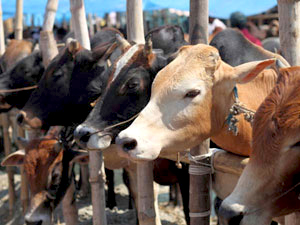
Beef possession not a criminal offence, rules Bombay HC

May 6, 2016

Mumbai, May 6: The Bombay High Court on Friday pronounced the judgement on a bunch of petitions challenging the constitutional validity of the beef ban in Maharashtra.

BeefAccording to news agency, the Bombay HC has passed order, which says that beef ban will continue in Maharashtra.

A ban on cow and bullock slaughtering to continue but beef possession (if brought from outside Maharashtra) is not a criminal offence, ruled the HC.

A division bench of Justices AS Oka and SC Gupte had reserved the ruling in January after hearing the arguments.

In February 2015, the President granted assent to the Maharashtra Animal Preservation (Amendment) Act. While the original 1976 Act banned slaughter of cows, the amendment prohibited, in addition, slaughter of bulls and bullocks and possession and consumption of their meat.

As per the Act, slaughter attracts a five-year jail-term and Rs 10,000 fine while possession of meat of bull or bullock attracts one-year in jail and Rs 2,000 fine.

During the hearing, the HC had refused to grant interim stay to the provisions penalising the possession of beef.

Arif Kapadia, a city resident, and noted lawyer Harish Jagtiani had challenged the provision which says mere possession of beef anywhere in the state is a crime.

This is arbitrary and undermines the cosmopolitan nature of the city which houses people from all religions and communities, they had contended.

Other petitions had been filed by Vishal Sheth, a lawyer, and Shaina Sen, a student, contending that the ban on beef violates fundamental rights of citizens.

Comments

Curious
 - 
Friday, 6 May 2016

Rat poisoning should also be banned because it is vehicle of so called God Ganesh. if everyone kills rat Ganesh will have no vehicle to ride to save and serve his devotees.

Satheesha
 - 
Friday, 6 May 2016

Why not other items like chicken, pork, fish and mutton not touched by the law. All lives are equally important but why this special category. Then all should be asked to be vegetarians

Shiva
 - 
Friday, 6 May 2016

One thing which Fadnavis should have concentrated is to make possession of cow and bulls attractive proposition to holders rather than go for ban on slaughter. this he would have achieved by making green every where, make water available and feed available, provide effective cost recovery of produce .. instead by banning he is burdening people who possess assets as cattle more marginalized and economically poorer .. his vision and his party''s vision is self centered and lacks focus of economics but working against poor, marginalized farmers, dalits and minorities,,, classic case of intolerance, stupidity and religious bigotry,, he deserves to be sacked ..

Real Hindu
 - 
Friday, 6 May 2016

Beef ban is on possession too. only beef procured from outside maharashtra allowed.but that we will handle by other

Add new comment

  • Coastaldigest.com reserves the right to delete or block any comments.
  • Coastaldigset.com is not responsible for its readers’ comments.
  • Comments that are abusive, incendiary or irrelevant are strictly prohibited.
  • Please use a genuine email ID and provide your name to avoid reject.
Media Release
February 14,2020

Veteran journalist P. Sainath has said that the nation is in a crisis. And this crisis is not limited to just the rural area. It has become a national crisis at various areas such as agriculture, education, economy, job creation etc.

He was delivering the endowment lecture on the topic ‘Indian democracy at the post-liberalization and post-truth era’ at Media Manthan 2020 organized by the PG department of journalism and mass communication at St Aloysius College (Autonomous). 

Mr Sainath said that the many policies adopted in the 90s led to India becoming unusually unequal. Referring to the speech Ambedkar had made at the Constituent Assembly while handing over the draft of the Constitution, Mr Sainath said, “Ambedkar had warned about the weakness of Indian democracy that liberty without equality allows the supremacy of a few over the multitude. Liberty, equality and fraternity must be kept together as we cannot have one without the other.” 

Mr Sainath stated that the agrarian crisis was no longer about the loss of productivity, employment or about farmer suicide; it was a societal, civilizational crisis. Commenting on the lopsided policies such as cow-slaughter ban, he explained how cow slaughter ban had adversely affected many industries due to their interdependency. While Muslims who slaughtered cows were rendered helpless, the cattle traders who were mostly OBCs lost their earnings as the cattle prices crashed. An important industry like Kolhapur sandals industry in Maharashtra went bankrupt as a result of the cow slaughter ban in Maharashtra. He said the policymakers had no idea how the rural industries were interconnected. Demonetisation too devastated the rural economy as 98 percent of rural transactions happen through cash. 

Mr Sainath also spoke about the crisis of inequality which affects the Dalits and the Adivasis far more than anyone else as 90 percent of the rural households take home less than Rs 10,000/- per month. “Women are yet another group whose labour is never counted in the gross domestic product. Women and girls globally do unpaid work which amounts to about 12.5 billion working hours per year. Monetarily speaking, this is worth 10.8 trillion dollars,” Mr Sainath added. 

Speaking about the crisis of jobs Mr Sainath said that major companies were laying off employees just to create more profits for the investors and the adoption of artificial intelligence in the industry would further destroy millions of jobs.

Rector of St Aloysius College Institutions Fr Dionysius Vaz SJ, Principal Dr (Fr) Praveen Martis SJ, HOD of Journalism and Mass Communication department Dr (Fr) Melwyn Pinto SJ were present.

‘Veerappan and Vijay Mallya’s business models are interesting!’

Addressing the gathering during his endowment lecture on Friday, Mr Sainath made an interesting comment on the so called ‘revenue model’. “Whenever I visit IIMs and IITs for lectures on my PARI project, the students there ask me what my revenue model for my project is. I tell them that I do not have a revenue model. In fact, journalism does not begin with a revenue model. Gandhiji, Ambedkar, Bhagat Singh were all great journalists. But they did not have a revenue model,” Mr Sainath said.

On a lighter note, he said that the best revenue model that he liked was that of forest brigand Veerappan and liquor baron Vijay Mallya. “Veerappan ruled the forest for forty years and from the top ministers to the villagers he could dictate terms and liver royally. Similarly, Mallya’s revenue model was to steal the banks and run away abroad and live like a king,” Mr Sainath added.

Journalism is not and can never be a business. It is a calling, he opined. While newspaper can be a business, television can be a business, journalism per se cannot be reduced to a business. “Unfortunately today, journalists are recruited on a contract basis and they have no bargaining power; and there are no unions to fight for their cause. Hence, they are at the mercy of the corporate media houses for their survival and are made to write stories that cannot be called journalism,” Mr Sainath said.

Answering a question as to the pressures he faced as a journalist, he said that external pressures from the government or others could be very well handled. It is the internal pressures from once own media house that journalists find it difficult to manage.


 

Comments

Add new comment

  • Coastaldigest.com reserves the right to delete or block any comments.
  • Coastaldigset.com is not responsible for its readers’ comments.
  • Comments that are abusive, incendiary or irrelevant are strictly prohibited.
  • Please use a genuine email ID and provide your name to avoid reject.
News Network
March 24,2020

Bangalore , Mar 24: Bizom, India's leading retail intelligence platform, announced free subscription of its retailer app and tele-ordering solutions for consumer businesses in India and other emerging economies. Both solutions enable retailers to send their orders directly to the brand.
In COVID-19 times of social distancing and prophylactic measures, brands are conscious about the safety of their salespersons. Also, retailers don't want travelling salespeople to enter their premises. Consequently, many retail stores are facing stockout situations of fast-moving product categories. Bizom's self-ordering solutions help brands to avoid stockouts of their products.
Bizom trends, which analyses consumption and demand for consumer brands, showed how a near-complete shutdown during the Janta Curfew followed panic buying in early March. The asymmetrical demand and a lack of salespeople for order-taking are driving the industry towards social-distancing-based store-stocking mechanisms.
Bizom provides social-distancing-based store-stocking solutions for consumer businesses. They include the Bizom Retailer App and the Bizom Tele-ordering.
The Bizom Retailer App enables self-ordering for a brand's key retail outlets and can be implemented in under two weeks. The mobile app, a B2B shopping app, is a simple installation for retailers. It lists and groups the brand's products as per its product categories. The app's interface is no different from that of leading e-commerce apps. All the user has to do is select the preferred SKUs and add them to their shopping carts.
The app also allows brands to customize the app to meet the requirements of their continually changing product categories. For instance, if an SKU runs out of stock, the brand can disable the given SKU from the app.
With the Bizom Retailer App, brands can take orders directly from retailers instead of the traditional order-taking approach, which requires high-touch from a salesperson. Some of the key features of the app are, the ability to provide product information directly through retailers including SKUs, competitor comparison and pricing.
It also enables self-ordering from the retailer to maintain the flow of products as per demand, enables scheme rollout information through a notification on the app rather than through salespeople, tracks delivery of goods to the retailer and enables incentive payments to retailers directly rather than through distributor claims.
With Bizom Tele-ordering, as the sales teams go remote, the tele-ordering solution will become useful for brands who want to get salespeople to take orders from retailers, remotely. It ensures continued service to outlets despite not being physically present in the market.
Here, salespeople can discuss product requirements with retailers and enter orders based on specific outlet types (grocery, chemist etc.), outlet class (Class A, Class B etc.) or based on their beat or as per a distributor.
The key features of the Bizom Tele-ordering solution are, its ability to help salespeople collect orders from retailers remotely and enter it for fulfilment into Bizom using a tool, the flexibility offered to salespeople for remote servicing of retailers as per outlet type, beat, distributor area etc., secondary schemes get applied automatically, variable discounts will get applied as applicable at an SKU level.
"At Bizom, we are conscious of our responsibility to help brands run faster during these COVID-19 times. Our solutions of Bizom Retailer App and Bizom Tele-ordering have been built to ensure that brands can leverage this situation of low direct touch with retailers to enable a better way of working, remotely. I am trying to help brands go live in a few days so that they, in turn, can serve consumers better during these testing times," said Lalit Bhise, CEO, Bizom.

Comments

Add new comment

  • Coastaldigest.com reserves the right to delete or block any comments.
  • Coastaldigset.com is not responsible for its readers’ comments.
  • Comments that are abusive, incendiary or irrelevant are strictly prohibited.
  • Please use a genuine email ID and provide your name to avoid reject.
News Network
February 1,2020

Bengaluru, Feb 1: The police have arrested two miscreants belonging to a saffron outfit after they threatened students in the city who were protesting the firing incident near Delhi’s Jamia Millia Islamia, telling them they would meet the same fate as the injured student.

Saffron extremist Gopal Sharma had opened fire at students protesting the Citizenship (Amendment) Act near the Delhi varsity on Thursday, injuring one.

The Bengaluru incident took place at Maurya Circle, where the nightlong demonstration against the Jamia firing and CAA began around 7.30pm. By 11pm, the number of protesters reduced to 30 but the group decided to stay back after getting the news of another alleged attack on women and Jamia students by Delhi police.

According to Adrian, a student who was at the scene, the small group of protesters stayed within a barricaded area on the road, chanting slogans, singing patriotic songs and playing music. “While we were raising anti-CAA slogans, two men from among us began shouting pro-CAA slogans. The duo was unknown and when we looked at them, they quietly moved away,” said Adrian, adding they were drunk and returned after a few minutes.

Saqib Idrees, another student protester, said the duo began to issue verbal threats. “They threatened us in Kannada that they would repeat the Jamia incident in Bengaluru,” said Saqib, adding the duo also taunted them saying ‘it’s not CAA down down, but you all will be brought down’.

When the students questioned the miscreants, cops stationed at the spot detained the duo. “Police were very cooperative. Almost 20 personnel were with us till 5am,” said Saqib.

Meanwhile, a friend of the duo watched the drama from a distance and approached the protesters to apologise on their behalf. “He said they belonged to the working class and FIRs would destroy their lives. He apologised to us and we decided to let the matter go. After all, we are Gandhians,” added Saqib.

Adrian said though the two men were drunk, their threats exposed their ideology. After the duo was detained, the students continued their protest till 5am and dispersed after singing the national anthem.

According to High Grounds police, the men are bank employees and were detained for disturbing the protesters at Maurya Junction. “They are from Andhra Pradesh and work in a PSU bank in the city. One of them is set to get married in February. He had thrown a party for his other friends for the same reason. The duo was drunk when confronted by the protesters. We booked a case of public nuisance and let them off after a warning,” police said.

Comments

Add new comment

  • Coastaldigest.com reserves the right to delete or block any comments.
  • Coastaldigset.com is not responsible for its readers’ comments.
  • Comments that are abusive, incendiary or irrelevant are strictly prohibited.
  • Please use a genuine email ID and provide your name to avoid reject.