


Beef possession not a criminal offence, rules Bombay HC

May 6, 2016

Mumbai, May 6: The Bombay High Court on Friday pronounced the judgement on a bunch of petitions challenging the constitutional validity of the beef ban in Maharashtra.
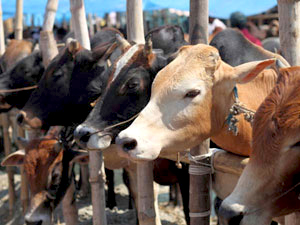
BeefAccording to news agency, the Bombay HC has passed order, which says that beef ban will continue in Maharashtra.

A ban on cow and bullock slaughtering to continue but beef possession (if brought from outside Maharashtra) is not a criminal offence, ruled the HC.

A division bench of Justices AS Oka and SC Gupte had reserved the ruling in January after hearing the arguments.

In February 2015, the President granted assent to the Maharashtra Animal Preservation (Amendment) Act. While the original 1976 Act banned slaughter of cows, the amendment prohibited, in addition, slaughter of bulls and bullocks and possession and consumption of their meat.

As per the Act, slaughter attracts a five-year jail-term and Rs 10,000 fine while possession of meat of bull or bullock attracts one-year in jail and Rs 2,000 fine.

During the hearing, the HC had refused to grant interim stay to the provisions penalising the possession of beef.

Arif Kapadia, a city resident, and noted lawyer Harish Jagtiani had challenged the provision which says mere possession of beef anywhere in the state is a crime.

This is arbitrary and undermines the cosmopolitan nature of the city which houses people from all religions and communities, they had contended.

Other petitions had been filed by Vishal Sheth, a lawyer, and Shaina Sen, a student, contending that the ban on beef violates fundamental rights of citizens.

Comments

Curious
 - 
Friday, 6 May 2016

Rat poisoning should also be banned because it is vehicle of so called God Ganesh. if everyone kills rat Ganesh will have no vehicle to ride to save and serve his devotees.

Satheesha
 - 
Friday, 6 May 2016

Why not other items like chicken, pork, fish and mutton not touched by the law. All lives are equally important but why this special category. Then all should be asked to be vegetarians

Shiva
 - 
Friday, 6 May 2016

One thing which Fadnavis should have concentrated is to make possession of cow and bulls attractive proposition to holders rather than go for ban on slaughter. this he would have achieved by making green every where, make water available and feed available, provide effective cost recovery of produce .. instead by banning he is burdening people who possess assets as cattle more marginalized and economically poorer .. his vision and his party''s vision is self centered and lacks focus of economics but working against poor, marginalized farmers, dalits and minorities,,, classic case of intolerance, stupidity and religious bigotry,, he deserves to be sacked ..

Real Hindu
 - 
Friday, 6 May 2016

Beef ban is on possession too. only beef procured from outside maharashtra allowed.but that we will handle by other

Add new comment

  • Coastaldigest.com reserves the right to delete or block any comments.
  • Coastaldigset.com is not responsible for its readers’ comments.
  • Comments that are abusive, incendiary or irrelevant are strictly prohibited.
  • Please use a genuine email ID and provide your name to avoid reject.
News Network
February 13,2020

Mangaluru, Feb 13: Jnandev Kamath, former President of erstwhile Mangalore Stock Exchange Limited died late last night in a private hospital in the city.

He was 65 and is survived by his wife and two daughters.

Jnandev Kamath was an alumnus of SDM College of Law and Business Management. 

He was one the founding members of Mangalore Stock Exchange Limited. He was an avid sportsman, an accomplished cricketer, a champion rallyist and golf coach. 

He often played for Pentlandpet Sports Association (PPSA) in his younger days.

Comments

Add new comment

  • Coastaldigest.com reserves the right to delete or block any comments.
  • Coastaldigset.com is not responsible for its readers’ comments.
  • Comments that are abusive, incendiary or irrelevant are strictly prohibited.
  • Please use a genuine email ID and provide your name to avoid reject.
News Network
February 28,2020

Bengaluru, Feb 28: Historian S. Shettar, 85, breathed his last early on February 28 in Bengaluru. He was suffering from respiratory problems and was hospitalised for over a week.

Shettar was known for his multi-disciplinary work, encompassing linguistics, epigraphy, anthropology, the study of religions and art history. He had extensively worked on the Jain practice of ritual death in Karnataka and Asoka edicts. He had studied and compiled early edicts in Kannada and worked extensively on the growth of Kannada language down the ages.

Born in 1935 at Hampasagara, Ballari district, he went on to study at Cambridge University and started his career as a Professor of History at Karnatak University, Dharwad, his alma mater. He later headed the National Museum Institute of the History of Art, Conservation and Museology in 1978 and Indian Council for Historical Research in 1996. He was also a visiting professor at the National Institute of Advanced Studies, Bengaluru.

He was a bilingual historian who wrote in English for most of his career, but started writing in Kannada in later years. In the last two decades, he developed a keen interest in linguistics and wrote multiple books on classical Kannada and Prakrit. His 2007 book “Shangam Tamilagam” is considered a seminal work in the study of the early period of Dravidian languages. It won him Bhasha Samman from Central Sahitya Akademi. He later wrote two works on Halegannada, classical Kannada. His most recent work was “Prakrita Jagadvalaya” in 2018.

Comments

Add new comment

  • Coastaldigest.com reserves the right to delete or block any comments.
  • Coastaldigset.com is not responsible for its readers’ comments.
  • Comments that are abusive, incendiary or irrelevant are strictly prohibited.
  • Please use a genuine email ID and provide your name to avoid reject.
News Network
May 7,2020

Bengaluru, May 7: Karnataka has revised its standard operating procedure (SOP) for international passengers. The first group of passengers will arrive in the state on May 8.

The number of categories has been reduced to two from three. Category A includes passengers symptomatic on arrival while Category B passengers are those asymptomatic on arrival. These are passengers who are either healthy or those having co-morbidities.

As per the revised SOP, the passenger will be released on the seventh day, if tested negative, to strict home quarantine for another seven days with stamping.

This norm is in contradiction to the Ministry of Home Affairs’ SOP for international passengers. As per the MHA’s SOP, the passengers (asymptomatic) will be under institutional quarantine for 14 days. Testing negative after 14 days, they will be allowed to go home and will undertake self-monitoring of their health for 14 more days.

On the contradiction, Pandey said, "We don't take chances as we rely on tests instead of just quarantining. Other states may be depending on just 14-day institutional quarantine."

"GOI SOP doesn't talk about Covid tests on international passengers. We have put an additional safety layer of three Covid tests on returnees -- one on arrival, second from 5-7 days and last on 12th day. This will ensure definite identification of positive cases even if they are asymptomatic and their subsequent treatment. We should look at the spirit behind the order," he added.

On the 14-day additional reporting period for category B, he said, "It is implied as category B patients should report to us for 14 days after their first 14-day quarantine period is over."

Medical Education Minister Dr K Sudhakar said that the State would follow the Centre’s norms.

Till Tuesday, Karnataka’s SOP had three categories. Under Category A (symptomatic), 14-day institutional quarantine at COVID-19 Health Care Centre was mandatory followed by 14-day reporting period. Under Category B (asymptomatic above 60 years with co-morbidities), seven-day institutional quarantine at hotel/hostel followed by seven-day home quarantine and 14-day reporting period had been recommended. The 14-day home quarantine and 14-day reporting period was mandatory for Category C (asymptomatic).

Comments

Add new comment

  • Coastaldigest.com reserves the right to delete or block any comments.
  • Coastaldigset.com is not responsible for its readers’ comments.
  • Comments that are abusive, incendiary or irrelevant are strictly prohibited.
  • Please use a genuine email ID and provide your name to avoid reject.