



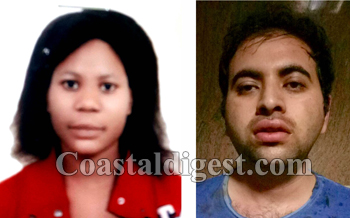
Bengaluru: Ugandan woman stabbed to death after scuffle overpayment for sex'

[email protected] (News Network)
February 3, 2017

Ugandan

Bengaluru, Feb 3: A 25-year-old Ugandan woman was allegedly stabbed to death at her house in Bengaluru in a scuffle over payment for sex in the early hours of Thursday.

Nakayaki Florence was a B.Com student, and a native of Kampala in Uganda. Ishaan (28), who reportedly knifed her to death, was nabbed from her house. The incident took place between 1.30 and 2 am at her second floor house in Thimmegowda Layout, near the Kothanur bus stand. Police said she was involved in the flesh trade, a charge members of her community believe diverts the case.

Ishaan, a native of Himachal Pradesh, told the police he was an M.Tech looking for a job in Bengaluru. He worked as a part-time tutor and was a paying guest in BTM?Layout, the police said. Ishaan met Nakayaki on Brigade Road, and struck a deal for Rs 5,000 to visit her house, a police source said, quoting Ishaan. She demanded Rs 10,000 as he had stayed longer than agreed, Ishaan purportedly told the police.

This resulted in a quarrel. Both were drunk, and Nakayaki grabbed a knife and charged at Ishaan, injuring his hand, according to the police. Ishaan then snatched it from her and stabbed her four or five times, killing her instantly. Hearing the commotion, the landlady rushed to the second floor and locked the door from outside, trapping Ishaan inside.

“We have already established that he (Ishaan) killed the victim, and prima facie, there is clear-cut circumstantial evidence,” said P S Harsha, Deputy Commissioner of Police, North-East Division. However, he did not divulge details, saying the investigation was in progress.

Since it was a murder involving a foreigner, a large number of policemen rushed to the area. People from several African countries had gathered at the spot and were seeking access to Ishaan. The police caned the crowd and whisked him away around 3 am. Soon a platoon of KSRP personnel arrived. The police have booked some Africans for assault, a policeman said.

An association of Africans took objection to the way the city police approached the case. “How can the police come out with conclusive statements that the victim was in the flesh trade and the cause of murder was money over unlawful activity? This is victimising the victim further,” said Bosco Kaweesi, legal adviser, All African Students in Bengaluru.

The fact of the case is that someone went to Nakayaki's house at night and murdered her, he said. “Let the police probe the case impartially,” Kaweesi urged. Three officials from the Ugandan High Commission, besides the Ugandan ambassador to India , will be coming to Bengaluru on Friday, said Bosco Kaweesi.

Comments

naren kotian
 - 
Saturday, 4 Feb 2017

charan anna , india cannot do that bro .. because indians and indian companies including govt companies have billions of investments in african countries , now china and india competing in africa for natural reserves , infrastructure development , factories , health care etc .. indians mega parallel economies in africa from kenya to tanzania , mauritius to ghana and nigeria .. and also millions of indians working in africa in projects . so this type of decision of blocking will create negative impact . In ethipopia in congo ,indians do farming in mega scale . best solution is deporting the students on case o case basis .

Charan Kumar
 - 
Friday, 3 Feb 2017

India should take a leaf out of trump'? visa ban and prohibit entry of Africans, especially their students, because of whom flesh trade and drug mafia is thriving in cities like Benglauru

Add new comment

  • Coastaldigest.com reserves the right to delete or block any comments.
  • Coastaldigset.com is not responsible for its readers’ comments.
  • Comments that are abusive, incendiary or irrelevant are strictly prohibited.
  • Please use a genuine email ID and provide your name to avoid reject.
News Network
March 24,2020

Udupi, Mar 24: Four people, including two women, suspected to have infected with Coron were admitted to the hospitals in Udupi district

According to the District Administration, in all, 51 samples were sent to the laboratory for test and 40 samples have been tested negative.

The result of remaining 11 swabs were awaited.

At least 21 people had been admitted to the isolation wards of hospitals in the district. Nine had been discharged from the isolation wards after they recovered from the health complications on Monday, it further said.

Comments

Add new comment

  • Coastaldigest.com reserves the right to delete or block any comments.
  • Coastaldigset.com is not responsible for its readers’ comments.
  • Comments that are abusive, incendiary or irrelevant are strictly prohibited.
  • Please use a genuine email ID and provide your name to avoid reject.
News Network
April 29,2020

Kasaragod, Apr 29: Kasaragod's General Hospital on Tuesday discharged the last of its 89 COVID-19 patients, who were admitted since the outbreak of the disease last month.

The patient discharged on Tuesday is a native of Anankur in Kerala. He was under treatment for 27 days following his return from Dubai. He was given a warm send-off at 12 noon by the doctors and hospital staff.

Of the 175 positive cases in Kasaragod district, only 12 are under treatment in other hospitals in the district now. Of them, seven had come from the Gulf and the remaining five were those in contact with them.

During a press meet, Chief Minister Pinarayi Vijayan, while referring the Kasaragod General Hospital's success story, congratulated the doctors, nurses and medical staff for the achievement.

According to Health Department, in spite of treating the highest number of COVID-19 patients in the state with meagre infrastructural facilities and even without the support of a medical college in the district, there have been no deaths.

According to the district administration, Kasaragod has conducted 4,112 tests so far, out of which 3,104 tested negative and the results of 833 are awaited.

The team of doctors, nurses and other staff numbering 250 is led by Dr Rajaram K Kandiyil, Superintendent of the Kasaragod General Hospital.

Comments

Add new comment

  • Coastaldigest.com reserves the right to delete or block any comments.
  • Coastaldigset.com is not responsible for its readers’ comments.
  • Comments that are abusive, incendiary or irrelevant are strictly prohibited.
  • Please use a genuine email ID and provide your name to avoid reject.
Wafa Sultana
April 4,2020

Over the last couple of days when the world was occupied with unifying efforts to fight the deadly Covid19 pandemic, sections of Indian media provided viewers a familiar scapegoat – the Indian Muslims – who are often stereotyped as a community being constantly at loggerheads with the citizenry and the State. Biased media channels were quick to resort to blaming the entire Muslim community for the spread of the disease in the country, thanks to an ill-timed Tablighi Jamaat gathering at its international headquarters in Delhi’s Nizamuddin. Unsurprisingly, the opprobrium was also marked by a sudden spike in WhatsApp forwards of videos with people wearing skullcaps licking spoons and performing Sufi breathing rituals, suggesting some sort of wild conspiracy on the part of the community to spread the virus.  Some media channels were quick to formulate, hypothesize and provide loose definitions of a newly discovered form of Jihad i.e. ‘Corona Jihad ’ thereby vilifying the Islamic faith and its followers.

While the investigation on the culpability of the organizers of the Nizamuddin event is still ongoing, there is enough information to suggest that the meeting was held before any lockdown was in force, and the problem began when there was no way of getting people out once the curfew was announced. Be that as it may, there is little doubt that organizing a meet of such a scale when there is a global pandemic smacks of gross misjudgment, and definitely the organizers should be held accountable if laws or public orders were defied. Attendees who attempt to defy quarantine measures must be dealt with strictly. However, what is alarming is that the focus and narrative have now shifted from the unfortunate event at Nizamuddin to the Tablighi Jamaat itself.

For those not familiar with the Tablighi Jamaat, the organization was founded in 1926 in Mewat by scholar Maulana Mohammad Ilyas. The Jamaat’s main objective was to get Muslim youth to learn and practice pristine Islam shorn of external influences. This is achieved through individuals dedicating time for moral and spiritual upliftment secluded from the rest of the world for a brief period of time. There is no formal membership process. More senior and experienced participants typically travel from one mosque to other delivering talks on religious topics, inviting local youth to attend and then volunteer for a spiritual retreat for a fixed number of days to a mosque in a nearby town or village to present the message to their co-religionists. Contrary to ongoing Islamophobic rhetoric, the movement does not actively proselytize. The focus is rather on getting Muslims to learn the teachings and practices of Islam.  This grassroots India-based movement has now grown to almost all countries with substantial Muslim populations. Its annual meets, or ‘ijtemas’ are among the largest Islamic congregations in the world after the annual Haj. One of the reasons for its popularity and wide network in the subcontinent and wordwide is the fact that it has eschewed the need for scholarly intervention, focusing on peer learning of fundamental beliefs and practice rather than high-falutin ideological debates. The Tablighi Jamaat also distinguishes itself from other Islamic movements through its strictly apolitical nature, with a focus on individual self-improvement rather than political mobilization. Hardships and difficulty in the world are expected to be face through ‘sabr’ (patience) and ‘dua’ (supplication),  than through quest for political power or influence. In terms of ideology, it is very much based on mainstream Sunni Islamic principles derived from the Deobandi school.

So, why is all this background important in the current context? While biased media entities have expectedly brought out their Islamophobic paraphernalia out for full display, more neutral commentators have tried to paint the Tablighi Jamaat as a fringe group and have tried to distance it from 'mainstream Muslims'. While the intent is no doubt innocent, this is a trap we must not fall into. This narrative, unfortunately, is also gaining ground due to apathy some Muslims have for the group, accusing it of being “disconnected from the realities of the world”. Unlike other Muslim organizations and movements, the Tablighi Jamat, by virtue of its political indifference, does not boast of high-profile advocates and savvy spokespersons who can defend it in mainstream or social media.  The use of adjectives such as 'outdated' and 'orthodox' by liberal columnists to describe the Jamaat feeds into the malignant attempt to change the narrative from the control of the spread of the pandemic due to the Nizamuddin gathering to 'raison d'etre' of the organization itself.

A large mainstream religious group like the Tablighi Jamaat with nearly a hundred-year history, normally considered to be peaceful, apolitical and minding its own business is now suddenly being villainized owing to unfortunate circumstances. Biased media reactions filled with disgust and hate seem to feed the Indian public conscience with a danngerous misconception - to be a nominal Muslim is okay but being a practicing one is not.  For those committed to the truth and fighting the spread of Islamophobia, the temptation to throw the entire Tablighi Jamaat under the bus must be resisted.

The writer is a lawyer and research scholar at Qatar University. Her research interests include Islamic law and politics.

Comments

zahoorahmed
 - 
Saturday, 4 Apr 2020

great article! provides a great perspective on tableeg jamat

Add new comment

  • Coastaldigest.com reserves the right to delete or block any comments.
  • Coastaldigset.com is not responsible for its readers’ comments.
  • Comments that are abusive, incendiary or irrelevant are strictly prohibited.
  • Please use a genuine email ID and provide your name to avoid reject.