



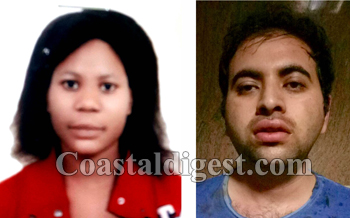
Bengaluru: Ugandan woman stabbed to death after scuffle overpayment for sex'

[email protected] (News Network)
February 3, 2017

Ugandan

Bengaluru, Feb 3: A 25-year-old Ugandan woman was allegedly stabbed to death at her house in Bengaluru in a scuffle over payment for sex in the early hours of Thursday.

Nakayaki Florence was a B.Com student, and a native of Kampala in Uganda. Ishaan (28), who reportedly knifed her to death, was nabbed from her house. The incident took place between 1.30 and 2 am at her second floor house in Thimmegowda Layout, near the Kothanur bus stand. Police said she was involved in the flesh trade, a charge members of her community believe diverts the case.

Ishaan, a native of Himachal Pradesh, told the police he was an M.Tech looking for a job in Bengaluru. He worked as a part-time tutor and was a paying guest in BTM?Layout, the police said. Ishaan met Nakayaki on Brigade Road, and struck a deal for Rs 5,000 to visit her house, a police source said, quoting Ishaan. She demanded Rs 10,000 as he had stayed longer than agreed, Ishaan purportedly told the police.

This resulted in a quarrel. Both were drunk, and Nakayaki grabbed a knife and charged at Ishaan, injuring his hand, according to the police. Ishaan then snatched it from her and stabbed her four or five times, killing her instantly. Hearing the commotion, the landlady rushed to the second floor and locked the door from outside, trapping Ishaan inside.

“We have already established that he (Ishaan) killed the victim, and prima facie, there is clear-cut circumstantial evidence,” said P S Harsha, Deputy Commissioner of Police, North-East Division. However, he did not divulge details, saying the investigation was in progress.

Since it was a murder involving a foreigner, a large number of policemen rushed to the area. People from several African countries had gathered at the spot and were seeking access to Ishaan. The police caned the crowd and whisked him away around 3 am. Soon a platoon of KSRP personnel arrived. The police have booked some Africans for assault, a policeman said.

An association of Africans took objection to the way the city police approached the case. “How can the police come out with conclusive statements that the victim was in the flesh trade and the cause of murder was money over unlawful activity? This is victimising the victim further,” said Bosco Kaweesi, legal adviser, All African Students in Bengaluru.

The fact of the case is that someone went to Nakayaki's house at night and murdered her, he said. “Let the police probe the case impartially,” Kaweesi urged. Three officials from the Ugandan High Commission, besides the Ugandan ambassador to India , will be coming to Bengaluru on Friday, said Bosco Kaweesi.

Comments

naren kotian
 - 
Saturday, 4 Feb 2017

charan anna , india cannot do that bro .. because indians and indian companies including govt companies have billions of investments in african countries , now china and india competing in africa for natural reserves , infrastructure development , factories , health care etc .. indians mega parallel economies in africa from kenya to tanzania , mauritius to ghana and nigeria .. and also millions of indians working in africa in projects . so this type of decision of blocking will create negative impact . In ethipopia in congo ,indians do farming in mega scale . best solution is deporting the students on case o case basis .

Charan Kumar
 - 
Friday, 3 Feb 2017

India should take a leaf out of trump'? visa ban and prohibit entry of Africans, especially their students, because of whom flesh trade and drug mafia is thriving in cities like Benglauru

Add new comment

  • Coastaldigest.com reserves the right to delete or block any comments.
  • Coastaldigset.com is not responsible for its readers’ comments.
  • Comments that are abusive, incendiary or irrelevant are strictly prohibited.
  • Please use a genuine email ID and provide your name to avoid reject.
News Network
May 27,2020

In a development which highlights the diversity in the United Kingdom’s legal system, a 40-year-old Muslim woman has become the first hijab-wearing judge in the country.

Raffia Arshad, a barrister, was appointed a deputy district judge on the Midlands circuit last week after 17-year career in law.  

She said her promotion was great news for diversity in the world’s most respected legal system. She hopes to be an inspiration to young Muslims.

Ms Arshad, who grew up in Yorkshire, north England, has wanted to work in law since she was 11.

Ms Arshad said the judicial office was looking to promote diversity, but when they appointed her they did not know that she wore the hijab.

‘It’s definitely bigger than me,” she told Metro newspaper. "I know this is not about me.

"It’s important for all women, not just Muslim women, but it is particularly important for Muslim women."

Ms Arshad, a mother of three, has been practising private law dealing with children, forced marriage, female genital mutilation and other cases involving Islamic law for the past 17 years.

She was the first in her family to go to university and has also written a leading text on Islamic family law.

Although the promotion by the Lord Chief Justice was welcome news for her, Ms Arshad said the happiness from other people sharing the news was “far greater”.

“I’ve had so many emails from people, men and women," she said.

"It’s the ones from women that stand out, saying that they wear a hijab and thought they wouldn’t even be able to become a barrister, let alone a judge."

Ms Arshad is regularly the subject of discrimination in the courtroom because of her choice to wear the hijab.

She is sometimes mistaken for a court worker or a client.

Ms Arshad said that recently she was asked by an usher whether she was a client, an interpreter, and even if she were on work experience.

“I have nothing against the usher who said that but it reflects that as a society, even for somebody who works in the courts, there is still this prejudicial view that professionals at the top end don’t look like me,” she said.

A family member once advised her to not wear a hijab at an interview for a scholarship at the Inns of Court School of Law in 2001, warning that it would affect her chances of landing the role.

“I decided that I was going to wear my headscarf because for me it’s so important to accept the person for who they are," Ms Arshad said.

"And if I had to become a different person to pursue my profession, it’s not something I wanted.”

The joint heads of St Mary’s Family Law Chambers said they were “delighted” to hear the news of her appointment.

“Raffia has led the way for Muslim women to succeed in the law and at the bar, and has worked tirelessly to promote equality and diversity in the profession,” Vickie Hodges and Judy Claxton said.

“It is an appointment richly deserved and entirely on merit, and all at St Mary’s are proud of her and wish her every success.”

Comments

Add new comment

  • Coastaldigest.com reserves the right to delete or block any comments.
  • Coastaldigset.com is not responsible for its readers’ comments.
  • Comments that are abusive, incendiary or irrelevant are strictly prohibited.
  • Please use a genuine email ID and provide your name to avoid reject.
News Network
June 8,2020

Bengaluru, Jun 8: Facing a shortage of labour, some top builders in the city have initiated efforts to bring back the migrant workers, who have returned to their native places following the COVID-19 lockdown, and are holding parleys with Railway authorities for operation of special trains to ferry them.

After the lockdown was announced, many construction projects came to a halt and accordingly the labourers were rendered jobless. These migrant workers preferred to go back to their home state as they were not paid when the projects were stopped and were caught in the big financial mess. Many of these migrants even chose to cover thousands of kilometres by foot when even trains, buses or any motor vehicles were not operating.

Keeping their woes in view, the Centre decided to run the Shramik Special trains to ferry them to their native places. But, after they were gone, the builders found themselves in a lurch. An executive of a builder told PTI "Yes, our builder and a few others are in talks with the Railways to run the special train to bring back the labourers." She said nothing has been materialised as of now.

According to her, the builders took the contact numbers of the workers when they left the city to their home states and are now contacting them one by one. The South Western Railway has so far sent 3.11 lakh migrant workers in 216 Shramik Special trains starting from May 3 to June 6.

Comments

Add new comment

  • Coastaldigest.com reserves the right to delete or block any comments.
  • Coastaldigset.com is not responsible for its readers’ comments.
  • Comments that are abusive, incendiary or irrelevant are strictly prohibited.
  • Please use a genuine email ID and provide your name to avoid reject.
News Network
January 4,2020

Tumakuru, Jan 4: Three people were burnt alive and four others sustained injuries in a head-on collision between a four-wheeler (Omni van) and a private bus on NH-206 near Doddaguni in Gubbi taluk of Tumakuru district in the early hours of Saturday.

Police said that Narasamma’s relatives and villagers were taking her to a hospital in Nittur when a private bus, heading to Shivamogga from Bengaluru, collided with the van on the tank bund road near Doddguni around 0200 hrs. The two vehicles caught fire and Vasanthkumar, Ramaiah and Narasamma were burnt alive in the van. The passengers in the private bus escaped unhurt.

The deceased were identified as Vasanthkumar (23), Ramaiah (62) and Narsamma (60) of N Hosahalli in Gubbi taluk, whereas the injured were identified as Ravikumar (23), Radhamani (30), Narasimha Murthy (40) and Gowramma (28).

Comments

Add new comment

  • Coastaldigest.com reserves the right to delete or block any comments.
  • Coastaldigset.com is not responsible for its readers’ comments.
  • Comments that are abusive, incendiary or irrelevant are strictly prohibited.
  • Please use a genuine email ID and provide your name to avoid reject.