


Bhaskar Shetty murder: Trio remanded in judicial custody till Aug 24

[email protected] (News Network)
August 17, 2016

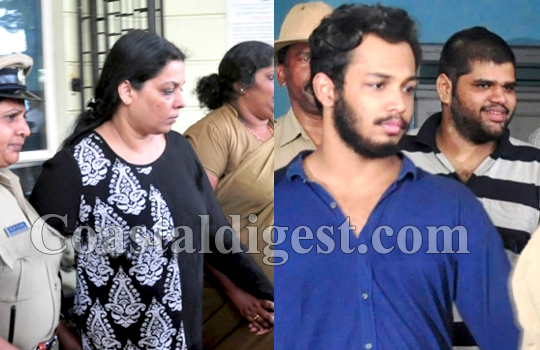
Udupi, Aug 16: The Principal Civil Judge's Court (Senior Division) on Tuesday remanded all the three suspects in the Bhaskar Shetty murder case --- wife Rajeshwari, son Navneeth and astrologer Niranjan Bhat --- in judicial custody up to August 24.
bsshetty

The judge pronounced the judicial custody as police did not seek the extension of police custody. The first suspect Rajeshwari has been shifted to the jail in Mangaluru as there is no women's cell in the district prison. The other two suspects will be housed at the district jail in Anjaru.

Senior assistant public prosecutor Praveen Kumar R N said the chargesheet would be filed within 90 days of the arrest.

A highly placed police source said many evidences have been collected and the investigating team needs some more time to interrogate thoroughly the evidences collected from the accused who were interrogated. The mother and son were taken into nine days custody, while the astrologer was taken to the police custody for four days. The police have the privilege of seeking the accused for 15 days' custody, the source added.

Meanwhile, the application for the DNA profiling of the blood samples of the mother and the elder brother of the deceased would come before the court on August 18, as the application was moved by the police on August 13.

The source added that the crucial evidences collected are now being meticulously linked up to build the chain of incidents involving crime. The accused have confessed of disposing the crucial evidences, including the mortal remains of Bhaskar Shetty, at three places, including rivers at Palli, Kadandale and Kalkaru.

While the bones and other remains of the body were dumped at one place, the mop used to wipe the blood stains and the pesticide and repellent bottles used for crime, the bucket and mugs were dumped in another river. The source added that the chances of collecting the evidences are grim due to the flow of water. But, the plastic materials like bottle, bucket and mug can be recovered, the added.

A major search would be taken up at Palli River to collect the evidences. The materials dumped in the river should be searched. If there are no further evidences recovered, there is no requirement for the police custody. The DNA report can be expected in another 15-20 days. The report plays a crucial role. Even the minute traces are also being dispatched for the DNA test which might take much longer period, the source said.

Mahazar was conducted at all the places. The articles used for crime were purchased from different outlets. There are nearly four to five shops. They conspired in different areas and later executed their plot accordingly. After the execution, the evidences were also disposed of at three to four places. The ashes were disposed of in Palli river. The source added that the conviction highly depends on DNA test.

Comments

babu bajarangi
 - 
Thursday, 18 Aug 2016

Dear Naren your caste only can do this type of crime

mahesh
 - 
Wednesday, 17 Aug 2016

chur churby jaidileka thojundu,

Add new comment

  • Coastaldigest.com reserves the right to delete or block any comments.
  • Coastaldigset.com is not responsible for its readers’ comments.
  • Comments that are abusive, incendiary or irrelevant are strictly prohibited.
  • Please use a genuine email ID and provide your name to avoid reject.
News Network
June 28,2020

Udupi, Jun 28: The Padubidri police have booked cases against two patients of Novel Coronavirus for not revealing their primary contacts and hiding their travel history.

According to DHO Sudhirchandra Sooda, two siblings from Hejamadi in Padubidri had tested positive for COVID-19 recently. After shifting to the hospital, when the officials asked them about their primary contacts and travel history, the patients furnished false information.

When the officials collected information from various sources, they realised that the duo had travelled to Bantwal, Kasargod, Ullal and other places in Dakshina Kannada, said Dr Sooda. Hence, the district administration decided to file cases against them, he added.

Comments

Add new comment

  • Coastaldigest.com reserves the right to delete or block any comments.
  • Coastaldigset.com is not responsible for its readers’ comments.
  • Comments that are abusive, incendiary or irrelevant are strictly prohibited.
  • Please use a genuine email ID and provide your name to avoid reject.
News Network
January 18,2020

Kozhikode, Jan 18: A "fifth-generation dynast" Rahul Gandhi has no chance in Indian politics against a "hard-working and self-made" Narendra Modi, and Kerala did a disastrous thing by electing the the Congress leader to Parliament, historian Ramachandra Guha said here on Friday.

Guha said the reduction of the Congress from a "great party" during the freedom movement to a "pathetic family firm" now is one of the reasons for the ascendency of Hindutva and jingoism in India.

"I have nothing against Rahul Gandhi personally. He is a decent fellow, very well-mannered. But young India does not want a fifth-generation dynast. If you Malyalis make the mistake of re-electing Rahul Gandhi in 2024 too, you are merely handing over an advantage to Narendra Modi," said Guha on the second day of the ongoing Kerala Literature Festival (KLF) during his talk, "Patriotism Vs Jingoism".

Addressing the crowd, full of Keralites, he said, "Kerala, you have done many wonderful things for India, but one of the disastrous thing you did was to elect Rahul Gandhi to Parliament."

"Narendra Modi's great advantage is that he is not Rahul Gandhi. He is self-made. He has run a state for 15 years, he has an administrative experience, he is incredibly hard working and he never takes holidays in Europe. Believe me I am saying all this in all seriousness," he said.

But, even if Rahul Gandhi was "much more intelligent, more hard-working, never took a holiday in Europe, as a fifth generation dynast he still will be at a disadvantage against a self-made person", the 61-year-old author said.

He took on Congress president Sonia Gandhi too who, he said, reminded him of the "late Mughal dynasty" and how aloof they were of the state of their kingdom.

"India is becoming more democratic and less feudal, and the Gandhis just don't realise this. You (Sonia) are in Delhi, your kingdom is shrinking more and more but still your chamchas (sycophants) are telling you that you are still the badshah," he said.

Further, he quoted his teacher and noted Indian sociologist Andre Beteille to describe the story of Nehru-Gandhi family as a classic "reversal of the famous Biblical injunction": the sins of the father will be visited upon seven successive generations.

"In the Nehru's case, it is the sins of the seven successive generations have been re-visited upon Nehru... look at the national debate today. Why is Nehru evoked everytime? Why does Modi always say Nehru ne Kashmir mein yeh kiya, China mein yeh kiya, Triple Talaq mein yeh kiye ... because Rahul Gandhi is there.

"Now if Rahul Gandhi disappears, Modi has to talk about his own policies and why they failed," he said.

According to Guha, "Hypocrisy of the Indian Left -- the fact that they loved other nations more than India", "rise of aggressive nationalism worldwide" and "the rise of Islamic fundamentalism in neighbouring countries" are some other reasons behind the evident leap of Hindutva in India in the recent times.

Historian William Dalrymple, novelists like Benyamin, Namita Gokhale, Chetan Bhagat and journalists Karan Thapar and Rajdeep Sardesai are among the many other writers who will be attending the four-day festival.

The focus theme of KLF 2020 is environment and climate change.

Comments

Add new comment

  • Coastaldigest.com reserves the right to delete or block any comments.
  • Coastaldigset.com is not responsible for its readers’ comments.
  • Comments that are abusive, incendiary or irrelevant are strictly prohibited.
  • Please use a genuine email ID and provide your name to avoid reject.
Media Release
February 14,2020

Veteran journalist P. Sainath has said that the nation is in a crisis. And this crisis is not limited to just the rural area. It has become a national crisis at various areas such as agriculture, education, economy, job creation etc.

He was delivering the endowment lecture on the topic ‘Indian democracy at the post-liberalization and post-truth era’ at Media Manthan 2020 organized by the PG department of journalism and mass communication at St Aloysius College (Autonomous). 

Mr Sainath said that the many policies adopted in the 90s led to India becoming unusually unequal. Referring to the speech Ambedkar had made at the Constituent Assembly while handing over the draft of the Constitution, Mr Sainath said, “Ambedkar had warned about the weakness of Indian democracy that liberty without equality allows the supremacy of a few over the multitude. Liberty, equality and fraternity must be kept together as we cannot have one without the other.” 

Mr Sainath stated that the agrarian crisis was no longer about the loss of productivity, employment or about farmer suicide; it was a societal, civilizational crisis. Commenting on the lopsided policies such as cow-slaughter ban, he explained how cow slaughter ban had adversely affected many industries due to their interdependency. While Muslims who slaughtered cows were rendered helpless, the cattle traders who were mostly OBCs lost their earnings as the cattle prices crashed. An important industry like Kolhapur sandals industry in Maharashtra went bankrupt as a result of the cow slaughter ban in Maharashtra. He said the policymakers had no idea how the rural industries were interconnected. Demonetisation too devastated the rural economy as 98 percent of rural transactions happen through cash. 

Mr Sainath also spoke about the crisis of inequality which affects the Dalits and the Adivasis far more than anyone else as 90 percent of the rural households take home less than Rs 10,000/- per month. “Women are yet another group whose labour is never counted in the gross domestic product. Women and girls globally do unpaid work which amounts to about 12.5 billion working hours per year. Monetarily speaking, this is worth 10.8 trillion dollars,” Mr Sainath added. 

Speaking about the crisis of jobs Mr Sainath said that major companies were laying off employees just to create more profits for the investors and the adoption of artificial intelligence in the industry would further destroy millions of jobs.

Rector of St Aloysius College Institutions Fr Dionysius Vaz SJ, Principal Dr (Fr) Praveen Martis SJ, HOD of Journalism and Mass Communication department Dr (Fr) Melwyn Pinto SJ were present.

‘Veerappan and Vijay Mallya’s business models are interesting!’

Addressing the gathering during his endowment lecture on Friday, Mr Sainath made an interesting comment on the so called ‘revenue model’. “Whenever I visit IIMs and IITs for lectures on my PARI project, the students there ask me what my revenue model for my project is. I tell them that I do not have a revenue model. In fact, journalism does not begin with a revenue model. Gandhiji, Ambedkar, Bhagat Singh were all great journalists. But they did not have a revenue model,” Mr Sainath said.

On a lighter note, he said that the best revenue model that he liked was that of forest brigand Veerappan and liquor baron Vijay Mallya. “Veerappan ruled the forest for forty years and from the top ministers to the villagers he could dictate terms and liver royally. Similarly, Mallya’s revenue model was to steal the banks and run away abroad and live like a king,” Mr Sainath added.

Journalism is not and can never be a business. It is a calling, he opined. While newspaper can be a business, television can be a business, journalism per se cannot be reduced to a business. “Unfortunately today, journalists are recruited on a contract basis and they have no bargaining power; and there are no unions to fight for their cause. Hence, they are at the mercy of the corporate media houses for their survival and are made to write stories that cannot be called journalism,” Mr Sainath said.

Answering a question as to the pressures he faced as a journalist, he said that external pressures from the government or others could be very well handled. It is the internal pressures from once own media house that journalists find it difficult to manage.


Comments

Add new comment

  • Coastaldigest.com reserves the right to delete or block any comments.
  • Coastaldigset.com is not responsible for its readers’ comments.
  • Comments that are abusive, incendiary or irrelevant are strictly prohibited.
  • Please use a genuine email ID and provide your name to avoid reject.