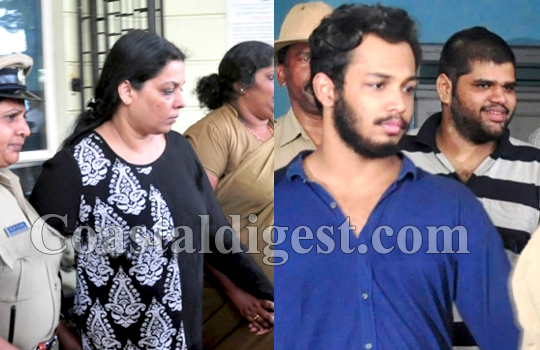
Bhaskar Shetty murder: Trio remanded in judicial custody till Aug 24

[email protected] (News Network)
August 17, 2016

Udupi, Aug 16: The Principal Civil Judge's Court (Senior Division) on Tuesday remanded all the three suspects in the Bhaskar Shetty murder case --- wife Rajeshwari, son Navneeth and astrologer Niranjan Bhat --- in judicial custody up to August 24.

bsshetty

The judge pronounced the judicial custody as police did not seek the extension of police custody. The first suspect Rajeshwari has been shifted to the jail in Mangaluru as there is no women's cell in the district prison. The other two suspects will be housed at the district jail in Anjaru.

Senior assistant public prosecutor Praveen Kumar R N said the chargesheet would be filed within 90 days of the arrest.

A highly placed police source said many evidences have been collected and the investigating team needs some more time to interrogate thoroughly the evidences collected from the accused who were interrogated. The mother and son were taken into nine days custody, while the astrologer was taken to the police custody for four days. The police have the privilege of seeking the accused for 15 days' custody, the source added.

Meanwhile, the application for the DNA profiling of the blood samples of the mother and the elder brother of the deceased would come before the court on August 18, as the application was moved by the police on August 13.

The source added that the crucial evidences collected are now being meticulously linked up to build the chain of incidents involving crime. The accused have confessed of disposing the crucial evidences, including the mortal remains of Bhaskar Shetty, at three places, including rivers at Palli, Kadandale and Kalkaru.

While the bones and other remains of the body were dumped at one place, the mop used to wipe the blood stains and the pesticide and repellent bottles used for crime, the bucket and mugs were dumped in another river. The source added that the chances of collecting the evidences are grim due to the flow of water. But, the plastic materials like bottle, bucket and mug can be recovered, the added.

A major search would be taken up at Palli River to collect the evidences. The materials dumped in the river should be searched. If there are no further evidences recovered, there is no requirement for the police custody. The DNA report can be expected in another 15-20 days. The report plays a crucial role. Even the minute traces are also being dispatched for the DNA test which might take much longer period, the source said.

Mahazar was conducted at all the places. The articles used for crime were purchased from different outlets. There are nearly four to five shops. They conspired in different areas and later executed their plot accordingly. After the execution, the evidences were also disposed of at three to four places. The ashes were disposed of in Palli river. The source added that the conviction highly depends on DNA test.

Comments

babu bajarangi
 - 
Thursday, 18 Aug 2016

Dear Naren your caste only can do this type of crime

mahesh
 - 
Wednesday, 17 Aug 2016

chur churby jaidileka thojundu,

Add new comment

  • Coastaldigest.com reserves the right to delete or block any comments.
  • Coastaldigset.com is not responsible for its readers’ comments.
  • Comments that are abusive, incendiary or irrelevant are strictly prohibited.
  • Please use a genuine email ID and provide your name to avoid reject.
Ram Puniyani
January 14,2020

In the beginning of January 2020 two very disturbing events were reported from Pakistan. One was the attack on Nankana Sahib, the holy shrine where Sant Guru Nanak was born. While one report said that the place has been desecrated, the other stated that it was a fight between two Muslim groups. Prime Minister of Pakistan Imran Khan condemned the incident and the main accused Imran Chisti was arrested. The matter related to abduction and conversion of a Sikh girl Jagjit Kaur, daughter of Pathi (One who reads Holy Guru Granth Sahib in Gurudwara) of the Gurudwara. In another incident one Sikh youth Ravinder Singh, who was out on shopping for his marriage, was shot dead in Peshawar.

While these condemnable attacks took place on the Sikh minority in Pakistan, BJP was quick enough to jump to state that it is events like this which justify the Citizenship Amendment Act (CAA). Incidentally CAA is the Act which is discriminatory and relates to citizenship with Religion, which is not as per the norms of Indian constitution. There are constant debates and propaganda that population of Hindus has come down drastically in Pakistan and Bangla Desh. Amit Shah, the Home minister stated that in Pakistan the population of Hindus has come down from 23% at the time of partition to 3.7% at present. And in Bangla Desh it has come down from 22% to present 8%.

While not denying the fact that the religious minorities are getting a rough deal in both these countries, the figures which are presented are totally off the mark. These figures don’t take into consideration the painful migrations, which took place at the time of partition and formation of Bangla Desh later. Pakistan census figures tell a different tale. Their first census was held in 1951. As per this census the overall percentage of Non Muslim in Pakistan (East and West together) was 14.2%, of this in West Pakistan (Now Pakistan) it was 3.44 and in Eat Pakistan it was 23.2. In the census held in Pakistan 1998 it became 3.72%. As far as Bangla Desh is concerned the share of Non Muslims has gone down from 23.2 (1951) to 9.6% in 2011.

The largest minority of Pakistan is Ahmadis, (https://minorityrights.org/country/pakistan/) who are close to 4 Million and are not recognised as Muslims in Pakistan. In Bangla Desh the major migrations of Hindus from Bangla Desh took place in the backdrop of Pakistan army’s atrocities in the then East Pakistan.

As far as UN data on refugees in India it went up by 17% between 2016-2019 and largest numbers were from Tibet and Sri Lanka.  (https://www.un.org/en/development/desa/population/migration/publication…)

The state of minorities is in a way the index of strength of democracy. Most South Asian Countries have not been able to sustain democratic values properly. In Pakistan, the Republic began with Jinnah’s classic speech where secularism was to be central credo of Pakistan. This 11th August speech was in a way what the state policy should be, as per which people of all faiths are free to practice their religion. Soon enough the logic of ‘Two Nation theory” and formation of Pakistan, a separate state for Muslim took over. Army stepped in and dictatorship was to reign there intermittently. Democratic elements were suppressed and the worst came when Zia Ul Haq Islamized the state in collusion with Maulanas. The army was already a strong presence in Pakistan. The popular formulation for Pakistan was that it is ruled by three A’s, Army, America and Allah (Mullah).

Bangla Desh had a different trajectory. Its very formation was a nail in the coffin of ‘two nation theory’; that religion can be the basis of a state. Bangla Desh did begin as a secular republic but communal forces and secular forces kept struggling for their dominance and in 1988 it also became Islamic republic. At another level Myanmar, in the grip of military dictatorship, with democratic elements trying to retain their presence is also seeing a hard battle. Democracy or not, the army and Sanghas (Buddhist Sang has) are strong, in Myanmar as well. The most visible result is persecution of Rohingya Muslims.

Similar phenomenon is dominating in Sri Lanka also where Budhhist Sanghas and army have strong say in the political affairs, irrespective of which Government is ruling. Muslim and Christian minorities are a big victim there, while Tamils (Hindus, Christians etc.) suffered the biggest damage as ethnic and religious minorities. India had the best prospect of democracy, pluralism and secularism flourishing here. The secular constitution, the outcome of India’s freedom struggle, the leadership of Gandhi and Nehru did ensure the rooting of democracy and secularism in a strong way.

India so far had best democratic credentials amongst all the south Asian countries. Despite that though the population of minorities rose mainly due to poverty and illiteracy, their overall marginalisation was order of the day, it went on worsening with the rise of communal forces, with communal forces resorting to identity issues, and indulging in propaganda against minorities.

While other South Asian countries should had followed India to focus more on infrastructure and political culture of liberalism, today India is following the footsteps of Pakistan. The retrograde march of India is most visible in the issues which have dominated the political space during last few years. Issues like Ram Temple, Ghar Wapasi, Love Jihad, Beef-Cow are now finding their peak in CAA.

India’s reversal towards a polity with religion’s identity dominating the political scene was nicely presented by the late Pakistani poetess Fahmida Riaz in her poem, Tum bhi Hum Jaise Nikle (You also turned out to be like us). While trying to resist communal forces has been an arduous task, it is becoming more difficult by the day. This phenomenon has been variously called, Fundamentalism, Communalism or religious nationalism among others. Surely it has nothing to do with the religion as practiced by the great Saint and Sufi traditions of India; it resorts mainly to political mobilization by using religion as a tool.


Comments

Ashi
 - 
Tuesday, 14 Jan 2020

If Malaysia implement similar NRC/CAA, India and China are the loser.

Add new comment

  • Coastaldigest.com reserves the right to delete or block any comments.
  • Coastaldigset.com is not responsible for its readers’ comments.
  • Comments that are abusive, incendiary or irrelevant are strictly prohibited.
  • Please use a genuine email ID and provide your name to avoid reject.
News Network
April 16,2020

Bengaluru, Apr 16: The lockdown in the wake ofthe coronavirus pandemic has turned out to be a deeply painful story for the Kannada film industry.

Schedules have gone awry following the stay-at-home curbs and operators in Sandalwood, as the industry is popularly known as, say about 100 films under production are affected.

They include big budget movies- 'Raja Veera Madakari Nayaka', 'Kotigobba 3', 'Robert' and 'Yuvaratna.'

Noted producer Rockline Venkatesh told P T I that the loss to the industry is to the tune of hundreds of crores of rupees.

In addition, it's a challenge for producers to secure the content of their movies from "piracy and leak" during long periods of time before their release, Venkatesh, who is Secretary of Karnataka Cine Artistes' Association, said.

A leading distributor said even after the lockdown is lifted and situation returns to normalcy, it remains a big question if investment in film business will pay off at all.

"People don't have money. We will know the impact when things become normal. Questions many ask if people will return to cinema halls like the way they did before or they prefer to stay away from crowd."

Venkatesh, who had also produced Rajinikanth-starrer 'Lingaa' and co-produced 'Bajrangi Bhaijaan' with Salman Khan in the lead role, said it would take at least one to one-and- half years for the industry to be back on its legs.

"That too if the government does hand-holding but if the industry faces a bad hit in terms of income tax and GST and other taxation, 80-90 per cent of the industry will face closure," he said.

"It does not matter if the government does not help the industry but they should not trouble us with things like IT and GST," Venkatesh, who is also a distributor and artiste, said.

A top director said people's "behaviour" towards movies is crucial for the industry's health in the post lockdown scenario.

"With people likely to shy away from going to malls, cinema theatres because of large gatherings there, it's going to be a long road to recovery for us", an industry insider said.

Striking a philosophical tone, Venkatesh said all that people worry now is to save their life and keep good health, adding, amassing money and wealth is the last thing on their mind.

Producers Soorappa Babu and Umesh Banakar, who is also Vice-President of the Karnataka Film Chamber of Commerce, told P T I that the industry has taken a huge hit.

Banakar said the loss to the industry due to the lockdown is at least Rs 1,000 crore.

"The coronavirus has affected the entire world. We don't know what to do; we just have to wait," Soorappa Babu, producer of Kiccha Sudeep-starrer 'Kotigobba 3', said.

Comments

Add new comment

  • Coastaldigest.com reserves the right to delete or block any comments.
  • Coastaldigset.com is not responsible for its readers’ comments.
  • Comments that are abusive, incendiary or irrelevant are strictly prohibited.
  • Please use a genuine email ID and provide your name to avoid reject.
News Network
July 14,2020

Mangaluru, July 14: In order to detect COVID-19 cases quickly in Dakshina Kannada, the government has commissioned a programme to administer rapid antigen tests.

The coastal district has already received 3,500 rapid antigen test kits, which can give results in 30 minutes, an official said, adding that tests will be conducted shortly and training is being imparted on the use of the kits.

The antigen tests will be conducted for emergency cases like delivery, surgery, persons with severe symptoms of Covid-19, multiple-organ failure and for those whose condition is critical. 

"If a symptomatic patient tests negative for Covid-19, then his throat swab sample would be sent for lab testing," the district health officer (DHO) said.

The rapid antigen tests is expected to help in increasing the number of tests and bring down the load of testing on labs, as antigen kits allow faster diagnosis.

It takes a minimum of eight hours to get the results via real-time polymerase chain reaction (RT-PCR) test. Antigen tests can provide results within half an hour.

Comments

Add new comment

  • Coastaldigest.com reserves the right to delete or block any comments.
  • Coastaldigset.com is not responsible for its readers’ comments.
  • Comments that are abusive, incendiary or irrelevant are strictly prohibited.
  • Please use a genuine email ID and provide your name to avoid reject.