



Bhiku Daji Bhilare, man who saved Mahatma Gandhi passes away

Agencies
July 20, 2017

Mumbai, Jul 20: Bhiku Daji Bhilare, who was claimed to have saved Mahatma Gandhi from being killed by Nathuram Godse in 1944, passed away today after a brief illness. The 98-year-old Gandhian, popularly known as ‘Bhilare Guruji’, was cremated at his village, Bhilar, in Mahabaleshwar Teshil in western Maharashtra’s Satara district, family sources said.Bhiku
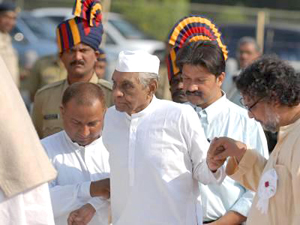
Bhilare, born on November 28, 1919, is survived by three sons. While there is no documented history about Bhilare having foiled Godse’s earlier attack, the great grandson of Mahatma Gandhi, Tushar Gandhi, in his new book has dwelt on how fundamentalists had planned and made many attempts on the life of the Father of the Nation before he was finally killed.

According to him, there were four attempts on the Mahatma’s life, before Godse killed him in 1948. The attack at Panchgani in 1944, where Bhilare Guruji overpowered Nathuram, was the second of these attempts, he has claimed in the book. “(In) July 1944, after his release from the Aga Khan Palace Prison Camp in May 1944, Gandhi contracted malaria and was advised rest by his physician. He retired to Panchgani, a mountain resort near Poona (now Pune), where he stayed at Dilkhush Bungalow. “A group of 18 or 20 men reached Panchgani by a chartered bus from Poona and held a day-long protest against Gandhi. When Gandhi was told about this, he contacted the leader of the group, Nathuram Vinayak Godse, for a discussion. Nathuram rejected the invitation and continued with his demonstration,” the book says.

“During a prayer meeting that evening, Nathuram Godse, dressed in a Nehru shirt, pajama and jacket, rushed towards Gandhi. He was brandishing a dagger in his hand and shouting anti-Gandhi slogans. Godse was overpowered by Manishankar Purohit, the proprietor of the Surti lodge of Poona, and D Bhilare Guruji of Satara, who later became a Congress legislator from Mahabaleshwar. The other youth accompanying Godse ran away,” it said. In 2008, at an event in Mumbai, Bhilare was lauded for having had the presence of mind and the daring to twist the knife out of Nathuram Godse’s hand as he rushed to kill Gandhiji in a frenzy.

In 1944, Bhilare was the taluka pramukh of the Rashtra Seva Dal. “It was a wet July evening in Panchgani in 1944,” Bhilare Guruji had recalled at the event. “All of us had assembled in the Batha High School hall for the evening prayers when suddenly a door opposite me opened and in rushed Nathuram Godse. He was wielding a knife and muttering incoherently.” Bhilare blocked his path and twisted the knife out of his hand.

“My colleagues in the Seva Dal were also quick to react, and threw him out of the premises,” he had recalled. Bhilare had also claimed that Gopal Godse and Narayan Apte, who were implicated in the Mahatma’s assassination, were present at the spot. The Panchgani incident has been documented in the memoirs of Gandhiji’s close associate, said Pyarelal, a functionary of Mani Bhawan in Mumbai from where Mahatma Gandhi initiated satyagraha and propagated the cause of swadeshi.

Comments

Add new comment

  • Coastaldigest.com reserves the right to delete or block any comments.
  • Coastaldigset.com is not responsible for its readers’ comments.
  • Comments that are abusive, incendiary or irrelevant are strictly prohibited.
  • Please use a genuine email ID and provide your name to avoid reject.
Agencies
May 25,2020

New Delhi, May 25: Union Home Minister Amit Shah on Monday extended his greetings on the occasion of Eid-ul-Fitr and wished that the festival will bring peace and happiness to all.

"Extend my warm greetings on the occasion of Eid-ul-Fitr. May this festival bring peace and happiness in everyone's life," Shah tweeted.

Eid-ul-Fitr is being celebrated across the country on Monday.

Comments

ikram parvez
 - 
Sunday, 21 Jun 2020

How to download <a href="https://eid2020.net/best-eid-mubarak-wishing-images/">download eid images</a> For free?

Add new comment

  • Coastaldigest.com reserves the right to delete or block any comments.
  • Coastaldigset.com is not responsible for its readers’ comments.
  • Comments that are abusive, incendiary or irrelevant are strictly prohibited.
  • Please use a genuine email ID and provide your name to avoid reject.
Agencies
June 15,2020

New Delhi, Jun 15: Average temperature of India experienced a rise of 0.7 degree Celsius, along with decline in rainfall, significant increase in frequency of very severe cyclonic storms and droughts in over a decade due to human activities, the Ministry of Earth Sciences in its research report said.

The contentions were made in a report issued by the ministry on the impact of climate change. It will be published by Union Minister Harsh Vardhan on June 19.

According to the report, "Since the middle of the twentieth century, India witnessed rise in temperature; decrease in monsoon; rise in extreme temperature and rainfall, droughts, and sea levels; and increase intensity of severe cyclones.

The report, prepared by researchers of the Centre for Climate Change Research, a cell under The Ministry's Indian Institute of Tropical Meteorology, Pune, further stated that there is compelling scientific evidence that human activities have influenced these changes in regional climate.

India's average temperature has risen by around 0.7 degrees Celsius during 1901-2018, it said, adding that the rise is largely on account of GHG-induced warming and partially offset by forcing due to anthropogenic aerosols.

It states that the average temperature over India is projected to rise by 4.4 degrees Celsius, while the intensity of heat waves is likely to increase by 3-4 times by the end of the century.

In the 30-year period between 1986 and 2015, temperatures of the warmest day and the coldest night of the year have risen by about 0.63 degrees Celsius and 0.4 degree Celsius.

According to the report, by the end of the century, the temperatures of the warmest day and the coldest night are projected to rise by approximately 4.7 degrees Celsius and 5.5 degrees Celsius, respectively.

Alarmingly, sea surface temperature of the tropical Indian Ocean has also risen by one degrees Celsius on average during 1951-2015.

"The frequency of very severe cyclonic storms during the post-monsoon season has increased significantly (+1 event per decade) during the last two decades (2000-2018)," it added.

This came in the backdrop of Cyclone 'Amphan' and 'Nisarga' which made landfalls on May 20 and June 3 and killed several people, flattened villages, and destroyed farms.

"This is the first-ever climate change assessment report for India. This report will be very useful for policy makers, researchers, social scientists, economists, and students," said M. Rajeevan, secretary, the Ministry of Earth Sciences.

Besides this, the report also highlighted various other unnerving data on climate change in the country. Both the frequency and extent of droughts have increased significantly during 1951-2016.

The overall decrease of seasonal "summer monsoon rainfall" during the last 6-7 decades has led to an increased propensity for droughts over India.

"In particular, areas over central India, southwest coast, southern peninsula and north-eastern India have experienced more than 2 droughts per decade, on average, during this period. The area affected by drought has also increased by 1.3 per cent per decade over the same period."

The Hindu Kush Himalayas (HKH) also experienced a temperature rise of about 1.3 degree Celsius during 1951-2014.

Several areas of the Himalayas have experienced a declining trend in snowfall and also retreat of glaciers in recent decades. By the end of the twenty-first century, its annual mean surface temperature is projected to increase by about 5.2 degree Celsius.

The summer monsoon precipitation from June to September over India has also declined by around 6 per cent from 1951 to 2015, with notable decreases over the Indo-Gangetic Plains and the Western Ghats, the report further states.

Comments

Add new comment

  • Coastaldigest.com reserves the right to delete or block any comments.
  • Coastaldigset.com is not responsible for its readers’ comments.
  • Comments that are abusive, incendiary or irrelevant are strictly prohibited.
  • Please use a genuine email ID and provide your name to avoid reject.
Agencies
August 4,2020

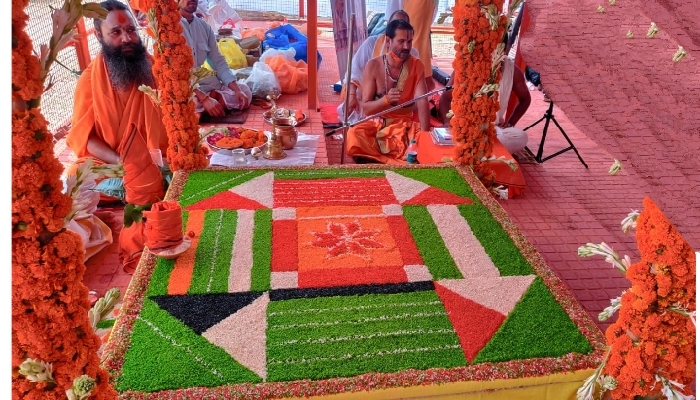
Ayodhya, Aug 4: Ramarchan puja begins at Ram Janmabhoomi site ahead of the foundation laying ceremony of Ram Temple in Ayodhya.
Ramarchan Puja is a prayer to invite all major gods and goddesses ahead of Lord Ram's arrival.

Mahesh Bhagchandka, one of the trustees of Ashok Singhal foundation as Yajman in the puja said, "This is being conducted at the temporary seat of Ramlalla. The pooja will be conducted in four phases."

Speaking about the third and fourth phases, he said: "In the third phase, Dashrath, father of Lord Ram with his wives will be worshipped and then all three brothers of Lord Ram - Laxman, Bharat and Shatrughan with their wives. Lord Hanuman ji will too be worshipped. Whereas in the fourth phase, Lord Ram will be worshipped."
Meanwhile, security has been heightened in Ayodhya ahead of the foundation laying ceremony.

Temples across the city is decorated with lights, diyas and flowers ahead of the grand event. Patna's Mahavir Mandir Trust is preparing over 1.25 lakh 'Raghupati Laddoos' for the occasion. Thes laddoos will be distributed as 'prasad' to devotees.

Uttar Pradesh Chief Minister Yogi Adityanath on Monday offered prayers at the Hanuman Garhi temple during his visit to Ayodhya to take stock of the preparations for the 'bhoomi pujan'.
He along with officials also visited 'Ram ki Paudi' to inspect the arrangements ahead of the foundation stone laying ceremony.

Prime Minister Narendra Modi is scheduled to lay the foundation stone of the Ram Temple in Ayodhya on August 5. 

Comments

Add new comment

  • Coastaldigest.com reserves the right to delete or block any comments.
  • Coastaldigset.com is not responsible for its readers’ comments.
  • Comments that are abusive, incendiary or irrelevant are strictly prohibited.
  • Please use a genuine email ID and provide your name to avoid reject.