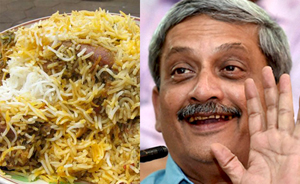
Is BJP ‘Beef Joy Party’ now? VHP asks after Parrikar’s assurances to beef eaters

News Network
July 19, 2017

Panaji, Jul 19: BJP leader and Goa Chief Minister Manohar Parrikar’s claim that the state would never be short of beef, has landed him the soup. A senior leader of Vishwa Hindu Parishad (VHP) has asked him whether BJP has become the Beef Joy Party. On the other hand the Opposition have slammed the brazen double standard of the saffron party.parikarbeef

NCP’s Nawab Malik, CPI (M)’s Sitaram Yechuri and Congress’ Rajeev Shukla said that the if the BJP approved Parriakar’s statements, then the party was indulging in a dangerous double game, as gau rakshaks, claiming to be members of the party, have been assaulting those they suspect of carrying beef..

“Manohar Parkiar's comments show the BJP has a special set of rules for its party members. The fact that Goa's CM said that there will be no shortage of beef in the state, and that beef will be imported from Karnataka shows how the party’s true colours,” he said.

Sitaram Yechuri of the CPI (M) echoed Malik’s statement, saying that it was a case of double-standards shown by the party. “While gau rakshaks create havoc in the rest of the country, the Goa CM proudly proclaims that there will be no shortage of beef in the state. I wonder how the BJP feels about his statement,” he added.

Parrikar on Tuesday said the state-run abattoir here produces around 2,000 kgs of beef per day and the additional demand for it is met by supplies from neighbouring Karnataka.

Addressing the state assembly on the first day of the monsoon session, Parrikar, in reply to a BJP member's concern over the quality of beef supplied from the neighbouring state, said the beef purchased from Karnataka would be subjected to proper inspection. "Approximately 2,000 kgs beef is produced per day at the state abattoir of the Goa Meat Complex Limited, while rest of beef is brought in from Karnataka. "The estimated sale of beef, based on the meat inspection charges paid by beef dealers/traders is approximately 2,300 - 2,400 kgs/day," said Parrikar, who also holds the animal husbandry portfolio.

“On one hand, the BJP assaults Dalits and Muslims, and on the other, the Goa CM says that there won't be a shortage of beef in the state for its citizens. It's quite the double speak on part of the party,” Rajeev Shukla of the Congress said.

While the party high command has not reacted to Parrikar’s statement, the VHP has called for the Goa Chief Minister’s resignation. “Has the BJP become the Beef Joy Party? Parrikar should resign for his comments,” VHP leader Dr Surendra Jain said in a series of tweets.

Comments

MBS
 - 
Saturday, 22 Jul 2017

Good decision go ahead,we are with you

Ahmed K. C.
 - 
Saturday, 22 Jul 2017

There are similarities between US and India like:-
Intolerance towards certain community
Favoring Super rich.
Hate speeches.
Self boasting.
Both love Israel cause common enemy.

But, lot of differences like:-
For us beef is god, for US beef is food.
We have Gou Rakshaks, US has Gou bakshaks.
For us only one national flag, for US each state have it's own flag besides national flag.
We buy weapons, US sells weapons.
We are just trying to get into wars, whereas US is always in war since 200 years.

Add new comment

  • Coastaldigest.com reserves the right to delete or block any comments.
  • Coastaldigset.com is not responsible for its readers’ comments.
  • Comments that are abusive, incendiary or irrelevant are strictly prohibited.
  • Please use a genuine email ID and provide your name to avoid reject.
News Network
August 5,2020

Shivamogga, Aug 5: Karnataka Minister KS Eshwarappa on Wednesday hailed the laying of foundation stone (bhoomi pujan) for a grand Ram temple in Ayodhya and said "Kashi Vishwanath and "Krishna Janmasthan temples have to be liberated".

"It is a good day that the foundation stone for Ram Temple has been laid. A beautiful temple will come up, but there are Kashi Vishwanath and Krishna Janmasthan temples which have to be liberated," Eshwarappa said.

The minister said that there is a "sign of slavery" at Krishna temple in Mathura and Kashi Vishwanath temple in Varanasi.

"The whole nation is dreaming of Shri Krishna temple in Mathura and Kashi Vishwanath temple. I have visited the two temples. 

There is a sign of slavery. Mosques are there at holy places. When I visited the place at Mathura, I witnessed the wall. When we look at the wall, we feel like we are still slaves," he said.

"While visiting Kashi, there is also a structure of slavery. Dream of Hindus is fulfilled in Ayodhya. One day, it will be fulfilled in Mathura and Kashi. Mathura Sri Krishna and Kashi Vishwanath will be freed and temple will be built," Eshwarappa added.

The Places of Worship Act, enacted in 1991, says that religious character of a place of worship existing on the August 15, 1947 shall continue to be the same as it existed on that day. The Act kept Ayodhya case out of its purview.

Comments

Add new comment

  • Coastaldigest.com reserves the right to delete or block any comments.
  • Coastaldigset.com is not responsible for its readers’ comments.
  • Comments that are abusive, incendiary or irrelevant are strictly prohibited.
  • Please use a genuine email ID and provide your name to avoid reject.
Agencies
January 1,2020

For many Indian tycoons, 2019 turned woeful as lenders -- empowered by the nation’s recent bankruptcy law and desperate to clean up soured debt from their books -- started seizing assets of delinquent firms or dragged them into insolvency.

Indian banks wrote off a record $39 billion of loans in the 18 months through September in a bid to repair their balance sheets as they battled the world’s worst bad debt pile. Making matters worse, a shadow banking crisis led to a funding squeeze, crushing debt-laden businesses that were critically dependent on rollover financing.

“Life has come a full circle for tycoons that had enjoyed debt-fueled growth,” said Nirmal Gangwal, founder of distress and debt restructuring advisory firm Brescon & Allied Partners LLP. “Many firms collapsed like a house of cards. The downfall was rather unprecedented.”
The government has also been cracking down on economic crime to assuage public anger over absconding businessmen. It’s even barred some from traveling overseas if they were deemed a flight risk.

Here are some of the country’s biggest and most-storied businessmen who saw their fortunes fade. Spokespersons for none of these tycoons, except Essar, immediately replied to emails and text messages seeking comments.

Anil Ambani

The chairman of Reliance Group, which makes movies to metro lines, had a close shave with jail time in March before his elder brother and Asia’s richest man, Mukesh Ambani, bailed him out at the last minute. The woes of the ex-billionaire came to the fore when India’s top court asked him to pay Ericsson AB’s India unit about $77 million of past dues or go to jail since Anil Ambani, 60, had given a personal guarantee. His telecom carrier slipped into insolvency this year, while unprofitable Reliance Naval & Engineering Ltd. faced a cash crunch. Reliance Capital Ltd. is selling assets to pare debt. Ambani is also fending off Chinese lenders in a London court.

Malvinder & Shivinder Singh

Karma caught up with ex-billionaires and brothers Malvinder Singh, 47, and Shivinder Singh, 44, and how. Scions of a prominent business family, they once helmed India’s top drug maker and second-largest hospital chain. In October, the two were arrested on charges of fraudulently diverting nearly $337 million from a lender they controlled. India’s market regulator found in 2018 that the brothers had defrauded their hospital company of about $56 million. The collapse of the $2 billion empire turned brother against brother, prompting their mother to broker a peace deal that was short-lived. In February, Malvinder accused Shivinder and their spiritual guru of fraud.

Shashikant & Ravikant Ruia

After a hard-fought battle to keep their flagship steel mill, the first-generation entrepreneurs finally saw the bankrupt Essar Steel India Ltd. pass on to ArcelorMittal last month. The $5.9 billion takeover was almost two years in the making with multiple legal wrangles. The group, controlled by Shashikant Ruia, 76, and Ravikant Ruia, 70, were also reprimanded by a U.K. judge in March this year for concealing documents. Started in 1969 as a construction firm, Essar Group diversified, investing about $18 billion between 2008 and 2012, and piled on debt. In 2017, the group had sold another prized asset, Essar Oil.

Selling an asset to pare a liability shouldn’t be seen as a “lost asset,” an Essar spokesman said, adding that the group remains a diversified conglomerate.

VG Siddhartha

Before jumping off a bridge into a river in July in an apparent suicide, the founder of India’s biggest coffee chain Cafe Coffee Day had penned a letter that spoke of pressure from lenders, a private equity firm and harassment by tax officials. He had spent much of the last two years pledging ever more of Coffee Day Enterprises Ltd. shares to refinance loans for ever shorter periods, at ever higher interest rates. “I would like to say I gave it my all,” V.G. Siddhartha, 60, wrote in the letter. “I fought for a long time but today I gave up.”

Naresh Goyal

The former ticketing agent who built India’s largest airline by value, stepped down as chairman of Jet Airways India Ltd. in March, caving in to pressure from banks who took over the company. Cut-throat price wars and surging costs pushed Jet deeper into loss. The airline stopped flying in April and went into bankruptcy two months later as lenders failed to find a buyer. In July, an Indian court barred Naresh Goyal from flying overseas after the government said it was investigating an alleged $2.6 billion fraud involving Jet Airways.

Rana Kapoor

The founder of Yes Bank Ltd., which became India’s fourth-largest non-state lender, tweeted in September 2018 that his shares were invaluable and requested his children never to sell them upon inheritance. But trouble was brewing. The nation’s banking regulator, which found the lender had repeatedly under-reported its bad loans, refused to extend his tenure as chief executive officer. This forced Rana Kapoor, 62, to step down by end-January. Kapoor, who has pledged some of his Yes Bank shares in July, sold almost his entire stake in the lender by October.

Subhash Chandra

The rice trader-turned-media mogul, 69, who brought cable television into Indian homes in the early 1990s with his ZEE TV, resigned as chairman of Zee Entertainment Enterprises Ltd. in November and lost control of his crown jewel. Subhash Chandra has been selling stake in Zee Entertainment in the past few months to repay group’s debt.

Gautam Thapar

A default by Gautam Thapar, founder of the paper mill-to-power transmission Avantha Group, on pledged shares made Yes Bank Ltd. the biggest shareholder in CG Power and Industrial Solutions Ltd. In August, the firm was hit by an accounting scandal forcing the board to remove Thapar, 59, from the chairman’s post. A month later, the market regulator ordered a forensic audit of the firm and barred Thapar from accessing securities market.


Comments

Add new comment

  • Coastaldigest.com reserves the right to delete or block any comments.
  • Coastaldigset.com is not responsible for its readers’ comments.
  • Comments that are abusive, incendiary or irrelevant are strictly prohibited.
  • Please use a genuine email ID and provide your name to avoid reject.
Agencies
February 8,2020

Mumbai, Feb 8: Anil Ambani, the brother of Asia’s richest man has pleaded poverty in his dispute with three Chinese banks seeking $680 million in defaulted loans.

“The value of my investments has collapsed,” Anil Ambani said, according to a court filing by the banks in a London lawsuit.

“The current value of my shareholdings is down to approximately $82.4m and my net worth is zero after taking into account my liabilities. In summary, I do not hold any meaningful assets which can be liquidated for the purposes of these proceedings.”

The lawsuit was filed by three state-controlled Chinese banks which argue that they provided a loan of $925 million to Ambani’s Reliance Communications Ltd. in 2012 with the condition that he personally guarantee the debt. The comments were disclosed on Friday as Ambani sought to avoid depositing hundreds of millions of dollars with the court ahead of a trial.

The embattled Indian tycoon says that while he agreed to give a non-binding “personal comfort letter,” he never gave a guarantee tied to his personal assets -- an “extraordinary potential personal liability.”

The 60-year-old is the brother of Mukesh Ambani, who’s worth $56.5 billion and is the wealthiest man in Asia. Anil, on the other hand, has seen his personal fortune dwindle over recent years, losing his billionaire status. His Reliance Communications filed for bankruptcy last year.

The banks asked Judge David Waksman to force Ambani to put up $656 million into the court’s account.

Representatives for Ambani’s Reliance Group said they couldn’t immediately comment. They said the group will issue a statement once the court issues the final order.

Ambani’s lawyer, Robert Howe, said the court shouldn’t order his client to make a payment he can’t make. The tycoon argues that an order requiring him to do so would hinder his ability to defend himself in the case, Howe said.

“There’s no evidence of some giant pot of gold that he can pull $1 million, let alone $10 million, let alone $100 million,” Howe said.

Bankim Thanki, an attorney representing Industrial & Commercial Bank of China Ltd., China Development Bank and the Export-Import Bank of China, said in a filing that Ambani’s statements are “plainly a yet further opportunistic attempt to evade his financial obligations to the lenders.”

Ambani was caught up in another legal wrangle last year when India’s Supreme Court threatened him with prison after Reliance Communications failed to pay Rs 5.5 billion ($77 million) to Ericsson AB’s Indian unit. The judges gave him a month to find the funds, and his brother, Mukesh, stepped in just in time to make the payment.

Anil said in a filing that he recognized that the judge would want to know if he could satisfy any order to put up funds from outside resources, including his family.

“I can confirm that I have made enquiries but I am unable to raise any finance from external sources,” he said. Judge Waksman had said in an earlier ruling that he believed Ambani’s defence would be shown to be “opportunistic and false.”

Ambani’s lawyer told the judge that as a result of the comments the tycoon’s relatives were unlikely to lend any funds.

There is a “very substantial risk they will never get it back,” Howe said.

Comments

Add new comment

  • Coastaldigest.com reserves the right to delete or block any comments.
  • Coastaldigset.com is not responsible for its readers’ comments.
  • Comments that are abusive, incendiary or irrelevant are strictly prohibited.
  • Please use a genuine email ID and provide your name to avoid reject.