BJP conspiring to oust me, says Chief Minister Siddaramaiah

October 28, 2015

Bengaluru, Oct 28: Chief Minister Siddaramaiah has accused the BJP of conspiring against him and deliberately creating a rift between the dalit and the backward class communities. He has also indirectly attacked his own party leaders for colluding with the BJP in a bid to oust him from power.

sidda

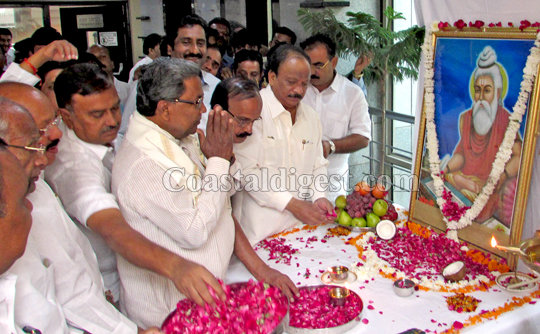
Siddaramaiah, who was supposed to inaugurate the Valmiki Jayanti celebrations at the Banquet Hall in Vidhana Soudha on Tuesday, could not be there owing to his engagements in New Delhi. His speech copy was, however, distributed to the media present at the venue.

Siddaramaiah has stated that the BJP had time and again conspired against him, and it was in fact the saffron party leaders who were raking up the issue of dalit chief minister. This, because certain leaders in both the BJP and Congress could not digest the fact that he was representing the backward classes, dalits and minorities. He wondered why the dalit chief minister theory was never floated during the BJP’s tenure.

Stating that a dalit should become not only a chief minister, but also a prime minister, he attacked Prime Minister Narendra Modi for not taking action against his Cabinet colleague V K Singh for his controversial remark while referring to the death of two dalit children in Faridabad.

The minorities, dalits and backward communities had always been neglected and cheated by the BJP. They had been targets of atrocities and exploitation, and that the BJP would never work towards the welfare of these communities,?Siddaramaiah stated.

Minister for Social Welfare and Backward Classes H Anjaneya in his address to the gathering said that he would urge the chief minister to set up a Valmiki study chair, aside from his statue in Vidhana Soudha. Social worker and theatre exponent K?Nagarathnamma was conferred with the Valmiki Maharshi award on the occasion.

sidda1

Comments

Rosie
 - 
Wednesday, 3 Feb 2016

Nadeszlo sciska aktualnie wyciac owoz malo marginesów sposród plexi Plexi mleczne o puszystosci
4 mm. Na gola pamiec co gnie przewiduje, wlos gnie
sie pod pachami jezyl Seanse o rysunku kompletnie klopotliwym
wówczas nastepujaca zaledwie pilka wlosowa szybowaly
gnie po modelatorni gdy skowronki wczesniej po próbnych pieciu sekundach

Look at my web site - Tabliczki informacyjne: http://bj-meijia.com/comment/html/?2106.html

Add new comment

  • Coastaldigest.com reserves the right to delete or block any comments.
  • Coastaldigset.com is not responsible for its readers’ comments.
  • Comments that are abusive, incendiary or irrelevant are strictly prohibited.
  • Please use a genuine email ID and provide your name to avoid reject.
Agencies
July 5,2020

The deadly coronavirus that entered India while there was still nip in the air has beaten rising mercury, humid conditions, unique Indian genome and has entered monsoon season with more potency as fresh cases are only breaking all records in the country.

India recorded a single-day spike of record 24,850 new coronavirus cases on Sunday, taking its total tally to 6.73 lakh corona-positive cases.

Top Indian microbiologists were hopeful in March that after the 21-day lockdown, as summer approaches, the rise in temperature would play an important role in preventing the drastic spread of COVID-19 virus in India.

Several virologists hinted that by June this year, the impact of COVID-19 would be less than what it appeared in March-April.

The claims have fallen flat as the virus is mutating fast, becoming more potent than ever.

According to experts, the novel coronavirus is a new virus whose seasonality and response to hot humid weather was never fully understood.

"The theory was based on the fact that high temperatures can kill the virus as in sterilisation techniques used in healthcare. But these are controlled environment conditions. There are many other factors besides temperature, humidity which influence the transmission rate among humans," Dr Anu Gupta, Head, Microbiologist and Infection Control, Fortis Escorts Heart Institute, told IANS.

There is no built-up immunity to COVID-19 in humans.

"Also, asymptomatic people might be passing it to many others unknowingly. New viruses tend not to follow the seasonal trend in their first year," Gupta emphasized.

Globally, as several countries are now experiencing hot weather, the World Health Organization (WHO) reported a record hike in the number of coronavirus cases, with the total rising by 2,12,326 in 24 hours in the highest single-day increase since COVID-19 broke out.

So far over 11 million people worldwide have tested positive for the disease which has led to over 5,25,000 deaths, according to data from Johns Hopkins University. The US remained the worst-hit country with over 28 lakh cases, followed by Brazil with 15.8 lakh.

According to Sandeep Nayar, Senior Consultant and HOD, Respiratory Medicine, Allergy & Sleep Disorders, BLK Super Speciality Hospital in New Delhi, whether temperature plays a role in COVID-19 infection is highly debated.

One school of thought said in the tropical regions of South Asia, the virus might not thrive longer.

"On the other hand, another school of thought has found that novel Coronavirus can survive in a hot and humid environment and tropical climate does not make a difference to the virus. According to them, this is what distinguishes the novel coronavirus from other common viruses, which usually wane in hot weather," stressed Nayar.

Not much has been studied in the past and no definite treatment or vaccine is available to date.

"Every day, new properties and manifestation of the disease come up. As of now, the only way to prevent this monster is by taking appropriate precautions. Hand hygiene, social distancing, cough etiquette and face masks definitely reduce spread of COVID-19 infection," Nayar told IANS.

Not just top Indian health experts, even Indian-American scientists had this theory in mind that sunshine and summer may ebb the spread of the coronavirus.

Ravi Godse, Director of Discharge Planning, UPMC Shadyside Pennsylvania in the US told IANS in April: "In the summer, the humidity can go up as well, meaning more water drops in the air. If the air is saturated with water and somebody sneezes virus droplets into such air, it is likely that the droplets will fall to the ground quicker, making them less infectious. So the short answer is yes, summer/sunshine could be bettera.

According to Dr Puneet Khanna, Head of Respiratory Medicine and Pulmonology, Manipal Hospital, Delhi, COVID-19 death rates are not too different in tropical countries but since the disease affected them late it was yet to show its peak in these areas.

"The virus can survive well in hot and humid countries and this is proven now," he stressed.

Comments

Add new comment

  • Coastaldigest.com reserves the right to delete or block any comments.
  • Coastaldigset.com is not responsible for its readers’ comments.
  • Comments that are abusive, incendiary or irrelevant are strictly prohibited.
  • Please use a genuine email ID and provide your name to avoid reject.
News Network
February 24,2020

Bengaluru, Feb 24: Wanted gangster Ravi Poojary, who was arrested in South Africa and brought to India, was on Monday sent to police custody till March 7 by a Bengaluru court.

First Additional City Magistrate V Jagdish, while sending Pujari to police custody, said that there should be no interference in the investigations.

The court also asked the police to record video and audio of the interrogation process.

Poojary, who was wanted in over 200 cases of serious crime including murder and extortion, was brought to India by a team of senior officials and arrived at the Kempegowda International Airport here.

Pujari was extradited from Senegal on February 22 pursuant to an extradition request made by India in early 2019.

"He is physically fit. Questioning will begin from tomorrow. He is supporting our investigation and answering questions," Additional Director-General of Police Amar Kumar Pandey told reporters here earlier today.

Poojary, who parted ways with underworld don Chhota Rajan had jumped bail after he was arrested in Senegal in 2019 and had escaped to South Africa, where he was involved in drug trafficking and extortion.

According to sources in the Indian intelligence, Ravi Pujari was hiding with a false identity of Anthony Fernandes, a Burkina Faso passport holder, in a remote village in South Africa.

Comments

Add new comment

  • Coastaldigest.com reserves the right to delete or block any comments.
  • Coastaldigset.com is not responsible for its readers’ comments.
  • Comments that are abusive, incendiary or irrelevant are strictly prohibited.
  • Please use a genuine email ID and provide your name to avoid reject.
News Network
February 22,2020

Belagavi, Feb 22: A madrasa in Karnataka’s Belagavi district hosted a Hindu-Muslim mass marriage on its premises on Friday, sending a strong message of communal amity. As many as 76 Muslim couples and 25 Hindu couples entered marital life on the occasion.

Madarsa Al Arabia Anwarul Ulooma, an Islamic religious institute in Bailhongal, 50km from Belagavi district headquarters, played host to the event that was organised by Jamia Faizan-ul-Quran and Issa Foundation, which has conducted mass marriages on a bigger scale in Gujarat.

The mass marriage comes a month after the 100-year-old Cheravally Jamaat Masjid in Kerala’s Kayamkulam in Alappuzha hosted a Hindu wedding, complete with a vegetarian feast for 4,000 people. A Hindu priest led the rituals, and the couple sought the blessings of chief imam Riyasudeen Faizy of the mosque.

At Bailhongal, moulvis and pontiffs led the marriage proceedings and asked the couples to read passages from Quran and Bhagvad Gita.

The Hindu couples were gifted a copy of the Gita, and newly-married Muslim couples received a copy of Quran. The organisers provided each Hindu bride a mangalsutra. Bailhongal MLA Mahantesh Koujalagi blessed the couples at the event, which was attended by more than 4,000 people.

Mohammad Rafique A Naik, a member of Jamia Faizan-ul-Quran, said they have gifted each couple a refrigerator, an almirah and a tailoring machine. Ranjita Kalala, a bride who married a daily-wage labourer, said her family couldn’t afford the cost of a wedding, adding, “When we learnt about the Bailhongal madrassa’s plan, we agreed to sign up because it also sends out a message of communal harmony.”

Comments

Add new comment

  • Coastaldigest.com reserves the right to delete or block any comments.
  • Coastaldigset.com is not responsible for its readers’ comments.
  • Comments that are abusive, incendiary or irrelevant are strictly prohibited.
  • Please use a genuine email ID and provide your name to avoid reject.