


BJP faced more adversities in independent India than Cong under British: Modi

August 18, 2016

New Delhi, Aug 18: BJP has faced more adversities in independent India as compared to what Congress would have during the British rule, Prime Minister Narendra Modi said today and lamented that every effort of his party was seen in "bad light".modi-7
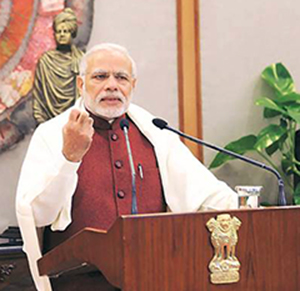
Asserting that BJP has made more sacrifices than any other party, Modi, who laid the foundation stone of the new party headquarters here, said fissiparous forces have become more active as the country's strength has grown and it is now more imperative to ensure that the society is strengthened and becomes more harmonious.

Underlining his party's commitment to take everybody along with the motto of 'sabka saath, sabka vikaas', he asked party workers to present to the country and the democratic world an example of how a party "devoted to ideals and devoid of dynasty" functions as the world knows the saffron outfit "not the way it is but based on hearsay".
"BJP will be the only party which has faced adversities since its birth. It faced difficulties at every turn and its every effort was seen in bad light.

"Even during the British times, the Congress party would not have faced so much adversity that we, our dedicated workers have gone through in 50-60 years," he said at the event attended by top BJP leaders including party chief Amit Shah, L K Advani, Rajnath Singh and Arun Jaitley among others.

During the recent West Bengal assembly polls, it was difficult for the BJP candidates to even hire an office in Kolkata as anybody willing to given them space would face trouble, he said in an apparent attack on the ruling Trinamool Congress.

"No party has perhaps made more sacrifices than us (BJP) after freedom," he said, adding that "hundreds of" its workers were killed because they were not associated with the prevalent ideology of those times.

BJP workers do not work for crowd but for organisation as "anybody can collect a crowd by talking about populist issues but what is more important is to stick to ideology", he said.

In a lighter vain, he said election candidates of no other party would have forfeited more deposits than those of BJP as they kept fighting for their ideology irrespective of the results.

Modi used the occasion to congratulate grappler Sakshi Malik for bringing glory to the country by winning a bronze medal in the Rio Olympics.

Comments

SK
 - 
Thursday, 18 Aug 2016

Fekuji, you should thank Nehru for stopping Sardar Patel, for not banning GOONDA RSS organisation ...He was the right man to ban such goons... If that has happened, then India would have been a peaceful country ..... Naren are you reading the news of killing of BJP worker by your own goonda RSS....

Add new comment

  • Coastaldigest.com reserves the right to delete or block any comments.
  • Coastaldigset.com is not responsible for its readers’ comments.
  • Comments that are abusive, incendiary or irrelevant are strictly prohibited.
  • Please use a genuine email ID and provide your name to avoid reject.
Agencies
June 23,2020

New Delhi, Jun 23: "Coming up with a clinically tested, evidence-based medicine was a challenge," said Yoga Guru Ramdev as on Tuesday he launched Patanjali's Coronil tablet, which he claims is a cure for COVID-19. He also talked about various other immunity boosters at an event here during the launch.

Patanjali claims those administered the medicine were fully cured and none died. Ramdev even claimed that 69 per cent of them recovered within 3 days.

"We appointed a team of scientists after COVID-19 outbreak," said Balkrishna, Ramdev's close aide and MD of Patanjali Ayurved. He added that Patanjali conducted a clinical case study on hundreds of positive patients.

Patanjali has claimed that the clinical trials which were controlled in nature, was jointly conducted by Patanjali Research Institute which is based out of Haridwar and the National Institute of Medical Sciences, Jaipur.

Talking about the clinical trials, Ramdev said, "Under this 280 patients were included and 100 per cent of those recovered." He added they were able to control Coronavirus and its complications.

He said that in the next few days, data of the trail will be released as evidence to bolster claims. There are now over 9 million people affected by the pandemic since it broke out in China's Wuhan city in December 2019.

He said Ayurvedic elements are being used in the tablet. "There are more than 100 compounds used in the Coronil," he added. An entire kit is being made for that which consists of other Ayurvedic medicine as well which helps in immunity. The entire kit comes at Rs 600. However, he claimed that it will be given for free to those living below the poverty line.

As for doses, Panajali prescribes: "2-2 tablets should be consumed with hot water half an hour after meals. The above mentioned drug intake and quantity is suitable for people between 15 to 80 years of age. Half the amount of the above mentioned medicines can be used for children between the age of 6 to 14 years." These are the written instructions on the pack.

India has been battling the pandemic with close to 4 lakh cases in India on Tuesday and around 14,000 deaths so far.

Comments

Add new comment

  • Coastaldigest.com reserves the right to delete or block any comments.
  • Coastaldigset.com is not responsible for its readers’ comments.
  • Comments that are abusive, incendiary or irrelevant are strictly prohibited.
  • Please use a genuine email ID and provide your name to avoid reject.
News Network
January 10,2020

New Delhi, Jan 10: One woman reported a rape every 15 minutes on average in India in 2018, according to government data released on Thursday, underlining its dismal reputation as one of the worst places in the world to be female.

The highly publicised gang rape and murder of a woman in a bus in New Delhi in 2012 brought tens of thousands onto the streets across India and spurred demands for action from film stars and politicians, leading to harsher punishments and new fast-track courts. But the violence has continued unabated.

Women reported almost 34,000 rapes in 2018, barely changed from the year before. Just over 85% led to charges, and 27% to convictions, according to the annual crime report released by the Ministry of Home Affairs.

Women's rights groups say crimes against women are often taken less seriously, and investigated by police lacking insensitivity.

"The country is still run by men, one (female prime minister) Indira Gandhi is not going to change things. Most judges are still men," said Lalitha Kumaramangalam, former chief of the National Commission for Women.

"There are very few forensic labs in the country, and fast-track courts have very few judges," said Kumaramangalam, a member of Prime Minister Narendra Modi's Bharatiya Janata Party (BJP).

The rape of a teenager in 2017 by former BJP state legislator Kuldeep Singh Sengar gained national attention when the accuser tried to kill herself the following year, accusing the police of inaction.

Five months before Sengar was convicted last December, the accuser's family had to be provided with security after a truck crashed into the car she was in, injuring her and killing two of her relatives.

A 2015 study by the Centre for Law & Policy Research in Bengaluru found that fast-track courts were indeed quicker, but did not handle a high volume of cases.

And a study in 2016 by Partners for Law in Development in New Delhi found that they still took an average of 8.5 months per case - more than four times the recommended period.

The government statistics understate the number of rapes as it is still considered a taboo to report rape in some parts of India and because rapes that end in the murder are counted purely as murders.

Comments

Add new comment

  • Coastaldigest.com reserves the right to delete or block any comments.
  • Coastaldigset.com is not responsible for its readers’ comments.
  • Comments that are abusive, incendiary or irrelevant are strictly prohibited.
  • Please use a genuine email ID and provide your name to avoid reject.
News Network
May 24,2020

New Delhi, May 24: The Indian economy is likely to slip into recession in the third quarter of this fiscal as loss in income and jobs and cautiousness among consumers will delay recovery in consumer demand even after the pandemic, says a report.

According to Dun & Bradstreet's latest Economic Observer, the country's economic recovery will depend on the efficacy and duration of implementation of the government's stimulus package.

"The multiplier effect of the stimulus measures on the economy will depend on three key aspects i.e. the time taken for effecting the withdrawal of the lockdown, the efficacy of implementation and duration of execution of the measures announced," Dun & Bradstreet India Chief Economist Arun Singh said.

The report noted that the government's larger-than-expected stimulus package is likely to re-start economic activities.

Besides, measures taken by the Reserve Bank of India like reducing the repo rate by a further 40 basis points to 4 per cent, extending the moratorium period by three months and facilitating working capital financing will also help stimulate the momentum.

Singh said while the measures announced by the government are "positive", most of them have been directed towards strengthening the supply side of the economy, and "it is to be noted that supply needs to be matched with demand", he said.

Besides, "in the absence of cash-in-hand benefits under the government's stimulus package, demand for goods and services is expected to remain depressed", he added.

He further said the loss in income and employment opportunities, and cautiousness among consumers, will lead to a delayed recovery in consumer demand, even after the pandemic. As debt and bad loan levels increase, the banking sector might face challenges.

The report further noted that even as the monetary stimulus is expected to inject liquidity and stimulate demand for a wider section of the economy, the channelisation of funds from the financial institutions will be subjected to several constraints.

The foremost concern being increase in risk averseness, as the balance sheets of firms, households, and banks/NBFCs have weakened considerably and low demand for funds by firms as production activities have been on a standstill during the lockdown period, Singh said.

India has been under lockdown since March 25 to contain the spread of the coronavirus, resulting in supply disruptions and demand compression.

Prime Minister Narendra Modi imposed a nationwide lockdown to control the spread of coronavirus on March 25. It has been extended thrice, with some relaxations. The fourth phase of the lockdown is set to expire on May 31. 

Comments

Add new comment

  • Coastaldigest.com reserves the right to delete or block any comments.
  • Coastaldigset.com is not responsible for its readers’ comments.
  • Comments that are abusive, incendiary or irrelevant are strictly prohibited.
  • Please use a genuine email ID and provide your name to avoid reject.