BJP faced more adversities in independent India than Cong under British: Modi

August 18, 2016

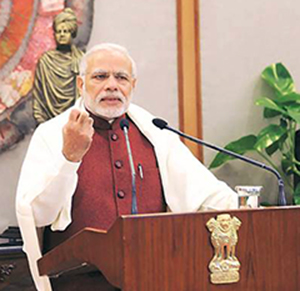
New Delhi, Aug 18: BJP has faced more adversities in independent India as compared to what Congress would have during the British rule, Prime Minister Narendra Modi said today and lamented that every effort of his party was seen in "bad light".modi-7

Asserting that BJP has made more sacrifices than any other party, Modi, who laid the foundation stone of the new party headquarters here, said fissiparous forces have become more active as the country's strength has grown and it is now more imperative to ensure that the society is strengthened and becomes more harmonious.

Underlining his party's commitment to take everybody along with the motto of 'sabka saath, sabka vikaas', he asked party workers to present to the country and the democratic world an example of how a party "devoted to ideals and devoid of dynasty" functions as the world knows the saffron outfit "not the way it is but based on hearsay".
"BJP will be the only party which has faced adversities since its birth. It faced difficulties at every turn and its every effort was seen in bad light.

"Even during the British times, the Congress party would not have faced so much adversity that we, our dedicated workers have gone through in 50-60 years," he said at the event attended by top BJP leaders including party chief Amit Shah, L K Advani, Rajnath Singh and Arun Jaitley among others.

During the recent West Bengal assembly polls, it was difficult for the BJP candidates to even hire an office in Kolkata as anybody willing to given them space would face trouble, he said in an apparent attack on the ruling Trinamool Congress.

"No party has perhaps made more sacrifices than us (BJP) after freedom," he said, adding that "hundreds of" its workers were killed because they were not associated with the prevalent ideology of those times.

BJP workers do not work for crowd but for organisation as "anybody can collect a crowd by talking about populist issues but what is more important is to stick to ideology", he said.

In a lighter vain, he said election candidates of no other party would have forfeited more deposits than those of BJP as they kept fighting for their ideology irrespective of the results.

Modi used the occasion to congratulate grappler Sakshi Malik for bringing glory to the country by winning a bronze medal in the Rio Olympics.

Comments

SK
 - 
Thursday, 18 Aug 2016

Fekuji, you should thank Nehru for stopping Sardar Patel, for not banning GOONDA RSS organisation ...He was the right man to ban such goons... If that has happened, then India would have been a peaceful country ..... Naren are you reading the news of killing of BJP worker by your own goonda RSS....

Add new comment

  • Coastaldigest.com reserves the right to delete or block any comments.
  • Coastaldigset.com is not responsible for its readers’ comments.
  • Comments that are abusive, incendiary or irrelevant are strictly prohibited.
  • Please use a genuine email ID and provide your name to avoid reject.
News Network
February 9,2020

New Delhi, Feb 8: Arvind Kejriwal is set to return as Delhi chief minister and his Aam Aadmi Party (AAP) will virtually sweep the assembly elections, exit polls predicted Saturday.

As polling came to a close at 6 pm, with the Election Commission of India (ECI) projecting a voter turnout at 60.24% (as of 9:50 pm), a poll of polls covering 10 exit polls gave 52 seats to AAP, 17 to the Bharatiya Janata Party and one to the Indian National Congress.

The polls, which are sample surveys conducted among voters exiting polling booths, signalled that the Delhi voter responded to AAP’s campaign that focused on “kaam”, or getting work done.

Kejriwal, a former civil servant and activist who stormed into electoral politics with an anti-corruption campaign in 2013, led a campaign focusing on the development work his government did in Delhi, especially in education and healthcare, as well as sops such as lower electricity bills and free bus rides for women.

The exit polls gave AAP between 47 and 68 seats in the 70-member Assembly.

They predicted an absolute rout for Congress, which ruled Delhi for three terms between 1998 and 2013. The maximum seats to AAP were given by India Today TV-Axis exit poll, which predicted 59-68 seats for the party, while giving 2-11 for the BJP and none to the Congress.

If these figures hold, the results will come as a disappointment for the BJP, which had hoped its sweep in the Lok Sabha elections in 2019 would reflect in the assembly polls.

Delhi’s voter turnout saw a sharp fall over the 2015 elections. According to the Election Commission of India, voter turnout till 9 pm was projected at 60.24% — lower than 67.12% in 2015.

Traditionally, a lower voter turnout is read as a vote for the incumbent.

The voter turnout in Delhi has been similar during the Congress regime under Sheila Dikshit, when she won consecutive terms. In 2003, when Delhi voted a second time for the Dikshit government, the voter turnout was 53.42%, and a comparable 57.58% was the turnout in 2008.

Later, in two consecutive elections — 2013 and 2015 — voters turned out in big numbers to vote Dikshit out of power. In 2013, 65.63% of Delhi turned out and the percentage increased further to 67.12% in 2015.

Across constituencies, Matia Mahal in Central Delhi registered the highest voter turnout of 68.36%, whereas Bawana assembly constituency in North district saw the lowest turnout at 41.95%. Among districts, North East district registered the highest (62.75%) voter turnout, while the lowest turnout was recorded in South East district (54.15%), according to the ECI app.

Comments

Add new comment

  • Coastaldigest.com reserves the right to delete or block any comments.
  • Coastaldigset.com is not responsible for its readers’ comments.
  • Comments that are abusive, incendiary or irrelevant are strictly prohibited.
  • Please use a genuine email ID and provide your name to avoid reject.
News Network
May 22,2020

Mumbai, May 22: The Reserve Bank of India (RBI) on Friday reduced repo rate by 40 basis points to 4 per cent in an effort to further boost liquidity in the economy which has been reeling under the impact of COVID-19 induced countrywide lockdown.

As a result, the reverse repo rate stands at 3.35 per cent, said RBI Governor Shaktikanta Das. The six-member monetary policy committee (MPC) voted 5:1 in favour of the decision.

Repo rate is the rate at which a country's central bank lends money to commercial banks, and the reverse repo rate is the rate at which it borrows from them. 

Comments

Add new comment

  • Coastaldigest.com reserves the right to delete or block any comments.
  • Coastaldigset.com is not responsible for its readers’ comments.
  • Comments that are abusive, incendiary or irrelevant are strictly prohibited.
  • Please use a genuine email ID and provide your name to avoid reject.
News Network
February 19,2020

New Delhi, Feb 19: India will switch to the world's cleanest petrol and diesel from April 1 as it leapfrogs straight to Euro-VI emission compliant fuels from Euro-IV grades now - a feat achieved in just three years and not seen in any of the large economies around the globe.

India will join the select league of nations using petrol and diesel containing just 10 parts per million of sulphur as it looks to cut vehicular emissions that are said to be one of the reasons for the choking pollution in major cities.

Sanjiv Singh, Chairman of Indian Oil Corp (IOC) - the firm that controls roughly half of the country's fuel market, said almost all refineries began producing ultra-low sulphur BS-VI (equivalent to Euro-VI grade) petrol and diesel by the end of 2019 and oil companies have now undertaken the tedious task of replacing every drop of fuel in the country with the new one.

"We are absolutely on track for supplying BS-VI fuel from April 1. Almost all refineries have begun supplying BS-VI fuel and the same has reached storage depots across the country," he said.

From storage depots, the fuel has started travelling to petrol pumps and in the next few weeks all of them will only have BS-VI grade petrol and diesel, he said. "We are 100 per cent confident that fuel that will flow from nozzles at all the petrol pumps in the country on April 1 will be BS-VI emission compliant fuel."

India adopted Euro-III equivalent (or Bharat Stage-III) fuel with a sulphur content of 350 ppm in 2010 and then took seven years to move to BS-IV that had a sulphur content of 50 ppm. From BS-IV to BS-VI it took just three years.

"It was a conscious decision to leapfrog to BS-VI as first upgrading to BS-V and then shifting to BS-VI would have prolonged the journey to 4 to 6 years. Besides, oil refineries, as well as automobile manufacturers, would have had to make investments twice - first to producing BS-V grade fuel and engines and then BS-VI ones," he said.

State-owned oil refineries spent about Rs 35,000 crore to upgrade plants that could produce ultra-low sulphur fuel. This investment is on top of Rs 60,000 crore they spent on refinery upgrades in the previous switchovers.

BS-VI has a sulphur content of just 10 ppm and emission standards are as good as CNG.

Originally, Delhi and its adjoining towns were to have BS-VI fuel supplies by April 2019 and the rest of the country was to get same supplies from April 2020.

But oil marketing companies switched over to supply of BS-VI grade fuels in the national capital territory of Delhi on April 1, 2018.

The supply of BS-VI fuels was further extended to four contiguous districts of Rajasthan and eight of Uttar Pradesh in the National Capital Region (NCR) on April 1, 2019, together with the city of Agra.

BS-VI grade fuels were made available in 7 districts of Haryana from October 1, 2019.

Singh said the new fuel will result in a reduction in NOx in BS-VI compliant vehicles by 25 per cent in petrol cars and by 70 per cent in diesel cars.

The switchover, he said, is a tedious task as every drop of old, higher-sulphur content fuel has to be flushed out in depots, pipelines and tanks before being replaced by BS-VI.

"We are confident of disruption-free switchover to BS-VI supplies across the country," he said. "What we will be supplying is the best quality available anywhere in the world. You don't have any better fuel that is supplied in any part of the world. Perhaps our BS-VI fuel will be better than equivalent fuel in some parts of the US and Europe."

India adopted a fuel upgradation programme in the early 1990s. Low lead gasoline (petrol) was introduced in 1994 in Delhi, Mumbai, Kolkata and Chennai. On February 1, 2000, unleaded gasoline was mandated nationwide.

Similarly, BS-2000 (Euro-I equivalent, BS-1) vehicle emission norms were introduced for new vehicles from April 2000. BS-II (Euro-II equivalent) emission norms for new cars were introduced in Delhi from 2000 and extended to the other metro cities in 2001.

Benzene limits have been reduced progressively from 5 per cent in 2000 to 1 per cent nationwide. Lead content in gasoline was removed in phases and only unleaded gasoline is being produced and sold from February 1, 2000.

The octane number of gasoline signifies the improved performance of the engine. Loss in octane number due to phasing out of lead was made up by installing new facilities in the refinery and changes in refinery operation. RON (Research Octane Number) of gasoline for BS-2000 spec was increased to 88. This has over time been increased to 91.

Singh said sulphur reduction will reduce Particulate Matter (PM) emissions even in the in-use older generation diesel vehicles.


Comments

Add new comment

  • Coastaldigest.com reserves the right to delete or block any comments.
  • Coastaldigset.com is not responsible for its readers’ comments.
  • Comments that are abusive, incendiary or irrelevant are strictly prohibited.
  • Please use a genuine email ID and provide your name to avoid reject.