BJP faced more adversities in independent India than Cong under British: Modi

August 18, 2016

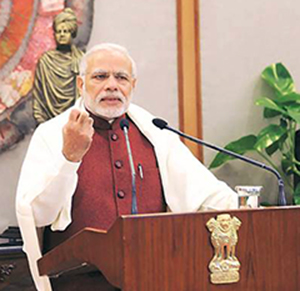
New Delhi, Aug 18: BJP has faced more adversities in independent India as compared to what Congress would have during the British rule, Prime Minister Narendra Modi said today and lamented that every effort of his party was seen in "bad light".modi-7

Asserting that BJP has made more sacrifices than any other party, Modi, who laid the foundation stone of the new party headquarters here, said fissiparous forces have become more active as the country's strength has grown and it is now more imperative to ensure that the society is strengthened and becomes more harmonious.

Underlining his party's commitment to take everybody along with the motto of 'sabka saath, sabka vikaas', he asked party workers to present to the country and the democratic world an example of how a party "devoted to ideals and devoid of dynasty" functions as the world knows the saffron outfit "not the way it is but based on hearsay".
"BJP will be the only party which has faced adversities since its birth. It faced difficulties at every turn and its every effort was seen in bad light.

"Even during the British times, the Congress party would not have faced so much adversity that we, our dedicated workers have gone through in 50-60 years," he said at the event attended by top BJP leaders including party chief Amit Shah, L K Advani, Rajnath Singh and Arun Jaitley among others.

During the recent West Bengal assembly polls, it was difficult for the BJP candidates to even hire an office in Kolkata as anybody willing to given them space would face trouble, he said in an apparent attack on the ruling Trinamool Congress.

"No party has perhaps made more sacrifices than us (BJP) after freedom," he said, adding that "hundreds of" its workers were killed because they were not associated with the prevalent ideology of those times.

BJP workers do not work for crowd but for organisation as "anybody can collect a crowd by talking about populist issues but what is more important is to stick to ideology", he said.

In a lighter vain, he said election candidates of no other party would have forfeited more deposits than those of BJP as they kept fighting for their ideology irrespective of the results.

Modi used the occasion to congratulate grappler Sakshi Malik for bringing glory to the country by winning a bronze medal in the Rio Olympics.

Comments

SK
 - 
Thursday, 18 Aug 2016

Fekuji, you should thank Nehru for stopping Sardar Patel, for not banning GOONDA RSS organisation ...He was the right man to ban such goons... If that has happened, then India would have been a peaceful country ..... Naren are you reading the news of killing of BJP worker by your own goonda RSS....

Add new comment

  • Coastaldigest.com reserves the right to delete or block any comments.
  • Coastaldigset.com is not responsible for its readers’ comments.
  • Comments that are abusive, incendiary or irrelevant are strictly prohibited.
  • Please use a genuine email ID and provide your name to avoid reject.
Agencies
May 23,2020

New Delhi, May 23: The nationwide lockdown will no longer help India in its fight against COVID-19, and in its place community-driven containment, isolation and quarantine strategies have to be brought into play, leading virologist Shahid Jameel said.

The recipient of Shanti Swarup Bhatnagar Prize for Science and Technology also stressed that testing should be carried out vigorously to identify coronavirus hotspots and isolate those areas.

"Our current testing rate at 1,744 tests per million population is one of the lowest in the world. We should deploy both antibody tests and confirmatory PCR tests. This will tell us about pockets of ongoing infection and past (recovered) infection. This will provide data to open up gradually and let economic activity resume," Jameel told PTI in an interview.

He stressed that testing has to be dynamic to continuously monitor red, orange and green zones and change these based on that data.

About community transmission of COVID-19 in India, Jameel said the country reached that stage long ago.

"We reached community transmission a long time ago. It's just that the health authorities are not admitting it. Even ICMR's own study of SARI (severe acute respiratory illness) showed that about 40 per cent of those who tested positive for SARS-CoV-2 did not have any history of overseas travel or contact to a known case. If this is not community transmission, then what is?" he posed.

Lockdown bought India time in its fight against coronavirus, but continuing it is unlikely to yield any further dividend, Jameel said.

"Instead, community-driven local lockdowns, isolations and quarantines have to come into play. Building trust is most important so that people follow rules. A public health problem cannot be dealt with as a law-and-order problem."

The nationwide lockdown, initially imposed from March 25 to April 14, has been extended thrice and will continue at least till May 31. The virus has claimed 3,720 lives and infected over 1.25 lakh people in the country so far.

Jameel has expertise in the fields of molecular biology, infectious diseases, and biotechnology. He is the CEO of Wellcome Trust/Department of Biotechnology's India Alliance and is best known for extensive research in Hepatitis E virus and HIV.

He said COVID-19 will eventually be controlled through herd immunity, which is acquired in two ways – when a sufficient fraction of the population gets infected and recovers, and with vaccination.

"It is estimated that for SARS-CoV-2 at least 60 per cent of the population would have to be infected and recovered, or vaccinated. This will happen over the course of the next few years," Jameel said.

Herd immunity is reached when the majority of a population becomes immune to an infectious disease, either because they have become infected and recovered, or through vaccination. When that happens, the disease is less likely to spread to people who aren't immune, because there just aren't enough infectious carriers.

"India has 1.38 billion people, a population density of about 400/sq km and a healthcare system ranked at 143 in the world. If we allow 60 per cent people to get infected quickly in the hopes of herd immunity, that would mean 830 million infections," Jameel said.

"If 15 per cent need hospitalization that means about 125 million isolation beds (we have 0.3 million). If five per cent need oxygen and ventilatory support, this amounts to about 42 million oxygen support and ICU beds; we have 0.1 million oxygen support beds and 34,000 ICU beds. This would overwhelm the healthcare system causing mayhem," he said.

Jameel said if the population level mortality is 0.5 per cent that would mean 40 lakh deaths. "Are we prepared to pay this price for herd immunity in the short term? Clearly not," he said.

He said it is unlikely that a vaccine would be available by the end of the year.

"Even then, we don't know yet how long it would give protection – weeks, months, one year, a few years? I don't think we will return to pre-coronavirus days for at least the next 3-5 years. This is also a chance to evaluate if we want to return to those unsustainable, environment-damaging ways. COVID-19 is a timely warning to reform our way of living," he said.

Jameel said it is hard to predict but plausible that COVID-19 would return in second or third wave.

"Later waves come when we don't understand the disease and become lax. A comparison to Spanish Flu is not entirely valid because in 1918 no one knew what caused it. No one had seen a virus till the mid-1930s as the electron microscope needed to view those was invented in 1931," he said.

"Today we know a lot more about the pathogen, its genetic makeup, how it transmits and how to prevent it. We need to be sensible and follow expert advice," he said.

If there is any scientific evidence linking deforestation, rapid urbanisation, climate change with pandemics like COVID-19, he said zoonotic viruses -- those that jump from animals to humans -- happen so when wild animal–human contacts increase.

"Deforestation destroys animal habitats bringing them closer to humans. When you cut forests, bats come to roost on trees closer to human habitations. Their viruses in secretions/stool get transmitted to domestic animals and on to humans. This happened clearly with Nipah virus outbreak in Malaysia in 1997-98 from fruit bats to pigs to humans," he said.

"COVID-19 possibly arose in wet animal markets due to dietary habits that bring all kinds of live and dead wild animals in close contact with humans," Jameel added.


Comments

Add new comment

  • Coastaldigest.com reserves the right to delete or block any comments.
  • Coastaldigset.com is not responsible for its readers’ comments.
  • Comments that are abusive, incendiary or irrelevant are strictly prohibited.
  • Please use a genuine email ID and provide your name to avoid reject.
Agencies
June 2,2020

Singapore, Jun 2: Moody's Investors Service on Tuesday downgraded 11 Indian banks along with as many non-financial companies and infrastructure majors besides four government-related issuers following a downgrade of the Indian government's issuer rating to Baa3 from Baa2 with a negative outlook.

The rapid and widening spread of the coronavirus outbreak, deteriorating global economic outlook, volatile oil prices and asset price declines are creating a severe and extensive credit shock across many sectors, regions and markets, said Moody's.

The Indian banking sector has been affected given the disruptions to India's economic activity from the coronavirus outbreak, which is weakening borrowers' credit profiles, it added.

The 11 lenders include Bank of Baroda, Bank of India, Canara Bank, Central Bank of India, Export-Import Bank of India, HDFC Bank, Indian Overseas Bank, IndusInd Bank, Punjab National Bank, State Bank of India and Union Bank of India.

The 11 non-finance companies are Oil and Natural Gas Corporation, Hindustan Petroleum Corporation, Oil India, Indian Oil Corporation, Bharat Petroleum Corporation, Petronet LNG, Tata Consultancy Services, Infosys, Reliance Industries, UPL Corporation and Genpact.

The 11 infrastructure companies are NTPC, NHPC, National Highways Authority of India, Power Grid Corporation, Gail India, Adani Green Energy Restricted Group (RG-2), Adani Transmission Restricted Group, Adani Ports and Special Economic Zone, Adani Transmission, Adani Electricity Mumbai and Azure Power Solar Energy.

The four Indian government-related issuers are Indian Railway Finance Corporation, Housing and Urban Development Corporation, Power Finance Corporation and REC Ltd.

"Government-related issuers in India have been affected because of disruptions to India's economy which will weaken borrowers' credit profiles," said Moody's.

Comments

Add new comment

  • Coastaldigest.com reserves the right to delete or block any comments.
  • Coastaldigset.com is not responsible for its readers’ comments.
  • Comments that are abusive, incendiary or irrelevant are strictly prohibited.
  • Please use a genuine email ID and provide your name to avoid reject.
News Network
January 18,2020

New Delhi, Jan 18: Asha Devi, the mother of the 2012 Delhi gang-rape victim, on Saturday slammed senior lawyer Indira Jaising for her suggestion that she should forgive her daughter's rapists.

"Who is Indira Jaising to give me such a suggestion? The whole country wants the convicts to be executed. Just because of people like her, justice is not done with rape victims," Asha Devi said here.

"Cannot believe how Indira Jaising even dared to suggest this. I met her many times over the years in Supreme Court, not even once has she asked for my well being and today she is speaking for the convicts. Such people earn their livelihoods by supporting rapists, hence rape incidents do not stop," she added.

Asha Devi further accused Jaising of using "the garb of human rights" to make a living.

'People like her keep earning money under the garb of human rights. I do not need her suggestions... Just because of people who think like her incidents like rape keep happening, she is a disgrace to women," she said.

Earlier yesterday, Indira Jaising, through a tweet, had urged Asha Devi to forgive the perpetrators and had used the example of Congress interim president Sonia Gandhi, who had forgiven Nalini, one of the convicts who was given the death penalty by the courts.

"While I fully identify with the pain of Asha Devi I urge her to follow the example of Sonia Gandhi who forgave Nalini and said she did not want the death penalty for her. We are with you but against the death penalty," Jaising's tweet read.

Comments

Add new comment

  • Coastaldigest.com reserves the right to delete or block any comments.
  • Coastaldigset.com is not responsible for its readers’ comments.
  • Comments that are abusive, incendiary or irrelevant are strictly prohibited.
  • Please use a genuine email ID and provide your name to avoid reject.