


BJP faced more adversities in independent India than Cong under British: Modi

August 18, 2016

New Delhi, Aug 18: BJP has faced more adversities in independent India as compared to what Congress would have during the British rule, Prime Minister Narendra Modi said today and lamented that every effort of his party was seen in "bad light".modi-7
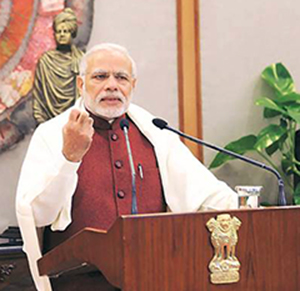
Asserting that BJP has made more sacrifices than any other party, Modi, who laid the foundation stone of the new party headquarters here, said fissiparous forces have become more active as the country's strength has grown and it is now more imperative to ensure that the society is strengthened and becomes more harmonious.

Underlining his party's commitment to take everybody along with the motto of 'sabka saath, sabka vikaas', he asked party workers to present to the country and the democratic world an example of how a party "devoted to ideals and devoid of dynasty" functions as the world knows the saffron outfit "not the way it is but based on hearsay".
"BJP will be the only party which has faced adversities since its birth. It faced difficulties at every turn and its every effort was seen in bad light.

"Even during the British times, the Congress party would not have faced so much adversity that we, our dedicated workers have gone through in 50-60 years," he said at the event attended by top BJP leaders including party chief Amit Shah, L K Advani, Rajnath Singh and Arun Jaitley among others.

During the recent West Bengal assembly polls, it was difficult for the BJP candidates to even hire an office in Kolkata as anybody willing to given them space would face trouble, he said in an apparent attack on the ruling Trinamool Congress.

"No party has perhaps made more sacrifices than us (BJP) after freedom," he said, adding that "hundreds of" its workers were killed because they were not associated with the prevalent ideology of those times.

BJP workers do not work for crowd but for organisation as "anybody can collect a crowd by talking about populist issues but what is more important is to stick to ideology", he said.

In a lighter vain, he said election candidates of no other party would have forfeited more deposits than those of BJP as they kept fighting for their ideology irrespective of the results.

Modi used the occasion to congratulate grappler Sakshi Malik for bringing glory to the country by winning a bronze medal in the Rio Olympics.

Comments

SK
 - 
Thursday, 18 Aug 2016

Fekuji, you should thank Nehru for stopping Sardar Patel, for not banning GOONDA RSS organisation ...He was the right man to ban such goons... If that has happened, then India would have been a peaceful country ..... Naren are you reading the news of killing of BJP worker by your own goonda RSS....

Add new comment

  • Coastaldigest.com reserves the right to delete or block any comments.
  • Coastaldigset.com is not responsible for its readers’ comments.
  • Comments that are abusive, incendiary or irrelevant are strictly prohibited.
  • Please use a genuine email ID and provide your name to avoid reject.
Agencies
July 16,2020

New Delhi, Jul 16: A group of 174 Indian nationals, including seven minors, has filed a lawsuit against the recent presidential proclamation on H-1B that would prevent them from entering the United States or a visa would not be issued to them.

Judge Ketanji Brown Jackson at the US District Court in the District of Columbia issued summonses on Wednesday to Secretary of State Mike Pompeo and acting Secretary of Homeland Security Chad F Wolf, along with Labor Secretary Eugene Scalia.

The lawsuit was filed in the US District Court on Tuesday.

"The proclamation 10052's H-1B/H-4 visa ban hurts the United States' economy, separates families and defies the Congress. While the two former points render it unseemly, the latter point renders it unlawful," said the lawsuit filed by lawyer Wasden Banias on behalf of the 174 Indian nationals.

The lawsuit seeks an order declaring the presidential proclamation restriction on issuing new H-1B or H4 visas or admitting new H-1B or H-4 visa holders as unlawful. It also urges the court to compel the Department of State to issue decisions on pending requests for H-1B and H-4 visas.

In his presidential proclamation on June 22, Trump temporarily suspended issuing of H-1B work visas till the end of the year.

"In the administration of our nation's immigration system, we must remain mindful of the impact of foreign workers on the United States labor market, particularly in the current extraordinary environment of high domestic unemployment and depressed demand for labor," said the proclamation issued by Trump.

In his proclamation, Trump said the overall unemployment rate in the United States nearly quadrupled between February and May of 2020 -- producing some of the most extreme unemployment ever recorded by the Bureau of Labor Statistics.

While the May rate of 13.3 per cent reflects a marked decline from April, millions of Americans remain out of work.

The proclamation also extends till year-end his previous executive order that had banned issuance of new green cards of lawful permanent residency. Green Card holders, once admitted pursuant to immigrant visas, are granted "open-market" employment authorisation documents, allowing them immediate eligibility to compete for almost any job in any sector of the economy, Trump said.

Forbes, which first reported the lawsuit filed by the Indian nationals, said the complaint points out that the Congress specified the rules under which H-1B visa holders could work in the US and balanced the interests of US workers and employers.

"The complaint seeks to protect H-1B professionals, including those who have passed the labor certification process and possess approved immigrant petitions. Such individuals are waiting for their priority date to obtain permanent residence, a wait that can take many years for Indian nationals," Forbes reported.

Meanwhile, several lawmakers urged Scalia on Tuesday to reverse the work visa ban.

"Throughout this administration, the president has continued to lament the alleged abuses of the immigration system while failing to address the systemic problems that have persisted and allowed businesses and employers to exploit and underpay immigrant workers, guest workers and American workers," the lawmakers wrote.

"This misguided attempt by the president to scapegoat immigrants for policy failures during the pandemic not only serves to hurt immigrants, but dismisses the true problem of a broken work visa program that is in desperate need of reform," said the letter, which among others was signed by Congressmen Joaquin Castro, Chair of the Congressional Hispanic Caucus; Bobby Scott, Chair of the Education and Labor Committee; Karen Bass, Chair of the Congressional Black Caucus; Judy Chu, Ra l Grijalva, Vicente Gonzalez, Yvette Clarke and Linda S nchez.

Comments

Add new comment

  • Coastaldigest.com reserves the right to delete or block any comments.
  • Coastaldigset.com is not responsible for its readers’ comments.
  • Comments that are abusive, incendiary or irrelevant are strictly prohibited.
  • Please use a genuine email ID and provide your name to avoid reject.
News Network
March 5,2020

New Delhi, Mar 5: The primary classes of all schools in the national capital will remain closed till March 31 to prevent a possibility of spread of coronavirus, Deputy Chief Minister Manish Sisodia announced on Thursday.

According to Directorate of Education (DoE) officials, while elaborate guidelines have been issued about preventive measures for coronavirus, students of nursery and primary classes are too young to understand the risk, making them more prone to infectious diseases.

Sisodia, who also holds the education portfolio, tweeted, "As a precautionary measure to prevent the possibility of spread of COVID-19 amongst our children, Delhi Government has directed the immediate closure of all primary schools (Govt/ aided/ private/MCD/NDMC) till 31/3/20(sic)."

A senior DoE official said, "Elaborate guidelines have already been issued. However, students of nursery and primary classes are too young to understand the risks associated with COVID-19. Thus they are more prone to infectious diseases and mingle around with classmates more often."

"It will be good if they are trained in the do's and dont's under the care and supervision of their parents at home. However, students of classes other than primary will continue to come to schools or examination centres for writing their examination as per schedule. The teaching, as well as non-teaching staff, will also attend regular school," the official said.

As of now, the number of confirmed COVID-19 cases in the country stands at 30, including 16 Italian tourists. The figure includes the first three cases reported from Kerala last month who have already been discharged following recovery.

Alerted by the coronavirus case reported in Delhi-NCR, schools in the region have sent out advisories to parents suggesting that they do not send their wards to attend classes even in case of mild cough or cold, and saying that they may declare holidays if the need arises. A few schools have announced already holidays and others have advanced their spring break.

Comments

Add new comment

  • Coastaldigest.com reserves the right to delete or block any comments.
  • Coastaldigset.com is not responsible for its readers’ comments.
  • Comments that are abusive, incendiary or irrelevant are strictly prohibited.
  • Please use a genuine email ID and provide your name to avoid reject.
News Network
January 13,2020

Jan 13: For the first time in years, the government of India’s Prime Minister Narendra Modi is playing defense. Protests have sprung up across the country against an amendment to India’s laws — which came into effect on Friday — that makes it easier for members of some religions to become citizens of India. The government claims this is simply an attempt to protect religious minorities in the Muslim-majority countries that border India; but protesters see it as the first step toward a formal repudiation of India’s constitutionally guaranteed secularism — and one that must be resisted.

Modi was re-elected prime minister last year with an enhanced majority; his hold over the country’s politics is absolute. The formal opposition is weak, discredited and disorganized. Yet, somehow, the anti-Citizenship Act protests have taken hold. No political party is behind them; they are generally arranged by student unions, neighborhood associations and the like.

Yet this aspect of their character is precisely what will worry Modi and his right-hand man, Home Minister Amit Shah. They know how to mock and delegitimize opposition parties with ruthless efficiency. Yet creating a narrative that paints large, flag-waving crowds as traitors is not quite that easy.

For that is how these protests look: large groups of young people, many carrying witty signs and the national flag. They meet and read the preamble to India’s Constitution, into which the promise of secularism was written in the 1970’s.

They carry photographs of the Constitution’s drafter, the Columbia University-trained economist and lawyer B. R. Ambedkar. These are not the mobs the government wanted. They hoped for angry Muslims rampaging through the streets of India’s cities, whom they could point to and say: “See? We must protect you from them.” But, in spite of sometimes brutal repression, the protests have largely been nonviolent.

One, in Shaheen Bagh in a Muslim-dominated sector of New Delhi, began simply as a set of local women in a square, armed with hot tea and blankets against the chill Delhi winter. It has now become the focal point of a very different sort of resistance than what the government expected. Nothing could cure the delusions of India’s Hindu middle class, trained to see India’s Muslims as dangerous threats, as effectively as a group of otherwise clearly apolitical women sipping sweet tea and sharing their fears and food with anyone who will listen.

Modi was re-elected less than a year ago; what could have changed in India since then? Not much, I suspect, in most places that voted for him and his party — particularly the vast rural hinterland of northern India. But urban India was also possibly never quite as content as electoral results suggested. India’s growth dipped below 5% in recent quarters; demand has crashed, and uncertainty about the future is widespread. Worse, the government’s response to the protests was clearly ill-judged. University campuses were attacked, in one case by the police and later by masked men almost certainly connected to the ruling party.

Protesters were harassed and detained with little cause. The courts seemed uninterested. And, slowly, anger began to grow on social media — not just on Twitter, but also on Instagram, previously the preserve of pretty bowls of salad. Instagram is the one social medium over which Modi’s party does not have a stranglehold; and it is where these protests, with their photogenic signs and flags, have found a natural home. As a result, people across urban India who would never previously have gone to a demonstration or a political rally have been slowly politicized.

India is, in fact, becoming more like a normal democracy. “Normal,” that is, for the 2020’s. Liberal democracies across the world are politically divided, often between more liberal urban centers and coasts, and angrier, “left-behind” hinterlands. Modi’s political secret was that he was that rare populist who could unite both the hopeful cities and the resentful countryside. Yet this once magic formula seems to have become ineffective. Five of India’s six largest cities are not ruled by Modi’s Bharatiya Janata Party in any case — the financial hub of Mumbai changed hands recently. The BJP has set its sights on winning state elections in Delhi in a few weeks. Which way the capital’s voters will go is uncertain. But that itself is revealing — last year, Modi swept all seven parliamentary seats in Delhi.

In the end, the Citizenship Amendment Act is now law, the BJP might manage to win Delhi, and the protests might die down as the days get unmanageably hot and state repression increases. But urban India has put Modi on notice. His days of being India’s unifier are over: From now on, like all the other populists, he will have to keep one eye on the streets of his country’s cities.

Comments

Add new comment

  • Coastaldigest.com reserves the right to delete or block any comments.
  • Coastaldigset.com is not responsible for its readers’ comments.
  • Comments that are abusive, incendiary or irrelevant are strictly prohibited.
  • Please use a genuine email ID and provide your name to avoid reject.