


BJP faced more adversities in independent India than Cong under British: Modi

August 18, 2016

New Delhi, Aug 18: BJP has faced more adversities in independent India as compared to what Congress would have during the British rule, Prime Minister Narendra Modi said today and lamented that every effort of his party was seen in "bad light".modi-7
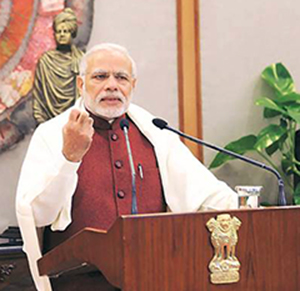
Asserting that BJP has made more sacrifices than any other party, Modi, who laid the foundation stone of the new party headquarters here, said fissiparous forces have become more active as the country's strength has grown and it is now more imperative to ensure that the society is strengthened and becomes more harmonious.

Underlining his party's commitment to take everybody along with the motto of 'sabka saath, sabka vikaas', he asked party workers to present to the country and the democratic world an example of how a party "devoted to ideals and devoid of dynasty" functions as the world knows the saffron outfit "not the way it is but based on hearsay".
"BJP will be the only party which has faced adversities since its birth. It faced difficulties at every turn and its every effort was seen in bad light.

"Even during the British times, the Congress party would not have faced so much adversity that we, our dedicated workers have gone through in 50-60 years," he said at the event attended by top BJP leaders including party chief Amit Shah, L K Advani, Rajnath Singh and Arun Jaitley among others.

During the recent West Bengal assembly polls, it was difficult for the BJP candidates to even hire an office in Kolkata as anybody willing to given them space would face trouble, he said in an apparent attack on the ruling Trinamool Congress.

"No party has perhaps made more sacrifices than us (BJP) after freedom," he said, adding that "hundreds of" its workers were killed because they were not associated with the prevalent ideology of those times.

BJP workers do not work for crowd but for organisation as "anybody can collect a crowd by talking about populist issues but what is more important is to stick to ideology", he said.

In a lighter vain, he said election candidates of no other party would have forfeited more deposits than those of BJP as they kept fighting for their ideology irrespective of the results.

Modi used the occasion to congratulate grappler Sakshi Malik for bringing glory to the country by winning a bronze medal in the Rio Olympics.

Comments

SK
 - 
Thursday, 18 Aug 2016

Fekuji, you should thank Nehru for stopping Sardar Patel, for not banning GOONDA RSS organisation ...He was the right man to ban such goons... If that has happened, then India would have been a peaceful country ..... Naren are you reading the news of killing of BJP worker by your own goonda RSS....

Add new comment

  • Coastaldigest.com reserves the right to delete or block any comments.
  • Coastaldigset.com is not responsible for its readers’ comments.
  • Comments that are abusive, incendiary or irrelevant are strictly prohibited.
  • Please use a genuine email ID and provide your name to avoid reject.
News Network
January 27,2020

Jan 27: The Andhra Pradesh Cabinet passed a resolution on Monday setting in motion the process for abolishing the state Legislative Council.

A similar resolution will now be adopted in the Legislative Assembly and sent to the Centre for necessary follow-up action.

With just nine members, the ruling YSR Congress is in minority in the 58-member Legislative Council. The opposition Telugu Desam Party (TDP) has an upper hand with 28 members and the ruling party could get a majority in the House only in 2021 when a number of opposition members will retire at the end of their six-year term.

The move by the Andhra Pradesh cabinet came after the Y S Jaganmohan Reddy government last week failed to pass in the Upper House of the state legislature two crucial Bills related to its plan of having three capitals for the state.

Andhra Pradesh Legislative Council Chairman M A Sharrif on January 22 referred to a select committee the two bills -- AP Decentralisation and Inclusive Development of All Regions Bill, 2020, and the AP Capital Region Development Authority (CRDA) Act (Repeal) Bill -- for deeper examination.

The chairman had said that he was using his discretionary powers under Rule 154 while referring the Bills to the select panel in line with the demand of the TDP.

Following this, the chief minister had told the Assembly, "We need to seriously think whether we need to have such a House which appears to be functioning with only political motives. It is not mandatory to have the Council, which is our own creation, and it is only for our convenience."

"So let us discuss the issue further on Monday and take a decision on whether or not to continue the Council," he had said.

In fact, the YSRC had on December 17 first threatened to abolish the Council when it became clear that the TDP was bent on blocking two Bills related to creation of a separate Commission for SCs and conversion of all government schools into English medium.

As the Legislature was adjourned sine dine on December 17, no further action was taken. But last week, the issue cropped up again as the TDP remained firm on its stand on opposing the three-capitals plan.

The YSRC managed to get two TDP members to its side, but the government failed to get the three capitals Bills passed in the Council.

"What will be the meaning of governance if the House of Elders does not allow good decisions to be taken in the interest of people and block enactment of laws? We need to seriously think about it… Whether we should have such a House or do away with it," the chief minister had said in the Assembly.

Comments

Add new comment

  • Coastaldigest.com reserves the right to delete or block any comments.
  • Coastaldigset.com is not responsible for its readers’ comments.
  • Comments that are abusive, incendiary or irrelevant are strictly prohibited.
  • Please use a genuine email ID and provide your name to avoid reject.
News Network
January 31,2020

New Delhi, Jan 31: Chief Economic Adviser K V Subramanian on Friday said India's GDP is expected to grow at 6-6.5 per cent next fiscal as the economic slowdown has bottomed out.

As per the first advance estimates released by the National Statistical Organisation (NSO), the country's economic growth is likely to hit an 11-year low of 5 per cent in the current fiscal ending March 2020.

The Economic Survey 2019-20, prepared by a team lead by Subramanian, has projected the GDP to expand in the range of 6-6.5 per cent during 2020-21.

The Indian economy has hit the bottom and it will see an uptick from here, he said in a media briefing post the Economic Survey.

Amidst a weak environment for global manufacturing, trade and demand, the Indian economy slowed down with GDP growth moderating to 4.8 per cent in the first half of 2019-20, lower than 6.2 per cent in H2 of 2018-19.

Based on NSO's first advance estimates of GDP growth for 2019-20 at 5 per cent, an uptick in GDP growth is expected in the second half of the fiscal, it said.

According to it, the uptick in second half of 2019-20 would be mainly due to ten positive factors like picking up of Nifty India Consumption Index for the first time this year, an upbeat secondary market, higher FDI flows, build-up of demand pressure, positive outlook for rural consumption, rebound of industrial activity, steady improvement in manufacturing, growth in merchandise exports, higher build-up of foreign exchange reserves and positive growth rate of GST revenue collection.

The survey also emphasised that merger of public sector banks may increase the financial strength of the merged entities, lower the risk aversion and result in lowering of lending rates.

Further, as the implementation of GST further settles down, the increased unification of the domestic market may reduce business costs and facilitate fresh investment.

Reforms in land and labour market may further reduce business costs, said the survey, presented a day before Sitharaman's Union Budget 2020-21.

Comments

Add new comment

  • Coastaldigest.com reserves the right to delete or block any comments.
  • Coastaldigset.com is not responsible for its readers’ comments.
  • Comments that are abusive, incendiary or irrelevant are strictly prohibited.
  • Please use a genuine email ID and provide your name to avoid reject.
News Network
March 27,2020

Mumbai, Mar 27: The Reserve Bank of India (RBI) on Friday lowered the key repo rate by 75 basis points to 4.4 per cent in a bid to arrest the economic slowdown amid coronavirus (COVID-19) outbreak.
The reverse repo rate now stands at 4 per cent, down by 90 basis points, said RBI Governor Shaktikanta Das adding this has been done to make it unattractive for banks to passively deposit funds with the central bank and instead lend it to the productive sectors.
The six-member monetary policy committee (MPC) met on March 24, 25 and 27 and voted 4:2 in favour of the repo rate reduction. The MPC also decided to continue with the accommodative stance as long as it is necessary to revive growth and mitigate the impact of COVID-19 on the economy while ensuring that inflation remains within the target.
"The need of the hour is to shield the economy from the pandemic," said Das. "We need to mitigate the impact of coronavirus, revive economic growth and provide financial stability."
Repo rate is the rate at which a country's central bank lends money to commercial banks, and the reverse repo rate is the rate at which it borrows from them.
The RBI Governor further said that the economic growth and inflation projection will be highly contingent depending on the duration, spread and intensity of the pandemic.
"Global economic activity has come to a near standstill as COVID-19 related lockdowns and social distancing are imposed across a widening swathe of affected countries. Expectations of a shallow recovery in 2020 from 2019's decade low in global growth have been dashed," said Das.
"The outlook is now heavily contingent upon the intensity, spread and duration of the pandemic. There is a rising probability that large parts of the global economy will slip into recession," he said.
However, the RBI has injected liquidity of Rs 2.8 lakh crore via various instruments equal to 1.4 per cent of GDP. "Along with today's measures, liquidity measures equal to 3.2 per cent of GDP. The RBI will take continuous measures to ensure liquidity in the system."
The RBI governor has said that all banking institutions can offer a three-month moratorium on all loans for a period of three months. The RBI has also allowed banks to restructure the working capital cycle for companies without worrying that these will have to be classified as a non-performing asset (NPA).
The three-month moratorium will permit banks to avoid a large onset of NPAs during the 21-day lockdown and keep their books healthy.
Das said banks and other financial institutions should do all they can to keep credit flowing to economic agents facing financial stress on account of the isolation that the virus has imposed.
"Market participants should work with regulators like the RBI and the Securities and Exchange Board of India (SEBI) to ensure the orderly functioning of markets in their role of price discovery and financial intermediation," he said.

Comments

Add new comment

  • Coastaldigest.com reserves the right to delete or block any comments.
  • Coastaldigset.com is not responsible for its readers’ comments.
  • Comments that are abusive, incendiary or irrelevant are strictly prohibited.
  • Please use a genuine email ID and provide your name to avoid reject.