BJP leader arrested after 200 cows starve to death at his gaushala in Durg

News Network
August 19, 2017

Durg, Aug 19: A government cattle shelter turned into a death trap for cows in Chhattisgarh. In yet another incident of neglect in cow shelters, allegedly over 200 cows died of starvation at a government-aided gaushala in Rajpur's Durg district.

The shocking incident has revealed blatant cruelty where the cows were left to starve with no fodder and water for 48 hours.

All fingers are pointing towards BJP leader Harish Verma, the moderator of this cow farm. Rajpur residents and state officials blame Verma for the deaths of the cows.

Accused of serious carelessness, Verma has now been arrested. Verma, who holds the post of vice-president in Jamul Municipality, has been booked under sections 4 and 6 of Chhattisgarh Agricultural Cattle Preservation Act 2004, under section 11 of Prevention of Cruelty to Animals Act 1960 and section 409 (criminal breach of trust) of the IPC, the IG said.

The leader has however, dusted off all allegations and claimed otherwise.

Speculations are rife that the cows were burried in many trenches in a bid to cover up the the severe incident of neglect.

Residents say they found trenches with 10 to 15 cows buried in each of them.

Rajpur's Sarpanch Pati Sevaram Sahu alleged that he found many trenches were being dug to bury the dead cows lying around, which made them suspicious.

Outrage however against the BJP leader hasn't yet cooled down with Opposition alleging that the shelters are facing neglect and the money to be spent on fodder being siphoned off.

Comments

khasai Khane
 - 
Sunday, 20 Aug 2017

60 Children died - No Probe, No arrests.

200 Cows die - Immediate arrest. 


A converted muslim girl marries  - NIA probe!

Truly, this country will not prosper!


Add new comment

  • Coastaldigest.com reserves the right to delete or block any comments.
  • Coastaldigset.com is not responsible for its readers’ comments.
  • Comments that are abusive, incendiary or irrelevant are strictly prohibited.
  • Please use a genuine email ID and provide your name to avoid reject.
coastaldigest.com web desk
August 1,2020

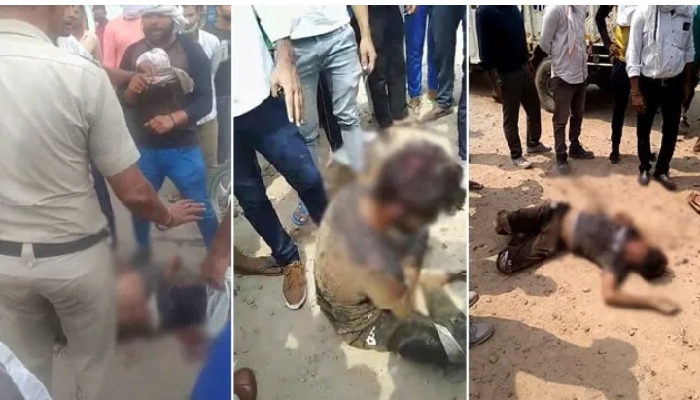
New Delhi, July 1: In a terrific incident with chilling echoes of the 2015 Dadri mob lynching, a Muslim man, who was carrying meat, was savagely attacked by a mob belonging to a saffron outfit in the presence of in BJP ruled Haryana on the eve of Eid al-Adha. 

The incident occurred at around 9 a.m. on Friday, July 31 at Badshahpur village in Haryana’s Gurgaon, when Lukman was transporting meat in a pic-kup truck. 

The attack was captured on mobile phones by onlookers and the video clips of the incident are now spreading on social media. 

A group of saffronite cow vigilantes chased the truck for about 8 km managed waylay it. Lukman, who was driving the truck was pulled out and brutally assaulted on the suspicion that he was transporting cow meat.

Just like Dadri, the police were faster at sending the meat to a lab for testing than catching any one of the suspects. One of the assailants - Pradeep Yadav- has been arrested. 

After being beating to an inch of his life, Lukman was bundled into the pick-up truck and taken back to Gurgaon's Badshahpur village where the goons started thrashing him again.

This is when the police stepped in and stopped them - only to find the assailants fearless enough to even take on them.

Lukman was taken to a hospital and the police filed a case against "unidentified individuals" even though the video of the incident recorded by witnesses shows the faces of the assailants.

The owner of the vehicles said that the meat was buffalo and he has been in the business for 50 years.

The police have so far refused to give a statement on record on the incident and explain their inaction as seen on video.

Comments

Add new comment

  • Coastaldigest.com reserves the right to delete or block any comments.
  • Coastaldigset.com is not responsible for its readers’ comments.
  • Comments that are abusive, incendiary or irrelevant are strictly prohibited.
  • Please use a genuine email ID and provide your name to avoid reject.
News Network
January 13,2020

Jan 13: For the first time in years, the government of India’s Prime Minister Narendra Modi is playing defense. Protests have sprung up across the country against an amendment to India’s laws — which came into effect on Friday — that makes it easier for members of some religions to become citizens of India. The government claims this is simply an attempt to protect religious minorities in the Muslim-majority countries that border India; but protesters see it as the first step toward a formal repudiation of India’s constitutionally guaranteed secularism — and one that must be resisted.

Modi was re-elected prime minister last year with an enhanced majority; his hold over the country’s politics is absolute. The formal opposition is weak, discredited and disorganized. Yet, somehow, the anti-Citizenship Act protests have taken hold. No political party is behind them; they are generally arranged by student unions, neighborhood associations and the like.

Yet this aspect of their character is precisely what will worry Modi and his right-hand man, Home Minister Amit Shah. They know how to mock and delegitimize opposition parties with ruthless efficiency. Yet creating a narrative that paints large, flag-waving crowds as traitors is not quite that easy.

For that is how these protests look: large groups of young people, many carrying witty signs and the national flag. They meet and read the preamble to India’s Constitution, into which the promise of secularism was written in the 1970’s.

They carry photographs of the Constitution’s drafter, the Columbia University-trained economist and lawyer B. R. Ambedkar. These are not the mobs the government wanted. They hoped for angry Muslims rampaging through the streets of India’s cities, whom they could point to and say: “See? We must protect you from them.” But, in spite of sometimes brutal repression, the protests have largely been nonviolent.

One, in Shaheen Bagh in a Muslim-dominated sector of New Delhi, began simply as a set of local women in a square, armed with hot tea and blankets against the chill Delhi winter. It has now become the focal point of a very different sort of resistance than what the government expected. Nothing could cure the delusions of India’s Hindu middle class, trained to see India’s Muslims as dangerous threats, as effectively as a group of otherwise clearly apolitical women sipping sweet tea and sharing their fears and food with anyone who will listen.

Modi was re-elected less than a year ago; what could have changed in India since then? Not much, I suspect, in most places that voted for him and his party — particularly the vast rural hinterland of northern India. But urban India was also possibly never quite as content as electoral results suggested. India’s growth dipped below 5% in recent quarters; demand has crashed, and uncertainty about the future is widespread. Worse, the government’s response to the protests was clearly ill-judged. University campuses were attacked, in one case by the police and later by masked men almost certainly connected to the ruling party.

Protesters were harassed and detained with little cause. The courts seemed uninterested. And, slowly, anger began to grow on social media — not just on Twitter, but also on Instagram, previously the preserve of pretty bowls of salad. Instagram is the one social medium over which Modi’s party does not have a stranglehold; and it is where these protests, with their photogenic signs and flags, have found a natural home. As a result, people across urban India who would never previously have gone to a demonstration or a political rally have been slowly politicized.

India is, in fact, becoming more like a normal democracy. “Normal,” that is, for the 2020’s. Liberal democracies across the world are politically divided, often between more liberal urban centers and coasts, and angrier, “left-behind” hinterlands. Modi’s political secret was that he was that rare populist who could unite both the hopeful cities and the resentful countryside. Yet this once magic formula seems to have become ineffective. Five of India’s six largest cities are not ruled by Modi’s Bharatiya Janata Party in any case — the financial hub of Mumbai changed hands recently. The BJP has set its sights on winning state elections in Delhi in a few weeks. Which way the capital’s voters will go is uncertain. But that itself is revealing — last year, Modi swept all seven parliamentary seats in Delhi.

In the end, the Citizenship Amendment Act is now law, the BJP might manage to win Delhi, and the protests might die down as the days get unmanageably hot and state repression increases. But urban India has put Modi on notice. His days of being India’s unifier are over: From now on, like all the other populists, he will have to keep one eye on the streets of his country’s cities.


Comments

Add new comment

  • Coastaldigest.com reserves the right to delete or block any comments.
  • Coastaldigset.com is not responsible for its readers’ comments.
  • Comments that are abusive, incendiary or irrelevant are strictly prohibited.
  • Please use a genuine email ID and provide your name to avoid reject.
News Network
May 6,2020

New Delhi, May 6: Around 39 crore people have received financial assistance of Rs 34,800 crore amid the COVID-19 lockdown under the Pradhan Mantri Garib Kalyan Package (PMGKP) as on May 5, the government said in a statement.

These people received the assistance, which was announced by Union Finance Minister Nirmala Sitharaman on March 26 to protect them from the impact of the lockdown due to COVID 19, via digital payment infrastructure.

The swift implementation of the free food grain and cash payment package under PMGKP is being continuously monitored by Central and state governments. Also, Fintech and digital technology have been employed for swift and efficient transfer to the beneficiary.

As per the data provided by the government, Rs 16,394 crore front-loaded towards payment of the first installment of PM-KISAN was provided to 8.19 crore beneficiaries.

Rs 10,025 crore credited to 20.05 crore (98.33 per cent) women Jan Dhan account holders as first installment and Rs 2,785 crore credited to 5.57 crore women in the second installment.

Further, Rs 1,405 crore was disbursed to about 2.82 crore old age persons, widows and disabled persons and Rs 3,492.57 crore financial support was given to 2.20 crore building and construction workers.

Moreover, foodgrain has been distributed, covering 60.33 crore beneficiaries in all 36 Union Territories and states till April and 12.39 crore beneficiaries by 22 states/UTs for May. Pulses have been distributed so far to 5.21 crore household beneficiaries out of 19.4 crore such beneficiaries.

Over 5 crore cylinders have been booked under the Pradhan Mantri Ujjwala Yojana (PMUY) and 4.82 crore free cylinders already delivered to beneficiaries.

While 9.6 lakh members of Employees' Provident Fund Organisation (EPFO) has taken benefit of online withdrawal of non-refundable advance from EPFO account amounting to Rs 2,985 crore, 24 per cent EPF contribution transferred to 44.97 lakh employees account amounting to Rs 698 crore.

In the current financial year, 5.97 crore person's man-days of work generated under MNREGA scheme and Rs 21,032 crore were released to states to liquidate pending dues of both wage and material.

Insurance scheme for health workers in government hospitals and health care centres has been operationalised by New India Assurance covering 22.12 lakh health workers.

Comments

Add new comment

  • Coastaldigest.com reserves the right to delete or block any comments.
  • Coastaldigset.com is not responsible for its readers’ comments.
  • Comments that are abusive, incendiary or irrelevant are strictly prohibited.
  • Please use a genuine email ID and provide your name to avoid reject.