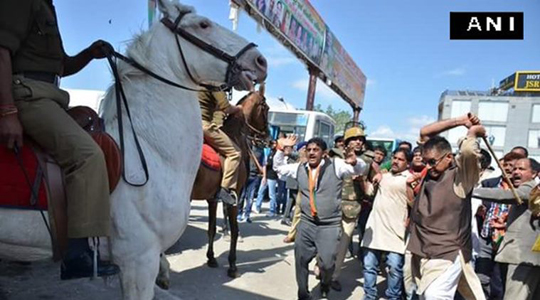
BJP MLA breaks police horse's leg during protest. Animal also anti-national'?

[email protected] (CD Network)
March 14, 2016

Dehradun, Mar 14: In a shocking incident, BJP MLA Ganesh Joshi was on Monday caught on camera beating up a police horse with a lathi' during a protest against state government in Dehradun. The horse was deployed at the venue to control the situation.

horse

Joshi lost his cool and attacked the horse with a lathi' and was followed by other protesters present there. The animal suffered serious injury in his leg and was admitted to the Indian Military Academy's Vetenirary Hospital, Dehradun SSP told news agency ANI.

“Doctors are saying that the horse's leg will have to be amputated. Case will be filed against the BJP MLA,” he added. Joshi, however, said that he was not at fault and that the horse was just thirsty. “As soon as the animal was given water, he was fine,” he said.

Reacting to the incident, Uttarakhand Chief Minister Harish Rawat said, “you are using lathi on a horse? I think the world tolerance in not in the BJP dictionary”.

horse-injured

Comments

Abdullah
 - 
Thursday, 17 Mar 2016

They broken their Pitha's Leg!!!!????
Merciless goons, Terrorists.

Animal rights.
 - 
Wednesday, 16 Mar 2016

A day will come when this horse will do the same to U over & over... it might be wierd but in the court of ALLAH (one who gave this life to this MLA & the horse)... it can take the revenge.

asif
 - 
Tuesday, 15 Mar 2016

what is the use of putting him in jail. he might be there for few days in jail with royal treatment. and once he come out from the jail i am sure he will get good post in party.

IBRAHIM.HUSSAIN
 - 
Tuesday, 15 Mar 2016

When BJP saffron goons cannot spare a animal, how can they spare Muslims. The act of atrocities are in their DNA.

Down Down Ganesh Joshi.

Ahmed Yanbu
 - 
Tuesday, 15 Mar 2016

Poor Horse. Cruel People.. Where is our Madam Menaka Ghandi...Lets see what action she will take on him.

AK
 - 
Tuesday, 15 Mar 2016

These Goons are worst than animal... How come our people who support them doesnot UNDERSTAND their evil acts.

UMMAR
 - 
Tuesday, 15 Mar 2016

PLEASE BREAK MLA,S LEG PLEASE.. ,

IF HE WAS IN FRONT OF MY EYES I WOULD HAVE SLAPPED HIM FOR SURE .. NO HUMANITY.. WHAT TYPE OF MLA HE IS.. KICK OUT OF INDIA.. IF U SEE THE LEG OF HORSE ,,, REALY... PUT HIM IN JAIL.

Aakriti
 - 
Tuesday, 15 Mar 2016

wht the hell! then I think his leg should also be broken with a stick. then he will come to know about the pain

Add new comment

  • Coastaldigest.com reserves the right to delete or block any comments.
  • Coastaldigset.com is not responsible for its readers’ comments.
  • Comments that are abusive, incendiary or irrelevant are strictly prohibited.
  • Please use a genuine email ID and provide your name to avoid reject.
coastaldigest.com news network
February 20,2020

Bengaluru, Feb 20: Leaving the organisers of an event to protest against the CAA, NRC and NRP here red-faced, a young woman on Thursday reportedly raised "Pakistan Zindabad" slogan in the presence of AIMIM chief Asaduddin Owaisi, who denounced her action and asserted "we are for India".

The woman, identified as Amulya, allegedly asked people to shout with her "Pakistan Zindabad" after the organisers of the event under the banner of "Save Constitution" invited her to address the gathering soon after Owaisi came on the stage.

Soon Owaisi rushed to snatch the mike from her hands and was joined by others who tried to remove her from the state.

But the woman was adamant and raised the slogan again repeatedly. Later, the police stepped in and removed her from the dais.

Owaisi then addressed the gathering, saying he did not agree with the woman.

"Neither me nor my party has any link with her. We denounce her. The organisers should not have invited her here. If I knew this, I would not have come here. We are for India and we no way support our enemy nation Pakistan. Our entire drive is to save India," the AIMIM MP said.

JD(S) corporator Imran Pasha claimed she was planted by some rival group to disrupt the event.

The woman, he said, was not in the list of speakers and demanded that the police investigate the matter seriously.

Sources say Amulya hails from Chikkamagaluru and her parents have always been in the forefront of taking on government and its policies for well over a decade. 

As per local TV reports, the student was taken to Upparpet police station, but later shifted to an undisclosed destination for more questioning.

Comments

Add new comment

  • Coastaldigest.com reserves the right to delete or block any comments.
  • Coastaldigset.com is not responsible for its readers’ comments.
  • Comments that are abusive, incendiary or irrelevant are strictly prohibited.
  • Please use a genuine email ID and provide your name to avoid reject.
News Network
April 13,2020

Bengaluru, Apr 13: Karnataka Chief Minister BS Yediyurappa today held a review meeting with his cabinet colleagues and senior officials regarding prevailing coronavirus situation and several other important issues in the state.

Chief Secretary TM Vijay Bhaskar was also present at the meeting. The possible situation once the COVID-19 lockdown is lifted was discussed along with the financial status of the state government and how to mobilise additional resources, sources said.

The Chief Minister also appealed to sugar factory owners to clear the pending payment to the tune of Rs 2834 crore to farmers in 11 districts. He also said that the government has released Rs 45 crore compensation to farmers for loss of paddy crop in Raichur and Koppal District due to hailstorm based on a report submitted by District Collectors.

Amid the lockdown distribution of free milk to the poor will also be continued for one more week, sources added.

The meeting also decided to speed up disposal of cases related to the regularisation of unauthorised constructions which are pending before the High Court and Supreme Court.

In addition to this, the government is planning to auction more than 12,000 corner sites lying idle in Bengaluru. An amendment to the law governing permission to allow sites in private and co-operative housing societies will be made. Hundreds of societies are waiting for approval from the government for releasing the sites, sources said.

It was also decided to utilise Rs 1,000 crore available at Rajiv Gandhi Health University to upgrade medical college hospitals.

Comments

Add new comment

  • Coastaldigest.com reserves the right to delete or block any comments.
  • Coastaldigset.com is not responsible for its readers’ comments.
  • Comments that are abusive, incendiary or irrelevant are strictly prohibited.
  • Please use a genuine email ID and provide your name to avoid reject.
Agencies
May 8,2020

Washington D.C., May 8: The prime time for brain development in a child's life is the first year, where the infant spends most of the time asleep. It is the time when neural connections form and sensory memories are encoded.

However, when sleep is disrupted, as occurs more often among children with autism, brain development may be affected, too.

New research led by the University of Washington finds that sleep problems in a baby's first 12 months may not only precede an autism diagnosis but also may be associated with altered growth trajectory in a key part of the brain, the hippocampus.

The study, which was published in the American Journal of Psychiatry, researchers report that in a sample of more than 400 taken of 6- to 12-month-old infants, those who were later diagnosed with autism were more likely to have had difficulty falling asleep.

It also states that this sleep difficulty was associated with altered growth trajectories in the hippocampus.

"The hippocampus is critical for learning and memory, and changes in the size of the hippocampus have been associated with poor sleep in adults and older children.

As many as 80 per cent of the children with autism spectrum disorder have sleep problems," said Annette Estes, director of the UW Autism Center and senior author of the study.

"In our clinical experience, parents have a lot of concerns about their children's sleep, and in our work on early autism intervention, we observed that sleep problems were holding children and families back," added Estes, who is also a UW professor of speech and hearing sciences.

"It could be that altered sleep is part-and-parcel of autism for some children. One clue is that behavioural interventions to improve sleep don't work for all children with autism, even when their parents are doing everything just right. This suggests that there may be a biological component to sleep problems for some children with autism," said Estes.

To consider links among sleep, brain development, and autism, researchers at the IBIS Network looked at MRI scans of 432 infants, surveyed parents about sleep patterns, and measured cognitive functioning using a standardized assessment.

At the outset of the study, infants were classified according to their risk for developing autism: Those who were at higher risk of developing autism -- about two-thirds of the study sample -- had an older sibling who had already been diagnosed.

Infant siblings of children with autism have a 20 per cent chance of developing autism spectrum disorder -- a much higher risk than children in the general population.

In the current study, 127 of the 432 infants were identified as "low risk" at the time the MRI scans were taken because they had no family history of autism.

They later evaluated all the participants at 24 months of age to determine whether they had developed autism. Of the roughly 300 children originally considered "high familial risk," 71 were diagnosed with autism spectrum disorder at that age.

Problems with sleep were more common among the infants later diagnosed with an autism spectrum disorder, as were larger hippocampi. No other subcortical brain structures were affected, including the amygdala, which is responsible for certain emotions and aspects of memory, or the thalamus, a signal transmitter from the spinal cord to the cerebral cortex.

The authors note that while parents reported more sleep difficulties among infants who developed autism compared to those who did not, the differences were very subtle and only observed when looking at group averages across hundreds of infants.

Sleep patterns in the first years of life change rapidly as infants transition from sleeping around the clock to a more adult-like sleep/wake cycle. Until further research is completed, Estes said, it is not possible to interpret challenges with sleep as an early sign of increased risk for autism.


Comments

Add new comment

  • Coastaldigest.com reserves the right to delete or block any comments.
  • Coastaldigset.com is not responsible for its readers’ comments.
  • Comments that are abusive, incendiary or irrelevant are strictly prohibited.
  • Please use a genuine email ID and provide your name to avoid reject.