


BJP MLA slams beef ban, urges govt not to snatch away the poor's meal

March 12, 2016

Mumbai, Mar 12: The ruling BJP in Maharashtra was left red-faced in the state legislative assembly on Thursday by one of its own MLAs who criticised the government over its beef ban, saying that it was not in the interest of farmers.
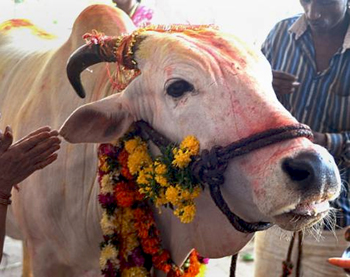
beefban“Why should you snatch away the poor's meal?” asked Bhimrao Dhonde, who represents Beed's Ashti, during a discussion on the state's agrarian crisis.

“In times of drought, feeding productive animals itself is a big challenge for farmers. How can a farmer sustain the additional burden of looking after spent cattle?” asked Dhonde.

The controversial beef ban, which was imposed by the Maharashtra government last March, has been opposed before, but this is perhaps the first time that a ruling party MLA has openly spoken against it.

Dhonde was with the Congress until 2014 when he switched to the BJP that March, just before the Lok Sabha polls. In the assembly polls held subsequently, he defeated former state minister Suresh Dhas of the NCP.

This is Dhonde's second term as an MLA from the Ashti constituency in Beed, which is one of the worst affected by drought.

Dhonde's criticism comes two days after the Centre's Chief Economic Advisor Arvind Subramanian quipped in Mumbai that he would not comment on the state's beef ban as it would cost him his job.

On Tuesday, asked to comment on the economic impact of the ban during an interaction with students at Mumbai University, Subramanian said: “You know that if I answer this question, I will lose my job. But thank you nevertheless for asking this question.”

Comments

Rikaz
 - 
Monday, 14 Mar 2016

It is better for government to impose ban on beef as it is not at all good for health.....Moton is a good meat and healthy...

Dean
 - 
Sunday, 13 Mar 2016

Without distributing the Ambani wealth to poor you cant impose ban on anything. Poor people are suffering because of rich Fadnavi who has easy access to all sort of food. I'm used to mutton now. Even if you allow me to eat beef i wont.

MM ADYAR
 - 
Saturday, 12 Mar 2016

There intention is not to snatch snatch away the meat of export from their leaders.

suleman
 - 
Saturday, 12 Mar 2016

Beef ban increased beef export. Hence, my guess, the farmers must be selling cows to the exporters. It is very clear that the present administration is anti poor. Election in the corner will woke him up now.

suresh
 - 
Saturday, 12 Mar 2016

dear avish, the loan burden and no food make the people to sucide. Do you say that the life of cow is more important than the human being? he can sell the cow if he want he can save his parents and family. If not all them should be opt for sucide. So parents sake and family sake he is ready to sell the other things which is not necessary at that moment. But people like you who think that more educated ( not being a human) think another way. It will be understandable only when your are in same situation

Suresh
 - 
Saturday, 12 Mar 2016

Dear Kumel are you educated? how the cow becomes your mother. Please check your DNA. We have never seen even in any holy books that the human being is born by Cow.

Mohidin
 - 
Saturday, 12 Mar 2016

Another prime example for dirty politics from BJP since Assembly electioons are on the corner, please do not react or comment

true indian
 - 
Saturday, 12 Mar 2016

Mr kumel,Who you are to feed 17 cr people. Who is parasitic?.mind your language.

Farmer
 - 
Saturday, 12 Mar 2016

Any action in this regard to be implemented immediately before beef eater communities are used to alternative diet, most of them now used to mutton and chicken, After that if we want sell we will never find anyone to buy it.

ahmed ali K.
 - 
Saturday, 12 Mar 2016

I think we have to ask all farmers to bring all their spent cattles to Mr. Kumel Chang house. He will look after these mother cows.

Avish Chandra
 - 
Saturday, 12 Mar 2016

I guess he'd be willing to let go of his parents and family as and when they become nonproductive. What a loser!

Priyanka Chinnu
 - 
Saturday, 12 Mar 2016

So parents are cattle? People like you will use any analogy to stick to your stand. Don't impose your ideas on the rural folks. They know exactly what they are doing and what to do with their life, diet, animals, crops etc. India is a non vegetarian country. Get used to it

Kumel Chang
 - 
Saturday, 12 Mar 2016

If we can feed 17 crore parasitic population of jihadis, surely we can feed the holy mother cow

Raju Chacha
 - 
Saturday, 12 Mar 2016

Very well said, I came from an agricultural family too and they have similar practice. I remember Bangalore in the 80's and the menace of cows roaming on the road. Then the IT boom happened and \ban\" we dont see them anymore and they are now sold as beef."

Add new comment

  • Coastaldigest.com reserves the right to delete or block any comments.
  • Coastaldigset.com is not responsible for its readers’ comments.
  • Comments that are abusive, incendiary or irrelevant are strictly prohibited.
  • Please use a genuine email ID and provide your name to avoid reject.
News Network
March 28,2020

Thiruvananthapuram, Mar 28: Kerala Chief Minister Pinarayi Vijayan has sought Prime Minister Narendra Modi's intervention to remove the blocking of roads including state highway along the border of Karnataka in view of lock down to contain the spread of COVID-19.

In a letter sent to the Prime Minister on Friday evening, the Chief Minister said certain actions by the Karnataka Police have resulted in the blocking the Thalassery-Coorg State Highway-30. This road connects Kerala with Coorg in Karnataka via Veerajapettah. This route is a lifeline for flow of essential commodities to Kerala."

"If this is blocked, vehicles carrying essential commodities will have to travel a much longer route to reach our state. Given the situation of national lock down, this will add much more hardship to people," it said.

"You will naturally agree with me that no action impeding the movement of essential commodities should be initiated at this moment of crisis," he hoped.

Comments

Add new comment

  • Coastaldigest.com reserves the right to delete or block any comments.
  • Coastaldigset.com is not responsible for its readers’ comments.
  • Comments that are abusive, incendiary or irrelevant are strictly prohibited.
  • Please use a genuine email ID and provide your name to avoid reject.
News Network
March 28,2020

Bengaluru, Mar 28: Sun Tsu, in 'The Art of War' speaks of a skilful general who can subdue his enemy without any fighting. This constitutes the ultimate triumph which is referred to as stratagem. Today, we would need one such when we are faced with the '21-day corona challenge' for India.
Nearly four weeks back, Dr Jyothsna Rao, Dr Gururaj Rao and I sat across the OPD in the afternoon at HCG Bengaluru discussing our ongoing cancer immunology research. While on this topic, we drifted into the discussion on the coronavirus. During this engaging discussion, we wondered the similarity of the enigma between the virus and cancer. I paused to ask Dr Jyothsna and Dr Guru - how we wish we could do something against this virus.
Dr Jyothsna is a PhD from NCBS and had worked under Dr Ralph Steinman, physician and researcher from Rockefeller University, who won the Nobel Prize for his discovery of the dendritic cell and its role in adaptive immunity in 2011. Dr Gururaj is a molecular and cell biologist who did his PhD at the Chapel Hill, University of North Carolina and is the Director of iCrest.
Jyothsna while hearing our perplexing conversation on the covid intervened, "Yes, surely. I think we should take a break from cancer and focus on the innate and adaptive immunity role in COVID-19."
Thus began this sincere attempt to relook the human immune system from the eyes of the COVID-19.
We have 10 types of immune cells at the least which are widely dispersed in millions across the body. When our body is invaded by a foreign organism (bacteria, fungi or virus), these cells work with each other to destroy the invader.
Now, the question is - how do the immune cells talk to each other? They use small-molecule substances called cytokines (cyto means cells; kine means movement). There are many cytokines that are involved in work on the immune system. The most relevant for viruses are interferons.
Interferons (IFN) as the name reflects have an ability to interfere with the viral activity and stop their multiplication. These specialised signal proteins are released by our cells in response to a viral attack to forewarn other cells. They help build the antiviral proteins within the cells to kill the virus as it tries to invade the new cells.
Historically, interferons are a group of cytokines known to be potent antiviral agents against viruses and a hallmark cytokine induced by the host upon viral infections. Interferons possess unique immunoregulatory activities and are signature cytokines released by (TH1) T immune cells, which are crucial in viral infections.
As the outbreak of COVID-19 grapples us, an urgent need for finding strategies to combat the virus is growing. Coronaviruses (CoVs) are a group of RNA viruses. In patients infected with coronavirus, it was indicated that the activation of the IFN does not occur until 48 hours post-infection. Thus the delayed IFN-related antiviral response by the healthy cells leads to coronavirus evade the immune response.
Numerous studies have presented the success in defeating CoVs by the direct administration of IFNs. In a combination as a concoction, it was shown to synergistically inhibit the virus replication in vitro.
Moreover, it is understood that the earlier induction of IFNs in children although they have a less developed immune system could be the reason behind the children being least affected.
The key to success in reducing the disease fatality might be the stimulation of the immune responses to trigger IFN production at the very early stages of the disease, which might be done through the administration of IFN. Despite the evidence for the efficacy of IFNs in treating CoV-induced infections, the proper dosing and ideal timing for such interventions needs to be verified in clinical trials.
For the later stages of the diseases in advance stages where patients are on ventilator and have developed respiratory distress, we propose to utilise the mesenchymal cells derived from donor bone marrow that have been known to treat acute respiratory syndrome. Mesenchymal cells are known to possess anti-inflammatory activity and thus used often in autoimmune diseases.
With this scientific background, we have activated T cells from healthy donors, in a cGMP facility at iCrest - HCG hospital with an enriched cocktail of cytokines rich in Interferons. Injections of this cocktail we believe will result in a surge of cytokines in the body of the infected person and will boost his ability to fight the virus in the early phases. We are in the initial phases of this study and hope to be ready in the coming weeks with meaningful data on its potential utility.
Currently, it awaits government approvals (Union and state) and we have applied to central drugs authority for their initial evaluation and further directions.
As my Guru often expounded the philosophy of 'Seva' - the goal of education is knowledge, the end goal of knowledge is service. In this attempt to serve our fellow humans at this brink of unprecedented crisis, medical fraternity stands with you and promises to do our best for your safety.
We assure to exhaust every bit of our spirit in this fight against coronavirus. We have lost the sight of shores and travelled thus far, but that is the mandatory first step to cross the ocean. Are we going to succeed in this battle, is something only time will answer. 

Comments

Add new comment

  • Coastaldigest.com reserves the right to delete or block any comments.
  • Coastaldigset.com is not responsible for its readers’ comments.
  • Comments that are abusive, incendiary or irrelevant are strictly prohibited.
  • Please use a genuine email ID and provide your name to avoid reject.
Agencies
April 15,2020

San Diego, Apr 15: Several people lost their sense of smell or taste weeks ago globally and are still waiting for it to come back and now, researchers have identified an association between sensory loss and novel coronavirus 2019 (COVID-19) infection, indicating that loss of smell and taste may be considered as early symptoms of the deadly disease.

Interestingly, the study also found that persons who reported experiencing a sore throat more often tested negative for COVID-19.

The team from University of California-San Diego found high prevalence and unique presentation of certain sensory impairments in patients positive with COVID-19.

Of those who reported a loss of smell and taste, the loss was typically profound, not mild.

"Based on our study, if you have smell and taste loss, you are more than 10 times more likely to have COVID-19 infection than other causes of infection. The most common first sign of a COVID-19 infection remains fever, but fatigue and loss of smell and taste follow as other very common initial symptoms," explained study researcher Carol Yan from UC San Diego.

"We know COVID-19 is an extremely contagious virus. This study supports the need to be aware of smell and taste loss as early signs of COVID-19," Yan added.

For the findings, published in the journal International Forum of Allergy and Rhinology, the research team surveyed 1,480 patients with flu-like symptoms and concerns regarding potential COVID-19 infection who underwent testing at UC San Diego Health from March 3 through March 29, 2020.

Within that total, 102 patients tested positive for the virus and 1,378 tested negatives. The study included responses from 59 COVID-19-positive patients and 203 COVID-19-negative patients.

Encouragingly, the rate of recovery of smell and taste was high and occurred usually within two to four weeks of infection.

"Our study not only showed that the high incidence of smell and taste is specific to COVID-19 infection but we fortunately also found that for the majority of people sensory recovery was generally rapid," said Yan.

"Among the COVID-19 patients with smell loss, more than 70 per cent had reported improvement of smell at the time of the survey and of those who hadn't reported improvement, many had only been diagnosed recently," she added.

Sensory return typically matched the timing of disease recovery.

In an effort to decrease the risk of virus transmission, UC San Diego Health now includes loss of smell and taste as a screening requirement for visitors and staff, as well as a marker for testing patients who may be positive for the virus.

"It is our hope that with these findings other institutions will follow suit and not only list smell and taste loss as a symptom of COVID-19, but use it as a screening measure for the virus across the world," Yan said.

Comments

Add new comment

  • Coastaldigest.com reserves the right to delete or block any comments.
  • Coastaldigset.com is not responsible for its readers’ comments.
  • Comments that are abusive, incendiary or irrelevant are strictly prohibited.
  • Please use a genuine email ID and provide your name to avoid reject.