


BJP to promotes Hindu unity; aims at reaching out to Dalits ahead of polls

March 5, 2016

New Delhi, Mar 5: Reeling from the fallout of the suicide of Dalit scholar Rohith Vemula and blowback from rural India because of two years of successive drought, the BJP has charted out a series of programmes to address these issues.
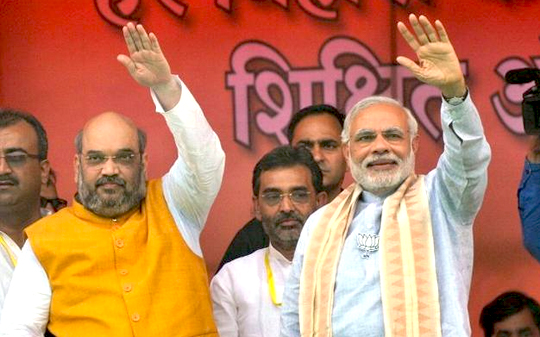
hinduunity

According to top sources in the party, at a meeting of party general secretaries held in Delhi and presided over by BJP president Amit Shah last week, it was decided that a week-long programme, commemorating Constitution framer Dr. Bhimrao Ambedkar be held starting from April 14, his birth anniversary.

“There is a growing feeling that Dalits who had in the General Elections of 2014 voted in large numbers for the BJP are not likely to do so in the Uttar Pradesh elections of 2017, where we are seeing a resurgent Bahujan Samaja Party,” said a general secretary who was present at the meeting.

The programme would be about the RSS' concept of “samajik samarasta” or social harmony that had first been articulated in the 1980s by then sarsanghchalak, Balasaheb Deoras.

A booklet, prepared by the RSS, titled Sabhi Hindu Sahodar Hain (all Hindus are brothers and sisters) will also be distributed.

The booklet praises Dr. Ambedkar, and contains the lectures of the late Deoras and Golwalkar denouncing untouchability.

The second set of programmes will start on May 1, when the party intends to launch a series of seminars on the panchayati raj and how best to deal with the impression (after the agitation against the Land Ordinance) that the party was against farmers.

The Union Budget, and its rural focus will also be selling point at these seminars.

“The Uttar Pradesh polls are looming in 2017, and we need to begin work on the ground to counter all this propaganda against us,” said the general secretary.

Comments

A. Mangalore
 - 
Saturday, 5 Mar 2016

First you give Azaadi for Untouchability.
People are started Azaadi from RSS gangs.
Count your days Mr. Shah, this is not encounter.

mr frank
 - 
Saturday, 5 Mar 2016

You cannot fool people of india,but people can fool same as they done in Delhi and Bihar

rikaz
 - 
Saturday, 5 Mar 2016

BJP, please dont bring disunity amongst Indians....we dont need your teaching.....all are well knowledgeable....try to hoist flag in RSS headquarter...if you really love India...

suresh
 - 
Saturday, 5 Mar 2016

What about Mr. Rohit vemula case. Can u arrest the culprits that is then u talk abt unity. First give the justice to them.

AK
 - 
Saturday, 5 Mar 2016

A old plan implementation to fool the Sleeping hindus... I think we should watch what kanaihya speaks after his release in youtu

Add new comment

  • Coastaldigest.com reserves the right to delete or block any comments.
  • Coastaldigset.com is not responsible for its readers’ comments.
  • Comments that are abusive, incendiary or irrelevant are strictly prohibited.
  • Please use a genuine email ID and provide your name to avoid reject.
News Network
June 20,2020

Bengaluru,  Jun 19: Following the coronavirus outbreak, Bengaluru's Kempegowda International Airport has introduced ultraviolet treatment while scanning outbound baggage apart from other measures to enhance passenger and staff safety.

"Two custom-designed UV tunnels have been created to disinfect trolleys after every use. Two custom-designed UV tunnels have been created to disinfect trolleys after every use. These Tunnels are located at a cordoned-off area of the Terminal," according to a statement by the Bangalore International Airport Limited (BIAL).

The airport plans to use an ultra-low volume (ULV) spray treatment for check-in bags: all outbound passenger baggage is sanitised before dispatch to the aircraft

Authorities also plan to minimise use of additional trays for footwear by introducing specially designed trays; the trays that are in use are UV treated and sanitised manually after every use.

Officials are currently in the process of implementing silver nano-coating for frequently used touchpoints for self disinfection like check-in counters, Immigration counters, ATRS trays, etc. Currently, sanitisation of high-traffic areas and frequently touched surfaces continues to be done every thirty minutes manually without disrupting the flow of passengers.

All high-traffic areas are sanitised once every three hours by using ULV machines - eight times in 24 hours.

Washrooms across the Airport premises are sanitised on a regular basis with dedicated manpower, irrespective of the frequency of use. 456 units of tabletop hand sanitiser and 107 units of sensor-based hand sanitisers have been placed across the Terminal.

120 biowaste bins located across the Airport campus enable passengers and staff to dispose of their masks, gloves and other PPE conveniently and safely. This bio-waste is managed by a dedicated team and handed over to a Pollution Control Board-approved vendor and taken away for incineration.

The Airport said that the passenger feedback for the contactless process has been positive. "The objective of the process is to minimise physical contact and enhance passenger throughput," it said.

These sanitisation measures come in light of the highly infectious COVID-19 pandemic which spreads through person-to-person contact. Small droplets from the nose or mouth can spread the virus when they land on objects and surfaces around the person.

Comments

Add new comment

  • Coastaldigest.com reserves the right to delete or block any comments.
  • Coastaldigset.com is not responsible for its readers’ comments.
  • Comments that are abusive, incendiary or irrelevant are strictly prohibited.
  • Please use a genuine email ID and provide your name to avoid reject.
News Network
February 24,2020

Bengaluru, Feb 24: Census authorities in Karnataka have requested deputy commissioners in the state’s districts to hold outreach and awareness campaigns about the National Population Register (NPR), as they fear misgivings about the exercise could hurt the forthcoming enumeration of population.

The house-listing phase of the Census and updating of NPR will be rolled out simultaneously by mid-April in the BJP-ruled state.

About 1,50,000 enumerators will handle the massive exercise.

Officials believe widespread awareness will help address concerns about the NPR data-gathering process and make people cooperate with enumerators when they visit houses for both NPR and census work.

“Sensing the kind of questions that enumerators may face when they do house visits, in all video conferences with deputy commissioners of districts, we have requested to establish contact with local representatives,” SB Vijay Kumar, director of Census Operations in Karnataka told news agency. “We have asked them to organise outreach programmes to ensure that people’s doubts are resolved before the information gathering work begins,” he added.

Census operations are handled by the Union home ministry. Several district officials are said to have raised concerns about the possibility of people refusing to share information when the work on the census and NPR begins in two months. This would affect the quality of the census work, making the exercise incomplete.

news channel earlier reported that people in parts of Karnataka had declined to share personal information with officials visiting households in connection with government programmes, suspecting them of gathering data for the yet-to-be unveiled National Register of Citizens, following enactment of the Citizenship Amendment Act (CAA) recently.

Kumar said district authorities will train and sensitise enumerators to tread carefully while gathering information. Enumerators will be told not to demand information but seek it gently.

“We will tell enumerators to proactively engage with people. For instance, if an old man in a village does not know his exact date or place of birth, the enumerator may engage in a conversation with the person that may elicit some anecdotes and roughly establish the year and the place of birth,” the census director said.

As of now, the NPR questionnaire has 21queries, but officials say it has not yet been finalised.

With most of the census and NPR data gathering and storage happening digitally this time, the challenge before census officials is to convince people that the data would remain safe.

“Individual data is sealed and all that we can see is collective data. The information is consolidated and tailor-made. We are telling district officials to create awareness about data safety as well,” Kumar said.

Comments

Add new comment

  • Coastaldigest.com reserves the right to delete or block any comments.
  • Coastaldigset.com is not responsible for its readers’ comments.
  • Comments that are abusive, incendiary or irrelevant are strictly prohibited.
  • Please use a genuine email ID and provide your name to avoid reject.
Agencies
January 19,2020

New Delhi, Jan 19: Senior Congress leader Kapil Sibal on Sunday asserted that every state assembly has the constitutional right to pass a resolution and seek the amended Citizenship Act's withdrawal, but if the law is declared constitutional by the Supreme Court then it will be problematic to oppose it.

His remarks came a day after he had said there is no way a state can deny the implementation of the Citizenship Amendment Act (CAA) when it is already passed by the Parliament.

"I believe the CAA is unconstitutional. Every State Assembly has the constitutional right to pass a resolution and seek its withdrawal. When and if the law is declared to be constitutional by the Supreme Court then it will be problematic to oppose it. The fight must go on!" Sibal said in a tweet.

His remarks on the CAA at the Kerala Literature Festival (KLF) on Saturday had caused a flutter as several non-BJP governments, including Kerala, Rajasthan, Madhya Pradesh, West Bengal and Maharashtra, have voiced their disagreement with the CAA as well as National Register of Citizens (NRC) and National Population Register (NPR).

"If the CAA is passed no state can say 'I will not implement it'. It is not possible and is unconstitutional. You can oppose it, you can pass a resolution in the Assembly and ask the central government to withdraw it.

"But constitutionally saying that I won't implement, it is going to be problematic and going to create more difficulties," said the former minister of law and justice.

Comments

Add new comment

  • Coastaldigest.com reserves the right to delete or block any comments.
  • Coastaldigset.com is not responsible for its readers’ comments.
  • Comments that are abusive, incendiary or irrelevant are strictly prohibited.
  • Please use a genuine email ID and provide your name to avoid reject.