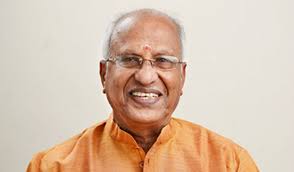
BJP scripts history in Kerala as 86-year-old Rajagopal wins Nemom Seat

[email protected] (CD Network)
May 19, 2016

Thiruvananthapuram, May 19: Scripting a new chapter for the BJP in Kerala, party veteran and former union minister O Rajagopal today won from Nemom constituency here to help the party make its debut in the state assembly.

rajagopalanNemom was one of the segments where the BJP had pinned its hope the most in the present election to open its account in the Assembly.

86-year-old Rajagopal, who had lost by a narrow margin in previous Lok Sabha and Assembly elections, wrested Nemom from sitting MLA and vibrant CPI(M)-LDF leader V Sivankutty defeating him by 8,671 votes

When many of his party colleagues were trailing, Rajagopal, former Union Minister in the A B Vajpayee government, maintained a clear lead since the beginning itself.

The historic victory is a sweet revenge for Rajagopal, as he had lost in the constituency in a photo finish to Sivankutty in the 2011 assembly polls.

Garnering 43,661 votes, he had come second to Sivankutty last time. He had also garnered 50,076 votes in Nemom against Congress's Shashi Tharoor who got 32,639 in the last Lok Sabha elections.

In the last civic polls, of the total 22 wards in Nemom, BJP and LDF got nine seats each and UDF four.

Born on September 15, 1929 to Madhavan Nair and O Kunhikkavu Amma at Pudukkod Panchayath in Palakkad district, he completed Law graduation in Chennai and began practicing law in 1956 at the Palakkad District Court.

In 1980, the Janata Party split and the Bharatiya Janata Party (BJP) was formed and he served as its Kerala president until 1985. He became All India Secretary, General Secretary, and the Vice President of BJP and was elected in 1992 and 1998 to the Rajya Sabha from Madhya Pradesh.

In the year 1999, he became the Minister of State in the Ministry of Law, Justice and Company Affairs and Minister of State in the Ministry of Parliamentary Affairs and then became the Minister of State in the Ministry of Railways between 2000 and 2002.

He later held the positions of Minister of State in the Ministry of Urban Development and Poverty Alleviation, Minister of State in the Ministry of Defence and Minister of State in the Ministry of Parliamentary Affairs.

Having fought several assembly and parliamentary elections from various constituencies in Kerala, Rajagopal had finally managed to win a seat.

Also Read :

After defeat BJP workers turn violent across Kasaragod; CPI MLA attacked

No major surprise in Kasaragod district: Muslim League 2, CPI(M) 2, CPI 1

CPI(M) worker killed in a bomb attack in Kannur amid LDF victory celebrations

Thanks for all the love... It's just a beginning, says Sreesanth after defeat

LDF regains power in Kerala, BJP opens account; CPI(M) focuses on finalising CM

Abdul Razak retains Manjeshwar; BJP loses by 89 votes

No Modi wave in Kasaragod: Muslim League's Nellikkunnu defeats Thantri

Comments

Rikaz
 - 
Thursday, 19 May 2016

Congratulations! Great job!

Ahmed
 - 
Thursday, 19 May 2016

In happy this person may have heart attack thus BJP loose again.

HARRIS
 - 
Thursday, 19 May 2016

FINALLY THIS GREAT POLITICIAN WON HIS LAST BATTLE ...A SALUTE
THIS MOST PROMINENTAND CLEAN POLITICAL PERSONALITY IN BJP, HE IS EDUCATED AND EXPERIANSED NON CONTROVERSIAL POLITICIAN OF DECADES HOPE HE WILL DO HIS BEST ...JAI RAJ GOPAL

\EVERY FAILURE WILL BRING A TASTE OF SUCCESS \""

Kanthappa Chen…
 - 
Thursday, 19 May 2016

This time Modi compared kerala with SOMALIA and fool keralies rewarded him with 1 Seat.
Next time he will compare with BANGALI and same people will reward him with 10 seat.

Jai Somalia Jai ho Somalies.

Add new comment

  • Coastaldigest.com reserves the right to delete or block any comments.
  • Coastaldigset.com is not responsible for its readers’ comments.
  • Comments that are abusive, incendiary or irrelevant are strictly prohibited.
  • Please use a genuine email ID and provide your name to avoid reject.
News Network
May 18,2020

Bengaluru, May 18: A large number of people in India are planning inter-city bus travel within a month of the lifting of travel restrictions, according to a randomised online survey of over 10,300 customers of redBus, India's largest online bus ticketing platform.

Nearly 57 per cent of the respondents are planning to travel within a month post the lockdown. However, there is a high standard of expectation on the implementation of measures to make buses safe for travel with over 79 per cent wanting deep cleaning and sanitisation of buses after every trip.

Hand sanitisers, mandatory masks and temperature screening for all passengers are next in expectations for bus travel. Over 78 per cent of the respondents want the implementation of hygienic conditions at boarding points and 70 per cent want social distancing protocols to be implemented at boarding points.

"The survey does underscore the fact that given the adherence to safety protocols, bus travel is possibly one of the safest options for travel since the number of travellers are fewer, checks can be done individually and the whole factor of pick up and drop as close to home as possible minimises the number of contacts throughout the journey," said redBus Chief Executive Officer Prakash Sangam.

In addition, online booking further reduces the number of contact points as people can book bus tickets directly from their home. Further, there is a heightened awareness of personal hygiene and safety measures which is important for the travel to be safe.

"The large number of people waiting to travel not only points to the need but also the importance it has for the revival of economic activity as very few of them would be travelling for leisure," said Sangam.

The survey also showed that passengers put a very high consideration on hygiene, sanitation and disinfection -- over 73 per cent -- and social distancing (63 per cent) and much lower consideration to traditional factors such as travel cost (22 per cent), comfort (21 per cent) and punctuality (18 per cent).

The survey was conducted among redBus customers across India. Only 5 per cent of the respondents were willing to postpone their travel to over six months while the rest had plans to travel within that period.

Comments

Add new comment

  • Coastaldigest.com reserves the right to delete or block any comments.
  • Coastaldigset.com is not responsible for its readers’ comments.
  • Comments that are abusive, incendiary or irrelevant are strictly prohibited.
  • Please use a genuine email ID and provide your name to avoid reject.
Ram Puniyani
February 10,2020

Noam Chomsky is one of the leading peace workers in the world. In the wake of America’s attack on Vietnam, he brought out his classic formulation, ‘manufacturing consent’. The phrase explains the state manipulating public opinion to have the public approve of it policies—in this case, the attack of the American state on Vietnam, which was then struggling to free itself from French colonial rule.

In India, we are witness to manufactured hate against religious minorities. This hatred serves to enhance polarisation in society, which undermines India’s democracy and Constitution and promotes support for a Hindu nation. Hate is being manufactured through multiple mechanisms. For example, it manifests in violence against religious minorities. Some recent ghastly expressions of this manufactured hate was the massive communal violence witnessed in Mumbai (1992-93), Gujarat (2002), Kandhamal (2008) and Muzaffarnagar (2013). Its other manifestation was in the form of lynching of those accused of having killed a cow or consumed beef. A parallel phenomenon is the brutal flogging, often to death, of Dalits who deal with animal carcasses or leather.

Yet another form of this was seen when Shambhulal Regar, indoctrinated by the propaganda of Hindu nationalists, burned alive Afrazul Khan and shot the video of the heinous act. For his brutality, he was praised by many. Regar was incited into the act by the propaganda around love jihad. Lately, we have the same phenomenon of manufactured hate taking on even more dastardly proportions as youth related to Hindu nationalist organisations have been caught using pistols, while police authorities look on.

Anurag Thakur, a BJP minster in the central government recently incited a crowd in Delhi to complete his chant of what should happen to ‘traitors of the country...” with a “they should be shot”. Just two days later, a youth brought a pistol to the site of a protest at Jamia Millia Islamia university and shouted “take Azaadi!” and fired it. One bullet hit a student of Jamia. This happened on 30 January, the day Nathuram Godse had shot Mahatma Gandhi in 1948. A few days later, another youth fired near the site of protests against the CAA and NRC at Shaheen Bagh. Soon after, he said that in India, “only Hindus will rule”.

What is very obvious is that the shootings by those associated with Hindu nationalist organisations are the culmination of a long campaign of spreading hate against religious minorities in India in general and against Muslims in particular. The present phase is the outcome of a long and sustained hate campaign, the beginning of which lies in nationalism in the name of religion; Muslim nationalism and Hindu nationalism. This sectarian nationalism picked up the communal view of history and the communal historiography which the British introduced in order to pursue their ‘divide and rule’ policy.

In India what became part of “social common sense” was that Muslim kings had destroyed Hindu temples, that Islam was spread by force, and that it is a foreign religion, and so on. Campaigns, such as the one for a temple dedicated to the Hindu god Rama to be built at the site where the Babri masjid once stood, further deepened the idea of a Muslim as a “temple-destroyer”. Aurangzeb, Tipu Sultan and other Muslim kings were tarnished as the ones who spread Islam by force in the subcontinent. The tragic Partition, which was primarily due to British policies, and was well-supported by communal streams also, was entirely attributed to Muslims. The Kashmir conflict, which is the outcome of regional, ethnic and other historical issues, coupled with the American policy of supporting Pakistan’s ambitions of regional hegemony, (which also fostered the birth of Al-Qaeda), was also attributed to the Muslims.

With recurring incidents of communal violence, these falsehoods went on going deeper into the social thinking. Violence itself led to ghettoisation of Muslims and further broke inter-community social bonds. On the one hand, a ghettoised community is cut off from others and on the other hand the victims come to be presented as culprits. The percolation of this hate through word-of-mouth propaganda, media and re-writing of school curricula, had a strong impact on social attitudes towards the minorities.

In the last couple of decades, the process of manufacturing hate has been intensified by the social media platforms which are being cleverly used by the communal forces. Swati Chaturvedi’s book, I Am a Troll: Inside the Secret World of the BJP’s Digital Army, tells us how the BJP used social media to spread hate. Whatapp University became the source of understanding for large sections of society and hate for the ‘Other’, went up by leaps and bounds. To add on to this process, the phenomenon of fake news was shrewdly deployed to intensify divisiveness.

Currently, the Shaheen Bagh movement is a big uniting force for the country; but it is being demonised as a gathering of ‘anti-nationals’. Another BJP leader has said that these protesters will indulge in crimes like rape. This has intensified the prevalent hate.

While there is a general dominance of hate, the likes of Shambhulal Regar and the Jamia shooter do get taken in by the incitement and act out the violence that is constantly hinted at. The deeper issue involved is the prevalence of hate, misconceptions and biases, which have become the part of social thinking.

These misconceptions are undoing the amity between different religious communities which was built during the freedom movement. They are undoing the fraternity which emerged with the process of India as a nation in the making. The processes which brought these communities together broadly drew from Gandhi, Bhagat Singh and Ambedkar. It is these values which need to be rooted again in the society. The communal forces have resorted to false propaganda against the minorities, and that needs to be undone with sincerity.

Combating those foundational misconceptions which create hatred is a massive task which needs to be taken up by the social organisations and political parties which have faith in the Indian Constitution and values of freedom movement. It needs to be done right away as a priority issue in with a focus on cultivating Indian fraternity yet again.


Comments

Add new comment

  • Coastaldigest.com reserves the right to delete or block any comments.
  • Coastaldigset.com is not responsible for its readers’ comments.
  • Comments that are abusive, incendiary or irrelevant are strictly prohibited.
  • Please use a genuine email ID and provide your name to avoid reject.
News Network
March 28,2020

Bengaluru, Mar 28: The Karnataka government on Saturday said that the state run Indira Canteens would provide food packets free of cost to the poor and needy in the wake of the lockdown, the government said here on Saturday.

The canteens would operate in three schedules -from 7:30 AM to 10 AM, 12:30 PM to 3 PM and 7:30 PM to 9 PM, the government said in a public announcement

During the scheduled hours, street side vendors, labourers and poor would be provided food free of cost.

After the cabinet meeting on Friday, Chief Minister B S Yediyurappa had said food packets would be provided to the poor and needy with the help of some organisations through the Canteens and had sought the help of everyone in this regard.

The State-sponsored, subsidised 'Indira Canteens' as of now serves breakfast at Rs five and lunch and dinner at Rs 10.

The government asked people availing the facility to maintain cleanliness at the canteen and staff who serve food to compulsorily use masks and hand gloves.

It also said soaps and sanitizers should be made available at the canteens.

The government also asked people to maintain a minimum distance of one metre while standing in queue and take all precautionary measures.

Earlier, a day after announcing that food would be provided free of cost through the canteens for daily wagers, Yediyurappa on March 24 had said it has been decided that the canteens will not be opened, after realizing that it was leading to crowding, which drew criticism.

Comments

Add new comment

  • Coastaldigest.com reserves the right to delete or block any comments.
  • Coastaldigset.com is not responsible for its readers’ comments.
  • Comments that are abusive, incendiary or irrelevant are strictly prohibited.
  • Please use a genuine email ID and provide your name to avoid reject.