BJP stalwart Sushma Swaraj passes away at 67 after heart attack

News Network
August 6, 2019

New Delhi, Aug 6: Former Union Minister Sushma Swaraj passed away on Tuesday night after suffering a heart attack in New Delhi. She was rushed to the Emergency at the All India Institute of Medical Sciences (AIIMS). Cardio-Pulmonary Resuscitation (CPR) was administered but doctors were unable to revive her, said hospital officials.

Prime Minister Narendra Modi paid rich tributes to Ms. Swaraj, saying: “A glorious chapter in Indian politics comes to an end. India grieves the demise of a remarkable leader who devoted her life to public service and bettering lives of the poor. Sushma Swaraj Ji was one of her kind, who was a source of inspiration for crores of people.”

Ms. Swaraj, 67, had a long career in politics known for her skilled oratory and had been, at 25 years, the youngest-ever Cabinet Minister in the Haryana government led by the late Devi Lal. A lawyer by training, Ms. Swaraj was part of the legal team put together by the Opposition when socialist leader George Fernandes was arrested around the Emergency. Since she and Swaraj Kaushal, who was also involved with the Socialists, were part of the legal team and had to travel to Mumbai together, their law professor and later Chief Justice of India A.S. Anand suggested that they get married, a story later recounted by her with much relish.

While she has been considered a late comer to the BJP, having started out in the socialist ranks, but she held the confidence of top leaders and was chosen by the late Prime Minister Atal Bihari Vajpayee to take on UPA chairperson Sonia Gandhi in Bellary in 1999. While she lost that election, she won hearts, narrowed the victory margin of the Congress and provided a foothold to the BJP in that area.

She was variously Information and Broadcasting, Parliamentary Affairs and Health Minister in the Vajpayee government and also served as Delhi Chief Minister in 1998, a position she lost to Sheila Dikshit who also passed away recently.

Ms. Swaraj and Ms. Gandhi tangled again in 2004, after the UPA came to power with the former threatening to shave her head and live on berries if the latter became Prime Minister. As Leader of the Opposition in the Lok Sabha between 2009 and 14, however, the two did repair their relationship.

The late leader was seen as part of the old guard of the BJP but fit in well as a responsive Minister for External Affairs on social media who nevertheless ceded the limelight to Prime Minister Modi in foreign policy.

Ill health (she had a kidney transplant a couple of years ago) made her opt out of electoral politics, and later also from the new Cabinet formed by Mr. Modi in his second term.

Her death has brought to a close an important chapter in Indian politics.

Comments

Mr Frank
 - 
Thursday, 8 Aug 2019

When some one die if people say good about her or him they are really good people and good in human gesture Sushmaji among one of them.

Add new comment

  • Coastaldigest.com reserves the right to delete or block any comments.
  • Coastaldigset.com is not responsible for its readers’ comments.
  • Comments that are abusive, incendiary or irrelevant are strictly prohibited.
  • Please use a genuine email ID and provide your name to avoid reject.
coastaldigest.com news network
August 8,2020

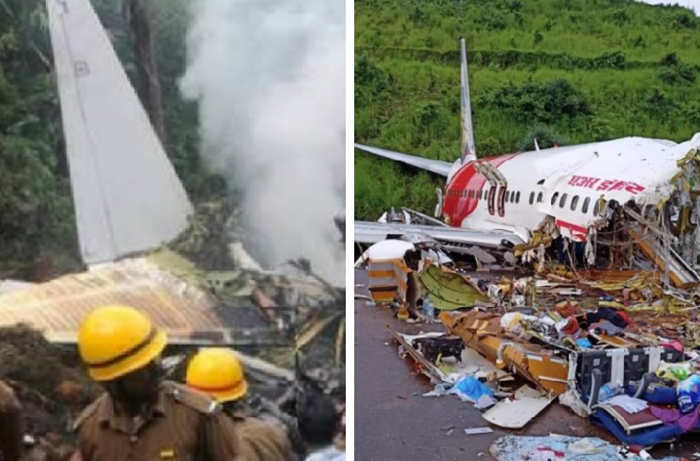
Mangaluru, Aug 8: As visuals of the Air India Express flight crash at Kozhikode international airport emerge, one cannot help but be reminded of an eerily similar and unfortunate accident that occurred a decade ago. The August 7, 2020 tragedy brought back memories of the 2010 crash.

It was on May 22, 2010 that an Air India Express Boeing 737-800 flight from Dubai to Mangaluru over shot the runway while landing at Bajpe airport and fell into a cliff. Of the 160 passengers and 6 crew members on board, 158 were killed (all crew members and 152 passengers) and only 8 survived.

Even back then, the plane had split into two. The crash has been termed as one of India's worst aviation disasters.

The final conversations between Air traffic control (ATC) and the pilot prior to the landing showed no indication of any distress.

Like the Mangaluru accident, Karipur crash too happened when the flight was attempting to land.

The captain of the aircraft which crashed at Mangaluru, Z Glucia, was an experienced pilot with 10,000 hours of flying experience and had 19 landings at the Mangalore airport. Co-pilot S S Ahluwalia, with 3,000 hours of flying experience had as many as 66 landings at this airport. Both the pilot and co-pilot were among the victims.

An investigation into the accident later found that the cause of the accident was the captain’s failure to discontinue an ‘unstabilised approach’ and his persistence to continue with the landing, despite three calls from the First Officer to ‘go-around’.

Comments

Add new comment

  • Coastaldigest.com reserves the right to delete or block any comments.
  • Coastaldigset.com is not responsible for its readers’ comments.
  • Comments that are abusive, incendiary or irrelevant are strictly prohibited.
  • Please use a genuine email ID and provide your name to avoid reject.
News Network
July 28,2020

Hounde, Jul 28: Coronavirus and its restrictions are pushing already hungry communities over the edge, killing an estimated 10,000 more young children a month as meager farms are cut off from markets and villages are isolated from food and medical aid, the United Nations warned Monday.

In the call to action shared with The Associated Press ahead of publication, four UN agencies warned that growing malnutrition would have long-term consequences, transforming individual tragedies into a generational catastrophe.

Hunger is already stalking Haboue Solange Boue, an infant from Burkina Faso who lost half her former body weight of 5.5 pounds (2.5 kilograms) in just a month. Coronavirus restrictions closed the markets, and her family sold fewer vegetables. Her mother was too malnourished to nurse.

“My child,” Danssanin Lanizou whispered, choking back tears as she unwrapped a blanket to reveal her baby's protruding ribs.

More than 550,000 additional children each month are being struck by what is called wasting, according to the UN — malnutrition that manifests in spindly limbs and distended bellies. Over a year, that's up 6.7 million from last year's total of 47 million. Wasting and stunting can permanently damage children physically and mentally.

“The food security effects of the COVID crisis are going to reflect many years from now,” said Dr. Francesco Branca, the WHO head of nutrition. “There is going to be a societal effect.”

From Latin America to South Asia to sub-Saharan Africa, more poor families than ever are staring down a future without enough food.

In April, World Food Program head David Beasley warned that the coronavirus economy would cause global famines “of biblical proportions” this year. There are different stages of what is known as food insecurity; famine is officially declared when, along with other measures, 30% of the population suffers from wasting.

The World Food Program estimated in February that one Venezuelan in three was already going hungry, as inflation rendered salaries nearly worthless and forced millions to flee abroad. Then the virus arrived.

“Every day we receive a malnourished child,” said Dr. Francisco Nieto, who works in a hospital in the border state of Tachira.

In May, Nieto recalled, after two months of quarantine, 18-month-old twins arrived with bodies bloated from malnutrition. The children's mother was jobless and living with her own mother. She told the doctor she fed them only a simple drink made with boiled bananas.

“Not even a cracker? Some chicken?” he asked.

“Nothing,” the children's grandmother responded. By the time the doctor saw them, it was too late: One boy died eight days later.

The leaders of four international agencies — the World Health Organization, UNICEF, the World Food Program and the Food and Agriculture Organization — have called for at least dollar 2.4 billion immediately to address global hunger.

But even more than lack of money, restrictions on movement have prevented families from seeking treatment, said Victor Aguayo, the head of UNICEF's nutrition program.

“By having schools closed, by having primary health care services disrupted, by having nutritional programs dysfunctional, we are also creating harm,” Aguayo said. He cited as an example the near-global suspension of Vitamin A supplements, which are a crucial way to bolster developing immune systems.

In Afghanistan, movement restrictions prevent families from bringing their malnourished children to hospitals for food and aid just when they need it most. The Indira Gandhi hospital in the capital, Kabul, has seen only three or four malnourished children, said specialist Nematullah Amiri. Last year, there were 10 times as many.

Because the children don't come in, there's no way to know for certain the scale of the problem, but a recent study by Johns Hopkins University indicated an additional 13,000 Afghans younger than 5 could die.

Afghanistan is now in a red zone of hunger, with severe childhood malnutrition spiking from 690,000 in January to 780,000 — a 13% increase, according to UNICEF.

In Yemen, restrictions on movement have blocked aid distribution, along with the stalling of salaries and price hikes. The Arab world's poorest country is suffering further from a fall in remittances and a drop in funding from humanitarian agencies.

Yemen is now on the brink of famine, according to the Famine Early Warning Systems Network, which uses surveys, satellite data and weather mapping to pinpoint places most in need.

Some of the worst hunger still occurs in sub-Saharan Africa. In Sudan, 9.6 million people live from one meal to the next — a 65% increase from the same time last year.

Lockdowns across Sudanese provinces, as around the world, have dried up work and incomes for millions. With inflation hitting 136%, prices for basic goods have more than tripled.

“It has never been easy but now we are starving, eating grass, weeds, just plants from the earth,” said Ibrahim Youssef, director of the Kalma camp for internally displaced people in war-ravaged south Darfur.

Adam Haroun, an official in the Krinding camp in west Darfur, recorded nine deaths linked with malnutrition, otherwise a rare occurrence, over the past two months — five newborns and four older adults, he said.

Before the pandemic and lockdown, the Abdullah family ate three meals a day, sometimes with bread, or they'd add butter to porridge. Now they are down to just one meal of “millet porridge” — water mixed with grain. Zakaria Yehia Abdullah, a farmer now at Krinding, said the hunger is showing “in my children's faces.”

“I don't have the basics I need to survive,” said the 67-year-old, who who hasn't worked the fields since April. “That means the 10 people counting on me can't survive either.”


Comments

Add new comment

  • Coastaldigest.com reserves the right to delete or block any comments.
  • Coastaldigset.com is not responsible for its readers’ comments.
  • Comments that are abusive, incendiary or irrelevant are strictly prohibited.
  • Please use a genuine email ID and provide your name to avoid reject.
News Network
June 12,2020

Bengaluru, Jun 12: All the four candidates, including former prime minister H D Deve Gowda (JDS), and senior Congress leader Mallikarjna Kharge, on Friday were declared elected unopposed to the Rajya Sabha from Karnataka.

Karnataka Assembly Secretary sources here said that all the four candidates, who were in the fray for as many berths, were elected after the last date of withdrawal of candidature ended on Friday.

Comments

Add new comment

  • Coastaldigest.com reserves the right to delete or block any comments.
  • Coastaldigset.com is not responsible for its readers’ comments.
  • Comments that are abusive, incendiary or irrelevant are strictly prohibited.
  • Please use a genuine email ID and provide your name to avoid reject.