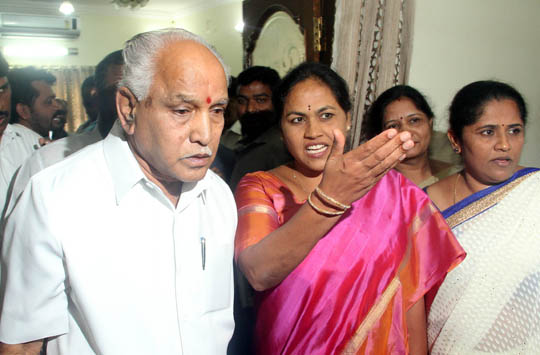
BJP will win 150 seats in next assembly polls; I will be CM: Yeddyurappa

April 10, 2016

Bengaluru, Apr 10: Former Chief Minister B.S. Yeddyurappa on Saturday said that he would be the “next Chief Minister of Karnataka” with the party confident of winning 150 seats in the 2018 Assembly polls.

shobhayeddi

Speaking to media persons at his Dollars Colony residence in Bengaluru, he said it was people of the state who wanted him to head the state.

Mr. Yeddyurappa, who occupied the coveted post of the party chief for the fourth time, refuted the argument that there was delay in his appointment because of internal differences. “The term of previous president Prahlad Joshi ended only ten days ago and it took some time for the party leadership to fill that post,” he added.

People in the state wanted Mr. Yeddyurappa to head the party in the State and “honouring their sentiments”, Prime Minister Narendra Modi and Party's chief Amith Shah had handed over the responsibility of strengthening the party in the State, he said. “I have a responsibility to live up to their expectation,” he added. “They have exonerated all the mistakes committed by me and given a huge responsibility.”

On whether he was inevitable for the party at this juncture, Mr. Yeddyurappa said there were many senior and experienced leaders in the party. “But, Central leadership felt my necessity at the juncture and they thought I can shoulder the responsibility of strengthening the party,” he explained.

On his immediate priority, Mr. Yeddyurappa said it was “freeing Karnataka from Congress.” Mr. Siddaramaiah was working as “dictator” instead of addressing the issues, he said, focusing on expanding his cabinet and filling posts of boards and corporations.

Despite opposition by the senior party leaders including former Chief Minister S.M. Krishna and senior party leader Janardhana Poojary, Mr. Siddaraaiah refused disband Anti Corruption Bureau, he formed overnight.

To free Karnataka from Congress, we will work as a team. “You have seen the response of the central ministers from Karnataka and senior party leaders in the state, who came here. We all join our hands in achieving the goal of bringing party to power in the State,” he explained.

He said that he would officially take charge as the party state head on April 15 and start touring the drought hit areas from 23. After taking stock of the situation, he along with other leaders, chalk out plan of action to fight against the ruling Congress in Karnataka.

Comments

SHAKUR
 - 
Sunday, 10 Apr 2016

VERY NICE DREAM BY YEDDY CHADDI

Fair talker
 - 
Sunday, 10 Apr 2016

Might be good for DK Dist.

Let him be whatever, we from DK Dist have some relation with him.

WellWisher
 - 
Sunday, 10 Apr 2016

Political Couples of new era n seems to be thirukana kanasu.

Now he will rush to neighbouring state to check with astrology about his fate and to perform maata mantra.

Wah re wah all to be spend from tax money.

sahil
 - 
Sunday, 10 Apr 2016

han and i will be a pm.

Abdullah
 - 
Sunday, 10 Apr 2016

He want to loot Karnataka again??!!!!

HARAM
 - 
Sunday, 10 Apr 2016

He needs Same Gava drink which MODI has drunk in SAUDI

Anil Holla
 - 
Sunday, 10 Apr 2016

Day Dreaming...Next C.M .Let him Win first then think about becoming C.M...
Our beloved SHOBAKKA already announced her LOVE as next C.M what an idea sir ji...Once again BJP will entertain us all with their HAGGA JAGGATA..... People of Karnataka Fasten your seat belts Yeddi and group is going to entertain us again...Jai Ho.

Add new comment

  • Coastaldigest.com reserves the right to delete or block any comments.
  • Coastaldigset.com is not responsible for its readers’ comments.
  • Comments that are abusive, incendiary or irrelevant are strictly prohibited.
  • Please use a genuine email ID and provide your name to avoid reject.
News Network
June 1,2020

Bengaluru, June 1: Prime Minister Narendra Modi today praised the Karnataka government for its handling of the COVID-19 pandemic.

Addressing the silver jubilee celebrations of the Rajiv Gandhi University of Health Sciences (RGUHS) via a digital platform, he spoke about the Karnataka government's efforts.

He appreciated the work of front-line warriors who are fighting every day in the war against COVID-19 and stressed the need to respect them.

"Doctors and other medical workers are soldiers without wearing the uniform of soldiers. Any kind of attack or violence against them is not acceptable," said Modi.

"There are incidents of violence against the front-line warriors. Any kind of abuse, violence or rude behaviour is not acceptable. The world is looking at doctors and medical staff with gratitude," he said.

"This is the biggest crisis since the two World Wars," the prime minister said. "Pre- and post-COVID-19, the world will be different. The discussions now at a global level are humanity-centric."

Stressing the importance of medical infrastructure, the prime minister spoke about the decision taken by the Union Government to set up a medical college in every district.

"A nation like ours has to have the medical infrastructure and medical education. Now, every district is going to have a medical college," he said.

However, the PM remained silent on salaries of front-line warriors. The Karnataka government has so far not released the salaries of doctors, nurses and lab technicians hired under National Health Mission.

Comments

Add new comment

  • Coastaldigest.com reserves the right to delete or block any comments.
  • Coastaldigset.com is not responsible for its readers’ comments.
  • Comments that are abusive, incendiary or irrelevant are strictly prohibited.
  • Please use a genuine email ID and provide your name to avoid reject.
coastaldigest.com web desk
February 1,2020

Shivamogga, Feb 1: A three-year-old girl who fell out of a moving vehicle had a miraculous escape in Agumbe Ghat section in Teerthahalli taluk of Shivamogga district of Karnataka.

The incident took place in the early hours of Friday when 12 members from three different families were returning from a tour of Kerala and Tamil Nadu. The girl was reunited with her family after 30 minutes of high drama.

The child, identified as Anavi, is believed to have fallen from the vehicle as it negotiated hairpin bends on the Agumbe Ghat road, 350km from Bengaluru. The child's parents, Binu and Lincy, from NR Pura in Chikkamagaluru district, and other family members reportedly dozed off and did not realize the child had fallen off the vehicle until they covered a distance of about 20km.

One of the family members noticed that child was missing from the seat next to the door. When the driver realized the door latch had given way, they suspected the child could have slipped out of the vehicle.

Then the family started searching along the road and learnt from a forest guard at the Agumbe checkpost that a missing child was found and it had been handed over to Agumbe police station.

An advocate who identified himself as Vinay spotted the girl child as he passed the deserted stretch minutes after the vehicle left and picked her up and handed her over to Agumbe police.

The child sustained minor injuries in the fall. She was provided medical treatment before she was handed over to the parents.

Sources said it wasn't known how the vehicle door opened. One theory is that the girl could have accidentally unlocked the door while clutching the latch in the bumpy ride on the ghat. Police did not file any complaint.

Similar incident

This incident is almost a rerun of a Kerala incident in which a one-year-old baby fell off a moving jeep and was reunited with its mother hours later in September 2019 in Idukki district.

The baby had slipped off the mother's arms while she dozed off in the vehicle. CCTV footage showed the baby, after falling on the road, crawling towards a lit-up area close by, which turned out to be a forest checkpost. Family realised child was missing after 20km.

Comments

Add new comment

  • Coastaldigest.com reserves the right to delete or block any comments.
  • Coastaldigset.com is not responsible for its readers’ comments.
  • Comments that are abusive, incendiary or irrelevant are strictly prohibited.
  • Please use a genuine email ID and provide your name to avoid reject.
Ram Puniyani
January 14,2020

In the beginning of January 2020 two very disturbing events were reported from Pakistan. One was the attack on Nankana Sahib, the holy shrine where Sant Guru Nanak was born. While one report said that the place has been desecrated, the other stated that it was a fight between two Muslim groups. Prime Minister of Pakistan Imran Khan condemned the incident and the main accused Imran Chisti was arrested. The matter related to abduction and conversion of a Sikh girl Jagjit Kaur, daughter of Pathi (One who reads Holy Guru Granth Sahib in Gurudwara) of the Gurudwara. In another incident one Sikh youth Ravinder Singh, who was out on shopping for his marriage, was shot dead in Peshawar.

While these condemnable attacks took place on the Sikh minority in Pakistan, BJP was quick enough to jump to state that it is events like this which justify the Citizenship Amendment Act (CAA). Incidentally CAA is the Act which is discriminatory and relates to citizenship with Religion, which is not as per the norms of Indian constitution. There are constant debates and propaganda that population of Hindus has come down drastically in Pakistan and Bangla Desh. Amit Shah, the Home minister stated that in Pakistan the population of Hindus has come down from 23% at the time of partition to 3.7% at present. And in Bangla Desh it has come down from 22% to present 8%.

While not denying the fact that the religious minorities are getting a rough deal in both these countries, the figures which are presented are totally off the mark. These figures don’t take into consideration the painful migrations, which took place at the time of partition and formation of Bangla Desh later. Pakistan census figures tell a different tale. Their first census was held in 1951. As per this census the overall percentage of Non Muslim in Pakistan (East and West together) was 14.2%, of this in West Pakistan (Now Pakistan) it was 3.44 and in Eat Pakistan it was 23.2. In the census held in Pakistan 1998 it became 3.72%. As far as Bangla Desh is concerned the share of Non Muslims has gone down from 23.2 (1951) to 9.6% in 2011.

The largest minority of Pakistan is Ahmadis, (https://minorityrights.org/country/pakistan/) who are close to 4 Million and are not recognised as Muslims in Pakistan. In Bangla Desh the major migrations of Hindus from Bangla Desh took place in the backdrop of Pakistan army’s atrocities in the then East Pakistan.

As far as UN data on refugees in India it went up by 17% between 2016-2019 and largest numbers were from Tibet and Sri Lanka.  (https://www.un.org/en/development/desa/population/migration/publication…)

The state of minorities is in a way the index of strength of democracy. Most South Asian Countries have not been able to sustain democratic values properly. In Pakistan, the Republic began with Jinnah’s classic speech where secularism was to be central credo of Pakistan. This 11th August speech was in a way what the state policy should be, as per which people of all faiths are free to practice their religion. Soon enough the logic of ‘Two Nation theory” and formation of Pakistan, a separate state for Muslim took over. Army stepped in and dictatorship was to reign there intermittently. Democratic elements were suppressed and the worst came when Zia Ul Haq Islamized the state in collusion with Maulanas. The army was already a strong presence in Pakistan. The popular formulation for Pakistan was that it is ruled by three A’s, Army, America and Allah (Mullah).

Bangla Desh had a different trajectory. Its very formation was a nail in the coffin of ‘two nation theory’; that religion can be the basis of a state. Bangla Desh did begin as a secular republic but communal forces and secular forces kept struggling for their dominance and in 1988 it also became Islamic republic. At another level Myanmar, in the grip of military dictatorship, with democratic elements trying to retain their presence is also seeing a hard battle. Democracy or not, the army and Sanghas (Buddhist Sang has) are strong, in Myanmar as well. The most visible result is persecution of Rohingya Muslims.

Similar phenomenon is dominating in Sri Lanka also where Budhhist Sanghas and army have strong say in the political affairs, irrespective of which Government is ruling. Muslim and Christian minorities are a big victim there, while Tamils (Hindus, Christians etc.) suffered the biggest damage as ethnic and religious minorities. India had the best prospect of democracy, pluralism and secularism flourishing here. The secular constitution, the outcome of India’s freedom struggle, the leadership of Gandhi and Nehru did ensure the rooting of democracy and secularism in a strong way.

India so far had best democratic credentials amongst all the south Asian countries. Despite that though the population of minorities rose mainly due to poverty and illiteracy, their overall marginalisation was order of the day, it went on worsening with the rise of communal forces, with communal forces resorting to identity issues, and indulging in propaganda against minorities.

While other South Asian countries should had followed India to focus more on infrastructure and political culture of liberalism, today India is following the footsteps of Pakistan. The retrograde march of India is most visible in the issues which have dominated the political space during last few years. Issues like Ram Temple, Ghar Wapasi, Love Jihad, Beef-Cow are now finding their peak in CAA.

India’s reversal towards a polity with religion’s identity dominating the political scene was nicely presented by the late Pakistani poetess Fahmida Riaz in her poem, Tum bhi Hum Jaise Nikle (You also turned out to be like us). While trying to resist communal forces has been an arduous task, it is becoming more difficult by the day. This phenomenon has been variously called, Fundamentalism, Communalism or religious nationalism among others. Surely it has nothing to do with the religion as practiced by the great Saint and Sufi traditions of India; it resorts mainly to political mobilization by using religion as a tool.


Comments

Ashi
 - 
Tuesday, 14 Jan 2020

If Malaysia implement similar NRC/CAA, India and China are the loser.

Add new comment

  • Coastaldigest.com reserves the right to delete or block any comments.
  • Coastaldigset.com is not responsible for its readers’ comments.
  • Comments that are abusive, incendiary or irrelevant are strictly prohibited.
  • Please use a genuine email ID and provide your name to avoid reject.