BJP's Tiranga Yatra turns into anti-Opposition campaign in Mangaluru

[email protected] (CD Network | Suresh)
August 21, 2016

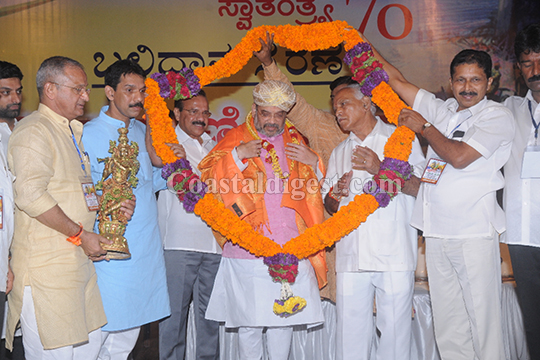
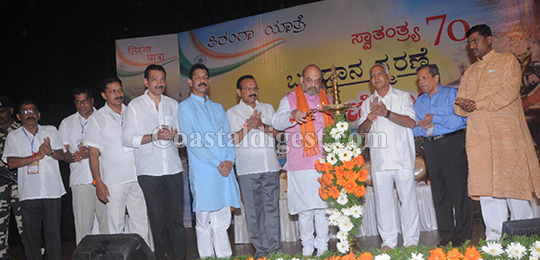
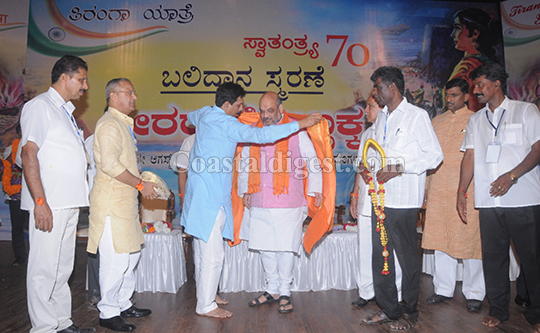
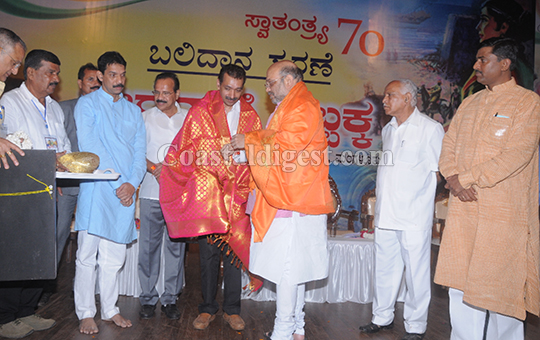
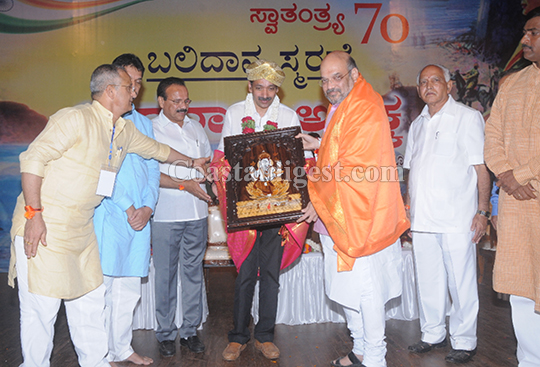
Mangaluru, Aug 21: The national president and other senior leaders of Bharatiya Janata Party, who were in the city to participate in Tiranga Yatra, tried to give a new definition to “nationalism” by depicting those who raise voice against union government as anti-nationals.

amittt 4

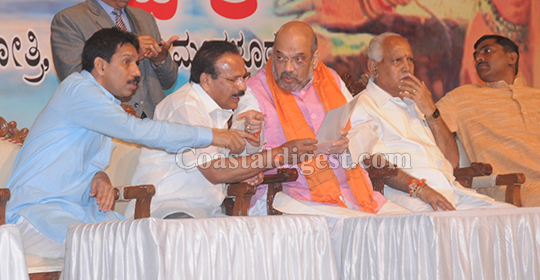
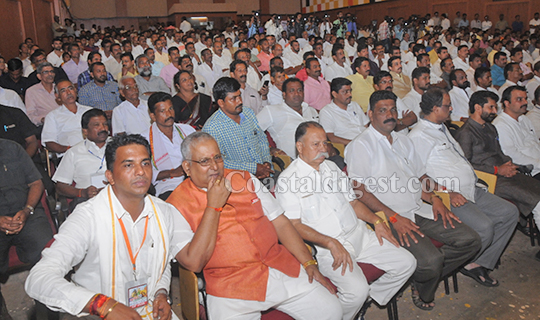
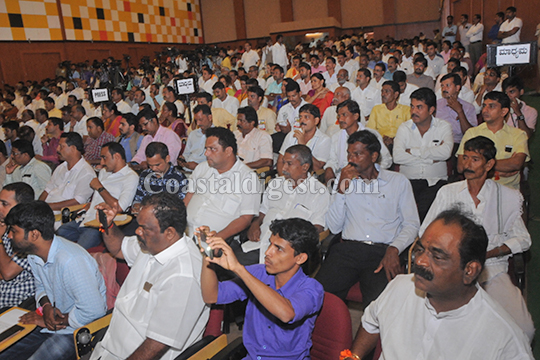
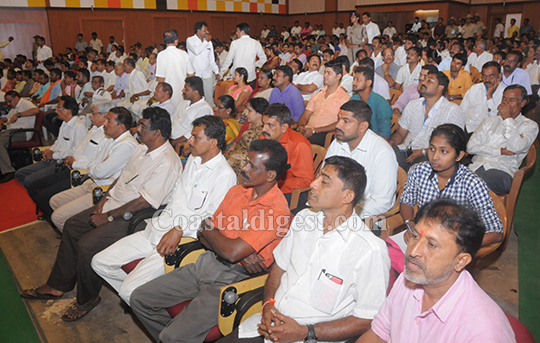
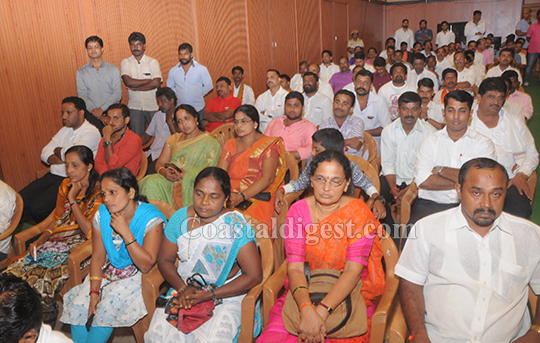
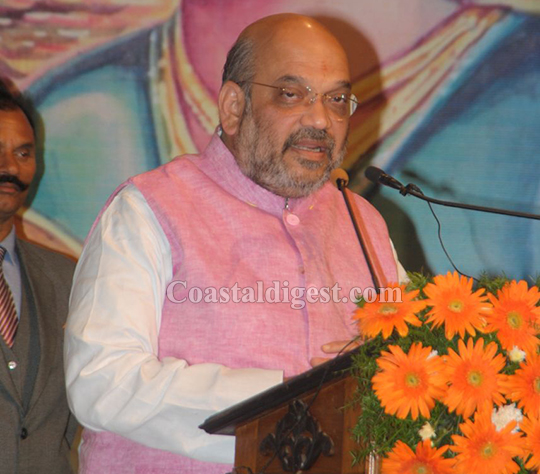
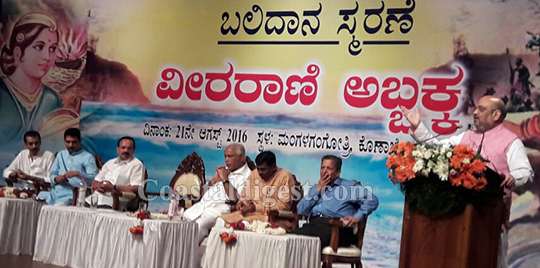
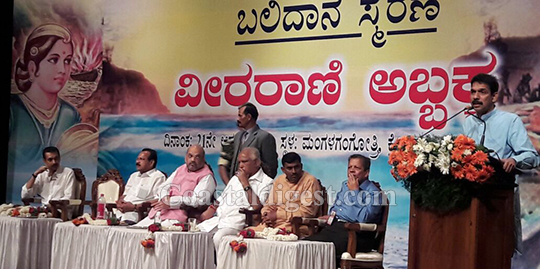
Speaking at a public meet organized by the saffron party in the name of 'Balidana Smarane' (honouring martyrs) on Mangaluru University campus as part of the Tiranga Yatra', BJP supremo Amit Shah accused the Congress party of backing anti-national ideologies.

Making a veiled attack on those who condemn Hindutva nationalism of BJP and promote secular nationalism, the BJP chief said that some people misuse freedom of speech to camouflage their anti-national sentiments. "Such people should be isolated," he said.

In the backdrop of the controversy over an Amnesty International India (AII) event in Bengaluru, where “anti-national” slogans were allegedly raised, Mr Shah said that people of the country should unite against “those anti-nationals”.

Mr Shah also seized the opportunity to promote his party with an eye on next Assembly polls and called B S Yeddyurappa, who was present on the stage as “Chief Minister in-waiting.” Responding to their leader's statement, the jubilant BJP workers began to raise slogans in support of Mr Yeddyurappa.

Abbakka to be honoured

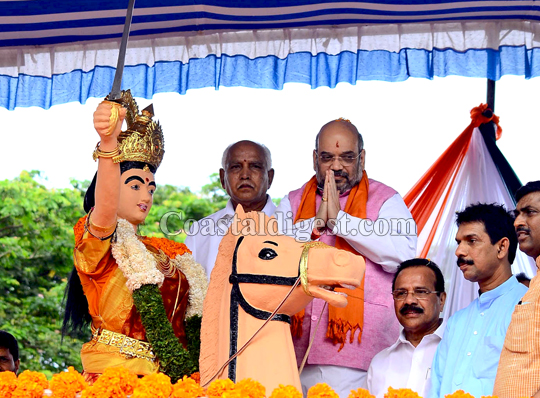
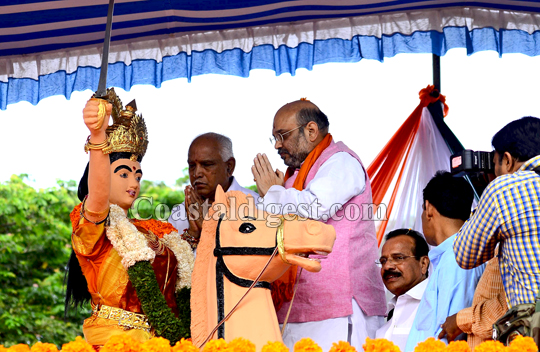
Prior to this Mr Shah garlanded the statue of Rani Abbakka at Ullal Circle. Abbakka Utsav Samithi president Dinkar Ullal submitted a representation to Mr Shah urging the Union government to name Mangaluru International Airport after Rani Abbakka. Also, at least one train starting from Mangaluru Railway Station should be named after Abbakka, the forum has requested the government in the memorandum.

The Samithi said one circle each in New Delhi, Bengaluru and Mangaluru should be named after Abbakka. The life story of Abbakka should be included in primary and high school curriculum. A theme park on Abbakka should be set up on 10 acres of land at Ullal, the Samithi has demanded.

The security was beefed up for Shah's programme. Senior police officers monitored the security arrangements. Along with CRPF Commandoes, a large number of police were deployed at the venue. IGP (Western range) Arun Chakravarthy, DCPs K M Shantharaju, Dr Sanjeev Paril and others had camped at the venue till the end of the programme.

amithshah1

amithshah2

amittt 1

amittt 2

amittt 3

amittt 5

amittt 6

amittt 7

amittt 8

amittt 9

amittt 10

amittsh 1

amittsh 2

amittsh 3

amittsh 4

Comments

CHOR
 - 
Monday, 22 Aug 2016

CHORONKI BARAAT..........

Add new comment

  • Coastaldigest.com reserves the right to delete or block any comments.
  • Coastaldigset.com is not responsible for its readers’ comments.
  • Comments that are abusive, incendiary or irrelevant are strictly prohibited.
  • Please use a genuine email ID and provide your name to avoid reject.
News Network
January 17,2020

Belagavi, Jan 17: Maharashtra Minister of State for Public Health, Medical Education, FDA and Textiles Rajendra Patil-Yadravkar who had come here to participate in the martyrs day programme of Maharashtra Ekikaran Samiti (MES) was detained by the police and escorted back till the state borders on Friday.

MES had organised its annual martyrs day programme at Hutatma Circle here. Its leaders had earlier been asked by the District Administration and City Police to ensure that none of the political leaders from Maharashtra participate and create law and order problems by their anti-state statements.

Patil had managed to sneak into the city through a route which was not manned by the police. He came in an auto-rickshaw to the programme venue.

Police personnel present for security took him into their custody and later escorted him till the state’s borders with Maharashtra at Kognoli on the Pune-Bengaluru national highway.

MES leaders alleged that the police personnel violated protocol while taking the incumbent minister into their custody and they also roughed him up.

All vehicles entering the city from different routes and particularly from Maharashtra were screened to confirm that political leaders from the neighbouring state do not participate in the martyrs day programme and create problems by their statements that also affect law and order along with linguistic harmony.

It was not known if Patil had landed in the city on Thursday and managed to reach the programme venue without getting noticed by using an auto-rickshaw.

Comments

Add new comment

  • Coastaldigest.com reserves the right to delete or block any comments.
  • Coastaldigset.com is not responsible for its readers’ comments.
  • Comments that are abusive, incendiary or irrelevant are strictly prohibited.
  • Please use a genuine email ID and provide your name to avoid reject.
Ram Puniyani
February 10,2020

Noam Chomsky is one of the leading peace workers in the world. In the wake of America’s attack on Vietnam, he brought out his classic formulation, ‘manufacturing consent’. The phrase explains the state manipulating public opinion to have the public approve of it policies—in this case, the attack of the American state on Vietnam, which was then struggling to free itself from French colonial rule.

In India, we are witness to manufactured hate against religious minorities. This hatred serves to enhance polarisation in society, which undermines India’s democracy and Constitution and promotes support for a Hindu nation. Hate is being manufactured through multiple mechanisms. For example, it manifests in violence against religious minorities. Some recent ghastly expressions of this manufactured hate was the massive communal violence witnessed in Mumbai (1992-93), Gujarat (2002), Kandhamal (2008) and Muzaffarnagar (2013). Its other manifestation was in the form of lynching of those accused of having killed a cow or consumed beef. A parallel phenomenon is the brutal flogging, often to death, of Dalits who deal with animal carcasses or leather.

Yet another form of this was seen when Shambhulal Regar, indoctrinated by the propaganda of Hindu nationalists, burned alive Afrazul Khan and shot the video of the heinous act. For his brutality, he was praised by many. Regar was incited into the act by the propaganda around love jihad. Lately, we have the same phenomenon of manufactured hate taking on even more dastardly proportions as youth related to Hindu nationalist organisations have been caught using pistols, while police authorities look on.

Anurag Thakur, a BJP minster in the central government recently incited a crowd in Delhi to complete his chant of what should happen to ‘traitors of the country...” with a “they should be shot”. Just two days later, a youth brought a pistol to the site of a protest at Jamia Millia Islamia university and shouted “take Azaadi!” and fired it. One bullet hit a student of Jamia. This happened on 30 January, the day Nathuram Godse had shot Mahatma Gandhi in 1948. A few days later, another youth fired near the site of protests against the CAA and NRC at Shaheen Bagh. Soon after, he said that in India, “only Hindus will rule”.

What is very obvious is that the shootings by those associated with Hindu nationalist organisations are the culmination of a long campaign of spreading hate against religious minorities in India in general and against Muslims in particular. The present phase is the outcome of a long and sustained hate campaign, the beginning of which lies in nationalism in the name of religion; Muslim nationalism and Hindu nationalism. This sectarian nationalism picked up the communal view of history and the communal historiography which the British introduced in order to pursue their ‘divide and rule’ policy.

In India what became part of “social common sense” was that Muslim kings had destroyed Hindu temples, that Islam was spread by force, and that it is a foreign religion, and so on. Campaigns, such as the one for a temple dedicated to the Hindu god Rama to be built at the site where the Babri masjid once stood, further deepened the idea of a Muslim as a “temple-destroyer”. Aurangzeb, Tipu Sultan and other Muslim kings were tarnished as the ones who spread Islam by force in the subcontinent. The tragic Partition, which was primarily due to British policies, and was well-supported by communal streams also, was entirely attributed to Muslims. The Kashmir conflict, which is the outcome of regional, ethnic and other historical issues, coupled with the American policy of supporting Pakistan’s ambitions of regional hegemony, (which also fostered the birth of Al-Qaeda), was also attributed to the Muslims.

With recurring incidents of communal violence, these falsehoods went on going deeper into the social thinking. Violence itself led to ghettoisation of Muslims and further broke inter-community social bonds. On the one hand, a ghettoised community is cut off from others and on the other hand the victims come to be presented as culprits. The percolation of this hate through word-of-mouth propaganda, media and re-writing of school curricula, had a strong impact on social attitudes towards the minorities.

In the last couple of decades, the process of manufacturing hate has been intensified by the social media platforms which are being cleverly used by the communal forces. Swati Chaturvedi’s book, I Am a Troll: Inside the Secret World of the BJP’s Digital Army, tells us how the BJP used social media to spread hate. Whatapp University became the source of understanding for large sections of society and hate for the ‘Other’, went up by leaps and bounds. To add on to this process, the phenomenon of fake news was shrewdly deployed to intensify divisiveness.

Currently, the Shaheen Bagh movement is a big uniting force for the country; but it is being demonised as a gathering of ‘anti-nationals’. Another BJP leader has said that these protesters will indulge in crimes like rape. This has intensified the prevalent hate.

While there is a general dominance of hate, the likes of Shambhulal Regar and the Jamia shooter do get taken in by the incitement and act out the violence that is constantly hinted at. The deeper issue involved is the prevalence of hate, misconceptions and biases, which have become the part of social thinking.

These misconceptions are undoing the amity between different religious communities which was built during the freedom movement. They are undoing the fraternity which emerged with the process of India as a nation in the making. The processes which brought these communities together broadly drew from Gandhi, Bhagat Singh and Ambedkar. It is these values which need to be rooted again in the society. The communal forces have resorted to false propaganda against the minorities, and that needs to be undone with sincerity.

Combating those foundational misconceptions which create hatred is a massive task which needs to be taken up by the social organisations and political parties which have faith in the Indian Constitution and values of freedom movement. It needs to be done right away as a priority issue in with a focus on cultivating Indian fraternity yet again.


Comments

Add new comment

  • Coastaldigest.com reserves the right to delete or block any comments.
  • Coastaldigset.com is not responsible for its readers’ comments.
  • Comments that are abusive, incendiary or irrelevant are strictly prohibited.
  • Please use a genuine email ID and provide your name to avoid reject.
News Network
July 14,2020

Bengaluru, Jul 14: The Karnataka government on Tuesday made changes to the Land Reforms Act 1961 through an ordinance to allow non-agriculturists to buy and own farmland for farming.

“The Land Reforms Act has been amended through an ordinance and notified after Governor Vajubhai R Vala gave his assent to it on Monday night,” a Revenue Department official told media persons.

It now permits non-farmers to buy farmland and grow food crops. But they can’t use it for other activities.

“Sections 79 A, B and C of the Act have been repealed, paving way for bona fide citizens to invest in farmland and take to farming as a hobby, passion or additional occupation, which is rewarding,” the official said.

The amended Act will enable the state to attract investment in the farm sector and boost food output. The farm sector’s contribution to the state’s gross domestic product (GDP) has been less than the manufacturing and services sectors over the last two decades.

Criticism by farmers, the Congress and the JD(S) since the cabinet approved changes on June 11 forced the state government to retain section 80 of the Act, with an amendment, to prevent sale of dam water irrigated farmland.

“The ordinance has also added a new section (80A), which says relaxations under the Act will not apply to land given to farmers under the Karnataka SC and ST (Scheduled Caste and Tribe) Act 1978,” the official said.

The changes permit mortgage of farmland only to the state-run institutions, firms and cooperative societies specified in the Act. The ordinance also makes legal cases pending in courts against the sections amended redundant as the new Act addresses the concerns raised in them.

“Besides generating substantial revenue for the state government, the Act will now allow farmers who find the occupation non-remunerative and risky due to droughts/floods and labour shortage to sell their surplus land to urban buyers,” the official said.

Ruling BJP Rajya Sabha member KC Ramamurthy from Bengaluru said the amended Act would allow any citizen to buy farmland.

“Though hundreds of people petitioned successive governments for the past 45 years to abolish the ‘draconian’ sections, they were ignored. I compliment Chief Minister BS Yediyurappa and Revenue Minister R Ashoka for the decision to allow everyone to buy farmland irrespective of their occupation or profession,” Ramamurthy told media persons.

Comments

Add new comment

  • Coastaldigest.com reserves the right to delete or block any comments.
  • Coastaldigset.com is not responsible for its readers’ comments.
  • Comments that are abusive, incendiary or irrelevant are strictly prohibited.
  • Please use a genuine email ID and provide your name to avoid reject.