BJP’s uproar over Roopa transfer continues, Yeddy calls Siddu pro-corrupt

Agencies
July 19, 2017

Bengaluru, Jul 19: The BJP today slammed the Karnataka government over the transfer of DIG (Prisons) D Roopa after she brought to light the alleged special treatment meted out to AIADMK (Amma) leader V K Sasikala in the central jail here.yeddi44

The party's state unit staged a protest here against the transfer and accused the state government of favouring corrupt officials.

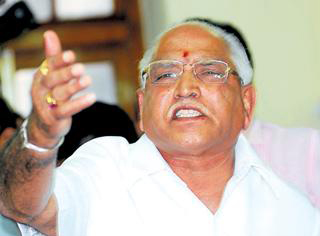
BJP's state unit chief B S Yeddyurappa accused the government of siding with corrupt jail officials by shunting out an "honest and upright" officer who had exposed alleged irregularities at the Parapana Agrahara central jail here.

"By transferring an honest and upright police official (Roopa)... the Siddaramaiah government has sided with corrupt jail officials. It is clear, and people should understand it," Yeddyurappa told reporters.

He demanded that Roopa should be reinstated with immediate effect.

The government had on Monday transferred Roopa and asked DGP (Prisons) H N Sathyanarayana Rao to go on compulsory leave after they sparred over a report on the allegations in public.

In her report, Roopa had alleged that Rs 2 crore had exchanged hands to provide special facilities to Sasikala and dragged Rao into the bribery charge, saying there was a "talk" that he was also a beneficiary.

The report and her transfer have raised a political storm in the state.

Yeddyurappa said there was no room for honest officers like Roopa in Siddaramaiah's government.He urged the government to take action against guilty police officials involved in jail irregularities.

Addressing BJP protesters earlier, he highlighted the government's "failure" to arrest killers of RSS activist SharathMadiwala in Dakshina Kannada district.

Former Deputy Chief Minister R Ashok demanded protection for honest officers.

Comments

Abdullah
 - 
Saturday, 22 Jul 2017

Only Barking in front of people.
Why dont you complaint in police?

Add new comment

  • Coastaldigest.com reserves the right to delete or block any comments.
  • Coastaldigset.com is not responsible for its readers’ comments.
  • Comments that are abusive, incendiary or irrelevant are strictly prohibited.
  • Please use a genuine email ID and provide your name to avoid reject.
Ram Puniyani
June 29,2020

In Minneapolis, US an African American, George Floyd lost his life as the white policeman, Derek Chauvin, caught hold of him and put his knee on his neck. This is a technique developed by Israel police. For nine long minutes the knee of the while policeman was on the neck of George, who kept shouting, I can’t breathe.

Following this gruesome murder America erupted with protests, ‘Black lives matter’. The protestors were not just African Americans but also a large section of whites. Within US one police Chief apologized for the act of this. In a touching gesture of apology the police force came on its knees. This had reverberations in different parts of the World.

The act was the outcome of the remnants of the racial hatred against blacks by the whites. It is the hatred and the perceptions which are the roots of such acts of violence. What was also touching that the state of democracy in US is so deep that even the police apologized, the nation, whites and blacks, stood up as a sensitive collective against this violence.

US is not the only country where the brutal acts of violence torment the marginalized sections of society. In India there is a list of dalits, minorities and adivasis who are regularly subjected to such acts. But the reaction is very different. We have witnessed the case of Tabrez Ansari, who was tied to the pole by the mob and beaten ruthlessly. When he was taken to police station, police took enough time to take him to hospital and Tabrez died.

Mohsin Sheikh, a Pune techie was murdered by Hindu Rashtra Sena mob, the day Modi came to power in 2014. Afrazul was killed by Shambhulal Regar, videotaped the act released on social media. Regar believed that Muslims are indulging in love Jihad, so deserve such a fate. Mohammad Akhlaq is one among many names who were mob lynched on the issue of beef cow. The list can fill pages after pages.

Recently a young dalit boy was shot dead for the crime of entering a temple. In Una four dalits were stripped above waste and beaten mercilessly. Commenting on this act the Union Minister Ramvilas Paswan commented that it is a minor incident. Again the list of atrocities against dalits is long enough. The question is what Paswan is saying is the typical response to such gruesome murders and tortures. In US loss of one black life, created the democratic and humane response. In India there is a general silence in response to these atrocities. Some times after a good lapse of time, the Prime Minister will utter, ‘Mother Bharati has lost a son’. Most of the time victim is blamed. Some social groups raise their voice in some fora but by and large the deafening silence from the country is the norm.

India is regarded as the largest democracy. Democracy is the rule of law, and the ground on which the injustices are opposed. In America though the present President is insensitive person, but its institutions and processes of democratic articulations are strong. The institutions have deepened their roots and though prejudices may be guiding the actions of some of the officers like the killer of George, there are also police officers who can tell their President to shut up if he has nothing meaningful to say on the issue. The prejudices against Blacks may be prevalent and deep in character, still there are large average sections of society, who on the principles of ‘Black lives matter’. There are large sections of vocal population who can protest the violation of basic norms of democracy and humanism.

In India by contrast there are multiple reasons as to why the lives of Tabrez Ansari, Mohammad Akhlaq, Una dalit victims and their likes don’t matter. Though we claim that we are a democracy, insensitivity to injustices is on the rise. The strong propaganda against the people from margins has become so vicious during last few decades that any violence against them has become sort of a new normal. The large populace, though disturbed by such brutalities, is also fed the strong dose of biases against the victims. The communal forces have a great command over effective section of media and large section of social media, which generates Hate against these disadvantaged groups, thereby the response is muted, if at all.

As such also the process of deepening of our democracy has been weak. Democracy is a dynamic process; it’s not a fixed entity. Decades ago workers and dalits could protest for their rights. Now even if peasants make strong protests, dominant media presents it as blocking of traffic! How the roots of democracy are eroded and are visible in the form where the criticism of the ruling dispensation is labelled as anti National..

Our institutions have been eroded over a period of time, and these institutions coming to the rescue of the marginalized sections have been now become unthinkable. The outreach of communal, divisive ideology, the ideology which looks down on minorities, dalits and Adivasis has risen by leaps and bounds.

The democracy in India is gradually being turned in to a hollow shell, the rule of law being converted in to rule of an ideology, which does not have faith in Indian Constitution, which looks down upon pluralism and diversity of this country, which is more concerned for the privileges of the upper caste, rich and affluent. The crux of the matter is the weak nature of democracy, which was on way to become strong, but from decades of 1980s, as emotive issues took over, the strength of democracy started dwindling, and that’s when the murders of the types of George Floyd, become passé. One does complement the deeper roots of American democracy and its ability to protect the democratic institutions, which is not the case in India, where protests of the type, which were witnessed after George Floyd’s murder may be unthinkable, at least in the present times. 

Comments

Add new comment

  • Coastaldigest.com reserves the right to delete or block any comments.
  • Coastaldigset.com is not responsible for its readers’ comments.
  • Comments that are abusive, incendiary or irrelevant are strictly prohibited.
  • Please use a genuine email ID and provide your name to avoid reject.
coastaldigest.com news network
May 27,2020

Bengaluru, May 27: Amidst helpless calls for learning to live with coronavirus and make a new beginning, the government of Karnataka is considering to reopen schools in the state from July 1.

Primary Education Minister S Suresh Kumar discussed the issue with the officials from the department at a meeting held on Tuesday. 

The expert committee in its report submitted to the Union Ministry for Human Resource Development recommended reopening of schools on July 1. The state department of primary and secondary education also discussed the issue. 

However, no decision has been taken yet and final decision is expected to out in a day or two. A source said that since the timetable for SSLC examination had been published and the lockdown was expected to be lifted after May 31, it had been planned to reopen the schools on July 1.

Following the recent representation by several academicians and social activists urging to cancel SSLC exams, the primary education minister met chief minister and briefed him about preparations for the safe conduct of exams.

“As of now there will not be any changes in SSLC exam schedule. We have reviewed the situation and preparations are underway for ensuring safety of children,” the source added. 

The report submitted by Nimhans about online education is yet to reach the secretariat.

Comments

Add new comment

  • Coastaldigest.com reserves the right to delete or block any comments.
  • Coastaldigset.com is not responsible for its readers’ comments.
  • Comments that are abusive, incendiary or irrelevant are strictly prohibited.
  • Please use a genuine email ID and provide your name to avoid reject.
News Network
July 22,2020

Bengaluru, Jul 22: On Wednesday morning starlet and Bigg Boss 3 contestant Jayashree Ramaiah sent social media into a tizzy with an update that read, “I quit. Goodbye to this f*****g world and depression.” Friends and acquaintances immediately began reaching out to the actor asking her to return their concerned calls and desist from taking any extreme steps.

“Jayashree has been battling depression for a while now. She had family issues and was also concerned about the lack of work,” shares actor Ashvithi Shetty. The Ramachari twins were in touch with Jayashree since they met at a celebrity cricket match four years ago. “She has shared several times about how low she’s been and I would try to cheer her up. But the problem was that she’d keep changing her phone number so often that it became difficult to keep track of how she was doing,” states Ashvithi.

Around four months ago, Jayashree moved into her own home and mentioned to her that she was happy with this new development in her life. “But she went retreated again and a few days ago, I messaged her on social media and she said she was doing fine. So I was shocked to see this update on Wednesday morning,” avers the actor. Repeated calls finally elicited a message from Jayashree that she was getting admitted to the hospital. “But I also got contradictory information that she had been discharged and had been taken to the hospital again but she was refusing to go inside. I am awaiting more clarity on the issue,” sums up Ashvithi.

Comments

Add new comment

  • Coastaldigest.com reserves the right to delete or block any comments.
  • Coastaldigset.com is not responsible for its readers’ comments.
  • Comments that are abusive, incendiary or irrelevant are strictly prohibited.
  • Please use a genuine email ID and provide your name to avoid reject.