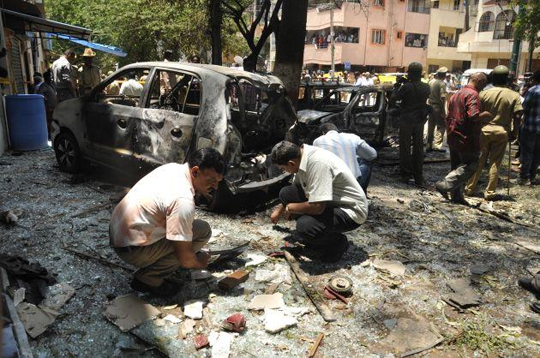
Blast near BJP office: Explosives supplier Danial Prakash arrested

[email protected] (CD Network)
June 14, 2016

Bengaluru, Jun 14: A 35-year-old man was arrested in connection with the blast that had occurred in front of the state BJP office at Malleswaram on April 17, 2013. Police said the accused had supplied explosive for the blast, after a plan was hatched to fix the explosive to a bike.

blast

Central Crime Branch police, who are probing the case, nabbed Danial Prakash alias Prakashm in Tirunelveli village of Tamil Nadu. The police have so far arrested 17 accused in connection with the blast and Prakash is 18th accused.

Police officials said the arrest was made based on information given by Pervez Basha, who was arrested in Tamil Nadu earlier.

In a press release, officials state that Prakash is one of the prime accused and he was active in supplying explosive material that was brought to Bengaluru.

Cops among injured

A bomb explosion of low intensity near the headquarters of the Bharatiya Janata Party at Malleswaram on April 17, 2013 had injured 17 people, including 12 police personnel. The police personnel were in a Karnataka State Reserve Police van stationed on 24-hour election duty.

Two cars and two two-wheelers were gutted, while the police van was damaged in the explosion that shook the densely populated semi-residential area. The 10.20 a.m. blast coincided with the last day of the filing of nominations for the May 5 Assembly polls. The busy street on Malleswaram, which was in the thick of electoral activity, was covered with shattered glass, mostly from broken vehicle window panes.

RSS leader's SIM

Nearly a month after the blast, police had revealed that the SIM card used to trigger the blast belonged to an RSS leader from the Karnataka-Kerala border. The police, had refused to identify the RSS leader.

However, the police has exonerated the SIM-card owner, and ruled out the involvement of a purported right-wing terror group.

Chargsheeted

However, after a few months of investigation, a chargesheet was filed in October 2013 against 15 accused: Basheer (30), Kichan Buhari (38), Sait Azgar Ali (29), Rehamathulla (34), Valayil Hakeem (32), Syed Suleman (24), Suleman (31), Zulfikar Ali (24), Mohammed Salim (30), Panna Ismail (38), Bilal Malik (25), Fakruddin (38), Pravai Basha, Ali Khan Kutti, Jhone Asir, (35) and Syed Ali (29) are currently judicial custody in the Parappana Agrahara prison.

Comments

ali
 - 
Tuesday, 14 Jun 2016

99 % OF CRIMES IN INDIA DONE BY RSS. By them directly or through hired goons.

ali
 - 
Tuesday, 14 Jun 2016

99 % OF CRIMES IN INDIA DONE BY RSS. By them directly or through hired goons.

Rajiv
 - 
Tuesday, 14 Jun 2016

no news in media, where is so called pyare indian, now slowly slowly people can understand who is the real terrorist and asali rastra bhaktah. shame on rss..

Add new comment

  • Coastaldigest.com reserves the right to delete or block any comments.
  • Coastaldigset.com is not responsible for its readers’ comments.
  • Comments that are abusive, incendiary or irrelevant are strictly prohibited.
  • Please use a genuine email ID and provide your name to avoid reject.
coastaldigest.com web desk
May 23,2020

The decision of the Indian government to ease the coronavirus-linked global travel restrictions imposed on those having OCI cards has given a big relief to many stranded overseas citizens of India across the world.

OCI card is issued to people of Indian origin globally which gives them almost all the privileges of an Indian national except for the right to vote, government service and buying agricultural land. The OCI card gives them a visa-free travel to India.

On Friday, the central government allowed certain categories of OCI card holders, who are stranded abroad, to come to the country. Earlier, according to the regulations issued by the Indian government in April, visas of foreign nationals and OCI cards were suspended as part of the new international travel restrictions following the COVID-19 pandemic.

This privilege of visa free travel to India was causing distress among a large number of people of Indian-origin and Indian citizens in countries like the US whose children were OCI card holders as they were born in this country.

Many Indian parents, several of whom lost their jobs as a result of the economic crisis due to coronavirus pandemic, but were not allowed to take the special evacuation flights of Air India from various US cities, took to social media and urged the Indian leaders to allow them to travel to India.

“This is a big relief for the OCI card holders. It was a humanitarian crisis in the making. I am pleased that the Indian Government listened to their voices,” said social activist Prem Bhandari, chairman of Jaipur Foot USA, who has been taking up the cause of the OCI card holders.

Dr Arathi Krishna, former deputy chairperson of NRI Forum of Karnataka government, who had been demanding this relaxation, many of the thousands of stranded OCI card holders in defferent parts of the world were in pursuading her to exert pressure on the authorities concerned for this much needed relaxation.

The restrictions on traveling of OCI card holders to India was issued by govt of India on March 13 in the wake of global outbreak of coronavirus pandemic. 

She said: "Many parents who are Indian nationals could not travel for emergency purpose to India after repatriation flights started due to their minor children being OCI card holders. Many children who were OCI card holders could not travel to India to perform last rites when there was death in their family due to these restrictions"

"I was constantly pressurising and bringing these issues to the attention of ministry officials in External Affairs and Home Affairs departments. I was following up with Mr Dammu Ravi who is heading the COVID task force  task firce in the ministry of overseas Indian affairs who took interest in solving this problem through his consistent efforts with MHA. Iam thankful to Fireign Secretary too for his efforts and concern and to MHA for making it easier now for OCI card holders to travel in repatriation flights with emergency reasons," she said.

Comments

Add new comment

  • Coastaldigest.com reserves the right to delete or block any comments.
  • Coastaldigset.com is not responsible for its readers’ comments.
  • Comments that are abusive, incendiary or irrelevant are strictly prohibited.
  • Please use a genuine email ID and provide your name to avoid reject.
coastaldigest.com news network
July 7,2020

Udupi, Jul 7: A hotelier committed suicide by jumping into a well at Hiriadka in Udupi district last evening. 

The deceased is Raghavendra Bhat (48), a resident of Kadiyali and owner of Hotel Shivasagar in Kadiyali.

He had been to his brother's house in Hiriyadka where he resorted to the extreme step. 

He was known for organising tiger dance competitions during Sri Krishnashtami every year.

He had contested the Udupi CMC election from Congress party, but had lost by a few votes. Later he had joined the BJP.

A case has been registered ar Hiriadka police station and investigations are on.

Comments

Add new comment

  • Coastaldigest.com reserves the right to delete or block any comments.
  • Coastaldigset.com is not responsible for its readers’ comments.
  • Comments that are abusive, incendiary or irrelevant are strictly prohibited.
  • Please use a genuine email ID and provide your name to avoid reject.
Ram Puniyani
February 10,2020

Noam Chomsky is one of the leading peace workers in the world. In the wake of America’s attack on Vietnam, he brought out his classic formulation, ‘manufacturing consent’. The phrase explains the state manipulating public opinion to have the public approve of it policies—in this case, the attack of the American state on Vietnam, which was then struggling to free itself from French colonial rule.

In India, we are witness to manufactured hate against religious minorities. This hatred serves to enhance polarisation in society, which undermines India’s democracy and Constitution and promotes support for a Hindu nation. Hate is being manufactured through multiple mechanisms. For example, it manifests in violence against religious minorities. Some recent ghastly expressions of this manufactured hate was the massive communal violence witnessed in Mumbai (1992-93), Gujarat (2002), Kandhamal (2008) and Muzaffarnagar (2013). Its other manifestation was in the form of lynching of those accused of having killed a cow or consumed beef. A parallel phenomenon is the brutal flogging, often to death, of Dalits who deal with animal carcasses or leather.

Yet another form of this was seen when Shambhulal Regar, indoctrinated by the propaganda of Hindu nationalists, burned alive Afrazul Khan and shot the video of the heinous act. For his brutality, he was praised by many. Regar was incited into the act by the propaganda around love jihad. Lately, we have the same phenomenon of manufactured hate taking on even more dastardly proportions as youth related to Hindu nationalist organisations have been caught using pistols, while police authorities look on.

Anurag Thakur, a BJP minster in the central government recently incited a crowd in Delhi to complete his chant of what should happen to ‘traitors of the country...” with a “they should be shot”. Just two days later, a youth brought a pistol to the site of a protest at Jamia Millia Islamia university and shouted “take Azaadi!” and fired it. One bullet hit a student of Jamia. This happened on 30 January, the day Nathuram Godse had shot Mahatma Gandhi in 1948. A few days later, another youth fired near the site of protests against the CAA and NRC at Shaheen Bagh. Soon after, he said that in India, “only Hindus will rule”.

What is very obvious is that the shootings by those associated with Hindu nationalist organisations are the culmination of a long campaign of spreading hate against religious minorities in India in general and against Muslims in particular. The present phase is the outcome of a long and sustained hate campaign, the beginning of which lies in nationalism in the name of religion; Muslim nationalism and Hindu nationalism. This sectarian nationalism picked up the communal view of history and the communal historiography which the British introduced in order to pursue their ‘divide and rule’ policy.

In India what became part of “social common sense” was that Muslim kings had destroyed Hindu temples, that Islam was spread by force, and that it is a foreign religion, and so on. Campaigns, such as the one for a temple dedicated to the Hindu god Rama to be built at the site where the Babri masjid once stood, further deepened the idea of a Muslim as a “temple-destroyer”. Aurangzeb, Tipu Sultan and other Muslim kings were tarnished as the ones who spread Islam by force in the subcontinent. The tragic Partition, which was primarily due to British policies, and was well-supported by communal streams also, was entirely attributed to Muslims. The Kashmir conflict, which is the outcome of regional, ethnic and other historical issues, coupled with the American policy of supporting Pakistan’s ambitions of regional hegemony, (which also fostered the birth of Al-Qaeda), was also attributed to the Muslims.

With recurring incidents of communal violence, these falsehoods went on going deeper into the social thinking. Violence itself led to ghettoisation of Muslims and further broke inter-community social bonds. On the one hand, a ghettoised community is cut off from others and on the other hand the victims come to be presented as culprits. The percolation of this hate through word-of-mouth propaganda, media and re-writing of school curricula, had a strong impact on social attitudes towards the minorities.

In the last couple of decades, the process of manufacturing hate has been intensified by the social media platforms which are being cleverly used by the communal forces. Swati Chaturvedi’s book, I Am a Troll: Inside the Secret World of the BJP’s Digital Army, tells us how the BJP used social media to spread hate. Whatapp University became the source of understanding for large sections of society and hate for the ‘Other’, went up by leaps and bounds. To add on to this process, the phenomenon of fake news was shrewdly deployed to intensify divisiveness.

Currently, the Shaheen Bagh movement is a big uniting force for the country; but it is being demonised as a gathering of ‘anti-nationals’. Another BJP leader has said that these protesters will indulge in crimes like rape. This has intensified the prevalent hate.

While there is a general dominance of hate, the likes of Shambhulal Regar and the Jamia shooter do get taken in by the incitement and act out the violence that is constantly hinted at. The deeper issue involved is the prevalence of hate, misconceptions and biases, which have become the part of social thinking.

These misconceptions are undoing the amity between different religious communities which was built during the freedom movement. They are undoing the fraternity which emerged with the process of India as a nation in the making. The processes which brought these communities together broadly drew from Gandhi, Bhagat Singh and Ambedkar. It is these values which need to be rooted again in the society. The communal forces have resorted to false propaganda against the minorities, and that needs to be undone with sincerity.

Combating those foundational misconceptions which create hatred is a massive task which needs to be taken up by the social organisations and political parties which have faith in the Indian Constitution and values of freedom movement. It needs to be done right away as a priority issue in with a focus on cultivating Indian fraternity yet again.


Comments

Add new comment

  • Coastaldigest.com reserves the right to delete or block any comments.
  • Coastaldigset.com is not responsible for its readers’ comments.
  • Comments that are abusive, incendiary or irrelevant are strictly prohibited.
  • Please use a genuine email ID and provide your name to avoid reject.