



The Bollywood story through film posters, lobby cards

January 2, 2014

BollywoodNew Delhi, Jan 2: Bollywood's unseen and lesser known stills capturing action, affection, portraiture and villainy through decades-old film memorabilia like cinema lobby and show cards is now put on show.

Curated by photographer Rahaab Allana as a tribute to 100 years of cinema, these curios are showing at an exhibition he has titled "Filmy Jagat: Shared Universe of Indian Cinema" at the Art Heritage Gallery here.

"The visual culture in India is vast. It was the end of the centenary and I felt in the end, we should talk about sub cultures rather than the mainstream activities going on all the time," Allana told PTI in an interview at the the opening of the exhibition.

The exhibition, says the photographer is an attempt by his team to bring to fore the sub culture of photography that existed in Hindi movies for four decades from 1940 to 1980s but still unknown to the masses.

"For instance, the lobby cards and show cards that would have originally been pinned up in cinema theatres, are some of the most acknowledged forms of photography. We have made them part of the exhibition," he says.

The focal point of the exhibition is a scrap book titled "Filmy Jagat" scribbled in hand on the cover.

Acquired by Allana a year ago, the pre-independence book paved the way for the exhibition. "Working around the streets of Mumbai and picking up material, I came upon this scrap book and I realize that a scrap book is an important sub-culture of photography. I realized that I would like to research it and found out that there was no publication or history around scrapbook so I thought to do one," he says.

Divided into different tropes and styles, the show highlights such film stills dating from a later period in Indian cinema, namely the 1960s-80s, an era that gave way to a global audience for Hindi films. Action, Affection, Portraiture and Villainy are therefore some of the recurring moments that were captured throughout film photography.

The curator of Alkazi Foundation for the Arts. Allana says he had no plans of putting up a show when he acquired the archives. "I had no thought while going for the archives. I acquired them I because liked them," he says.

Allana admits it was a challenging task to acquire all the archives. "It was challenging. Easy as everyone was dedicated to it but difficult for obvious reasons," the curator says.

He hopes that people visit the exhibition and they start "responding to it in their own capacity." Another reason which Allana had for putting up this exhibition was to show his support for offbeat cinema. "If we want to make that kind of cinema supporting this type of exhibition is good," he said.

The exhibition preempts a publication specific to the scrapbook, titled Filmi Jagat Scrapbook: Shared Universe of Indian Cinema, by Niyogi Books with a introduction by Shyam Benegal which will be released early next year. "Yes, we hope to release it in the first quarter of the year," says Allana.

Along with this a parallel exhibition titled Contemporary Artworks, where artists have responded to the "dynamic presence of Bollywood".

M F Husain's "Culture of the Streets", a portfolio of 20 signed photographs printed on Kodak C-Print with foil on photo paper shot in the 1980s, makes it clear that for Husain, the streets of Chennai with their enormous hoardings of South Indian movie stars were a part of the contemporary urban landscape and a part of the artist's visual vocabulary.

Younger artists like Bharti Verma's otherwise vacant streets and homes of New Delhi are dominated by a historic legacy of film posters that are suspended like a giant, silent backdrop in the distance. Sharmistha Dutta creates collages of 1970's film posters pasted on ruined, blood-splattered city walls, against which she arranges interesting and vivid portraits of the common man.

Comments

Pedro
 - 
Sunday, 20 Mar 2016

Thanks for the marvelous posting! I genuinely enjoyed reading it,
you may be a great author. I will ensure that I bookmark your blog and definitely will come back someday.
I want to encourage you to ultimately continue your great work,
have a nice holiday weekend!

Have a look at my web blog :: majaas: http://kaajmaaja.com

Add new comment

  • Coastaldigest.com reserves the right to delete or block any comments.
  • Coastaldigset.com is not responsible for its readers’ comments.
  • Comments that are abusive, incendiary or irrelevant are strictly prohibited.
  • Please use a genuine email ID and provide your name to avoid reject.
News Network
February 10,2020

Feb 10: Bong Joon-ho’s film “Parasite” starts in a dingy, half-basement apartment with a family of four barely able to scratch out a life. There must be no place to go but up, right? Yes and no. There’s nothing predictable when the South Korean director is on his game.

This dark, socially conscious film about the intertwining of two families is an intricately plotted, adult thriller. We can go up, for sure, but Bong can also take us deeper down. There’s always an extra floor somewhere in this masterpiece.

It tells the story of the impoverished four-person Kim family who, one by one, and with careful and devious planning, all get employed by the four-person affluent Park family — as a tutor, an art teacher, a driver and a housekeeper. They are imposters stunned by the way wealth can make things easier: “Money is an iron. It smooths out all the creases,” says the Park patriarch with wonder.

Bong, who directed and wrote the story for “Parasite,” has picked his title carefully, of course. Naturally, he’s alluding to the sycophantic relationship by a clan of scammers to the clueless rich who have unwittingly opened the doors of their home on a hill. But it’s not that simple. The rich family seem incapable of doing anything — from dishes to sex — without help. Who’s scamming who?

Bong’s previous films play with film genres and never hide their social commentary — think of the environmentalist pig-caper “Okja” and the dystopian sci-fi global warming scream “Snowpiercer.” But this time, Bong’s canvas is a thousand times smaller and his focus light-years more intense. There are no CGI train chases on mountains or car chases through cities. (There is also, thankfully, 100% less Tilda Swinton, a frequent, over-the-top Bong collaborator.

The two Korean families first make contact when a friend of the Kim’s son asks him to take over English lessons for the Park daughter. Soon the son (a dreamy Choi Woo-sik) convinces them to hire his sister (the excellent Park So-dam) as an art teacher, but doesn’t reveal it’s his sis. She forges her diploma and spews arty nonsense she learned on the internet, impressing the polite but firm Park matriarch (a superb Jo Yeo-jeong.)

The Park’s regular chauffer is soon let go and replaced by the Kim patriarch (a steely Lee Sun-kyun). Ditto the housemaid, who is dumped in favor of the Kims’ mother (a feisty Jang Hye-jin.) All eight people seem happy with the new arrangement until Bong reveals a twist: There are more parasites than you imagined. The clean, impeccably furnished Park home will have some blood splashing about.

Bong’s trademark slapstick is still here but the rough edges of his often too-loud lessons are shaved down nicely and his actors step forward. “Keep it focused,” the Kim’s son counsels his father at one point. Bong has followed that advice.

There are typically dazzling Bong touches throughout. Just look for all the insect references — stink bugs at the beginning to flies at the end, and a preoccupation with odor across the frames. And there’s a scene in which the rich matriarch skillfully winds noodles in a bowl while, in another room, duct tape is being wrapped around a victim and classical music plays.

Bong could have been more strident in his social critique but hasn’t. There are no villains in “Parasite” — and also no heroes. Both families are forever broken after chafing against each other, a bleak message about the classes ever really co-existing (Take that, “Downton Abbey”).

“Parasite” is a worthy winner of the Palme d’Or at the Cannes Film Festival, the first South Korean movie to win the prestigious top prize. The director has called it an “unstoppably fierce tragicomedy.” We just call it brilliant.

Comments

Add new comment

  • Coastaldigest.com reserves the right to delete or block any comments.
  • Coastaldigset.com is not responsible for its readers’ comments.
  • Comments that are abusive, incendiary or irrelevant are strictly prohibited.
  • Please use a genuine email ID and provide your name to avoid reject.
News Network
June 16,2020

Mumbai, Jun 16: In the wake of Sushant Singh Rajput's death, veteran actor Deepti Naval has opened up about her struggle with depression and suicidal thoughts in the early 90s.

Naval shared a poem that she wrote during her struggle with depression on her Facebook page after paying tributes to Rajput, who was found hanging in his Bandra apartment on Sunday at the age of 34.

According to a police official, Mumbai Police found out during the probe that the actor was under medication for depression

"Dark days these... So much has been happening - mind has come to a point of stillness... Or rather numbness. Today I feel like sharing a poem I wrote back in the years when I was fighting depression, anxiety, suicidal thoughts - Yes, fighting... and like how," Naval wrote.

The 68-year-old actor made her debut with Shyam Benegal's 1978 "Junoon" and went on to feature in films like "Chashme Buddoor", "Ankahee", "Mirch Masala", Saath Saath among others in the 80s.

Naval's poem, titled "Black Wind", begins by describing how anxiety engulfs a person.

"Anxiety grips me with both hands, spiked claws dig deep into my soul I gasp for breath and stagger around sharp corners of my single bed.."

In the poem, Naval talks about fighting suicidal thoughts and depression, describing it as a "ghoulish lust" she won't succumb to.

"The telephone rings... no, it stops...God damn! Why don't anyone speak? A voice, Just a human voice In this shameless, pitiless Abyss of the night - gloom deepens into darkness, turns purple I feel dark inside."

The actor ends by writing that she will survive the night, its "deathly design" and fight.

"The world's a snake pit, so let it be! I dare the devil to get the better of me! Deepti Naval, Night of July 28, 1991."

In an interview with PTI last year, Naval had mentioned how acting assignments started to thin in the late 90s and as a "serious actor" it was "devastating" to be ignored.

Comments

Add new comment

  • Coastaldigest.com reserves the right to delete or block any comments.
  • Coastaldigset.com is not responsible for its readers’ comments.
  • Comments that are abusive, incendiary or irrelevant are strictly prohibited.
  • Please use a genuine email ID and provide your name to avoid reject.
News Network
July 27,2020

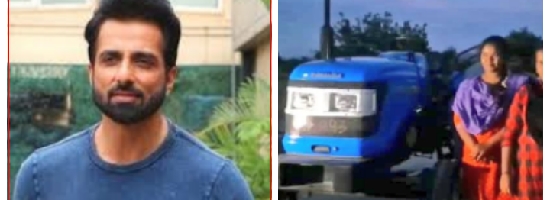
Mumbai, Jul 27: Reel life villain Sonu Sood turned real life hero once again, this time by gifting a tractor on Sunday to a farmer in a remote village in Andhra Pradesh to help him till the land. The actor came up with the gift after coming through a video clip on Twitter wherein a tomato farmer in Madanapalle in Chittoor district was seen ploughing the land with his two daughters carrying the yoke on their shoulders.

In his instant reaction, Sood promised a pair of ox to the farmer, but later said the family deserved a tractor. "So sending you one. By evening a tractor will be ploughing your fields. Stay blessed," Sood, who acted as a villain in numerous Telugu films, said in a tweet.

True to his word, a new tractor was delivered to the elated farmer Nageswara Rao at his Mahalrajupalle village by Sunday night. Telugu Desam Party president N Chandrababu Naidu, who belongs to Chittoor district, hailed the actor's gesture.

"Spoke with @sonusood ji and applauded him for his inspiring effort to send a tractor to Nageswara Rao's family in Chittoor district. Moved by the plight of the family, I have decided to take care of the education of the two daughters and help them pursue their dreams," Naidu said in a tweet.

Rao's elder daughter completed her Intermediate while the second one passed Class 10. Rao used to run a tea stall in Madanapalle before coronavirus left him out of business. He returned to his native Mahalrajupalle village to take up agriculture once again.

Given his penury, he could not hire either a pair of bulls or a tractor to till the land, when his daughters volunteered to help him on the chores. Their plight went viral on social media following which the actor stepped in with help.

Comments

Add new comment

  • Coastaldigest.com reserves the right to delete or block any comments.
  • Coastaldigset.com is not responsible for its readers’ comments.
  • Comments that are abusive, incendiary or irrelevant are strictly prohibited.
  • Please use a genuine email ID and provide your name to avoid reject.