Bomb explodes next to Prophet's Mosque as terrorists target Madinah after Jeddah, Qatif

[email protected] (CD Network)
July 4, 2016

Riyadh, Jul 4: Three suicide bombers struck in Saudi Arabia today in a rare incidence of multiple attacks in the kingdom where the anti-Islamic group called Islamic State' has previously staged deadly attacks. There were no immediate claims of responsibility.

1parking

The latest explosion occurred outside of Islam's three holiest sites, the Prophet's Mosque (Masjid an-Nabawi) in Madinah in the kingdom's west where Muhammad (pbuh) established first Islamic society after migration from Makkah.

Al-Arabiya said the Madinah incident occurred during sunset prayers after which Muslims break their fast during the holy month of Ramadan, which ends Tuesday.

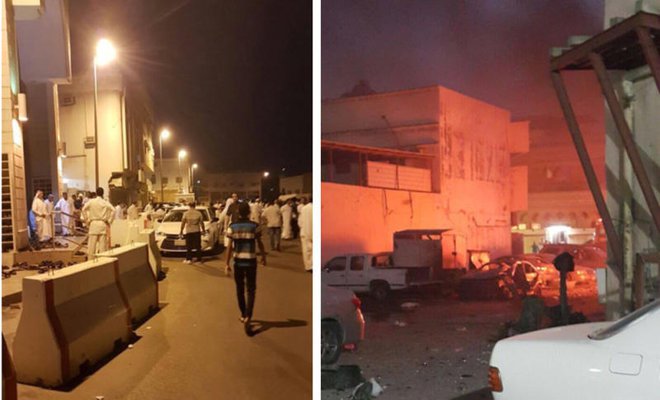
Four policemen were killed and five others were injured in Madinah when a suicide bomber struck in the vicinity of a police post outside the Prophet's Mosque, according to the interior ministry.

The bombing took place in a parking lot between the city court and the mosque, visited by millions every year.

When security officials became suspicious of an individual who was heading to the Prophet's Mosque they approached him resulting in him triggering his explosive belt killing four of the officers and injuring others.

The Prophet's Mosque is particularly crowded during the Muslim holy month of Ramadan, which is supposed to be a time of charity but has seen spectacular attacks around the region.

Earlier, in Qatif, two suicide bombers blew themselves up one after the other outside the Faraj Al-Omran Mosque. No casualties were reported. A witness said a car bomb was detonated near the mosque, which was followed by a suicide attack just before 7 p.m. Police have launched an investigation into the attack.

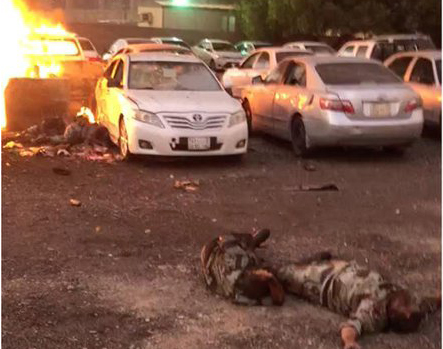
Before that at 2:15 a.m., a suicide bomber blew himself up near the US Consulate in Jeddah. Security officers confronted him as he moved suspiciously at a parking lot of the Dr. Soliman Fakeih Hospital. Two policemen were wounded lightly in the attack.

Maj. Gen. Mansour Al-Turki, Interior Ministry spokesman, said the bomber, in his 30s, was identified as an expatriate from the Pakistan.

Photos taken from the scene showed the bomber's body dismembered by the blast.

Daesh has carried out a series of bombing and shooting attacks in Saudi Arabia since 2014 that have killed scores of people, mostly Shiites and members of the security services. In January, a suicide bomber attacked a mosque in Al-Ahsa, killing four people before worshippers disarmed and tied up an accomplice who had shot at them.

In October last year, a gunman opened fire on worshippers in Qatif, killing five people before he was shot dead by police.

Also Read: 4 cops sacrifice their lives to prevent suicide bomber from entering Prophet's mosque
1blast

2madimah

1madinah 

Comments

Curious
 - 
Wednesday, 6 Jul 2016

Bopanna is currect ,because information he has is only from media. Media is dominated by westerns who are waging war with islam . Today's youth are dumb and def what they listen from media they believe. Only they don't believe is true message of Quran .

muhammed rafique
 - 
Tuesday, 5 Jul 2016

Bopanna ...your phrase is outdated.....

And mind you.... because of the Islamic country's Saudi;s sharia law you are highly secured in the Kingdom

probably Saudi is the only country to execute more terrorists than any other country

Bopanna
 - 
Tuesday, 5 Jul 2016

Nice try Ashish. Why is it that 99% of bombings are done by Muslims ? Immediately you guys say that they have nothing to do with Islam. Ye kab tak chalaoge ?

No Islam = Know Peace
Know Islam = No peace

Ashish
 - 
Tuesday, 5 Jul 2016

Mr. Bopanna,

Hinduism cannot be blamed for all the acts executed by hindutva activits(Self claimed). Similarly, Islam cannot be blamed for bunch of few extremist who doesn't have a basic humanity.

imtiaz
 - 
Tuesday, 5 Jul 2016

inna lillahi wa inna ilaihi raajiwoon.... may Allah protect us all from such bloody suicide bombers ...

Add new comment

  • Coastaldigest.com reserves the right to delete or block any comments.
  • Coastaldigset.com is not responsible for its readers’ comments.
  • Comments that are abusive, incendiary or irrelevant are strictly prohibited.
  • Please use a genuine email ID and provide your name to avoid reject.
News Network
March 28,2020

Bengaluru, Mar 28: Sun Tsu, in 'The Art of War' speaks of a skilful general who can subdue his enemy without any fighting. This constitutes the ultimate triumph which is referred to as stratagem. Today, we would need one such when we are faced with the '21-day corona challenge' for India.
Nearly four weeks back, Dr Jyothsna Rao, Dr Gururaj Rao and I sat across the OPD in the afternoon at HCG Bengaluru discussing our ongoing cancer immunology research. While on this topic, we drifted into the discussion on the coronavirus. During this engaging discussion, we wondered the similarity of the enigma between the virus and cancer. I paused to ask Dr Jyothsna and Dr Guru - how we wish we could do something against this virus.
Dr Jyothsna is a PhD from NCBS and had worked under Dr Ralph Steinman, physician and researcher from Rockefeller University, who won the Nobel Prize for his discovery of the dendritic cell and its role in adaptive immunity in 2011. Dr Gururaj is a molecular and cell biologist who did his PhD at the Chapel Hill, University of North Carolina and is the Director of iCrest.
Jyothsna while hearing our perplexing conversation on the covid intervened, "Yes, surely. I think we should take a break from cancer and focus on the innate and adaptive immunity role in COVID-19."
Thus began this sincere attempt to relook the human immune system from the eyes of the COVID-19.
We have 10 types of immune cells at the least which are widely dispersed in millions across the body. When our body is invaded by a foreign organism (bacteria, fungi or virus), these cells work with each other to destroy the invader.
Now, the question is - how do the immune cells talk to each other? They use small-molecule substances called cytokines (cyto means cells; kine means movement). There are many cytokines that are involved in work on the immune system. The most relevant for viruses are interferons.
Interferons (IFN) as the name reflects have an ability to interfere with the viral activity and stop their multiplication. These specialised signal proteins are released by our cells in response to a viral attack to forewarn other cells. They help build the antiviral proteins within the cells to kill the virus as it tries to invade the new cells.
Historically, interferons are a group of cytokines known to be potent antiviral agents against viruses and a hallmark cytokine induced by the host upon viral infections. Interferons possess unique immunoregulatory activities and are signature cytokines released by (TH1) T immune cells, which are crucial in viral infections.
As the outbreak of COVID-19 grapples us, an urgent need for finding strategies to combat the virus is growing. Coronaviruses (CoVs) are a group of RNA viruses. In patients infected with coronavirus, it was indicated that the activation of the IFN does not occur until 48 hours post-infection. Thus the delayed IFN-related antiviral response by the healthy cells leads to coronavirus evade the immune response.
Numerous studies have presented the success in defeating CoVs by the direct administration of IFNs. In a combination as a concoction, it was shown to synergistically inhibit the virus replication in vitro.
Moreover, it is understood that the earlier induction of IFNs in children although they have a less developed immune system could be the reason behind the children being least affected.
The key to success in reducing the disease fatality might be the stimulation of the immune responses to trigger IFN production at the very early stages of the disease, which might be done through the administration of IFN. Despite the evidence for the efficacy of IFNs in treating CoV-induced infections, the proper dosing and ideal timing for such interventions needs to be verified in clinical trials.
For the later stages of the diseases in advance stages where patients are on ventilator and have developed respiratory distress, we propose to utilise the mesenchymal cells derived from donor bone marrow that have been known to treat acute respiratory syndrome. Mesenchymal cells are known to possess anti-inflammatory activity and thus used often in autoimmune diseases.
With this scientific background, we have activated T cells from healthy donors, in a cGMP facility at iCrest - HCG hospital with an enriched cocktail of cytokines rich in Interferons. Injections of this cocktail we believe will result in a surge of cytokines in the body of the infected person and will boost his ability to fight the virus in the early phases. We are in the initial phases of this study and hope to be ready in the coming weeks with meaningful data on its potential utility.
Currently, it awaits government approvals (Union and state) and we have applied to central drugs authority for their initial evaluation and further directions.
As my Guru often expounded the philosophy of 'Seva' - the goal of education is knowledge, the end goal of knowledge is service. In this attempt to serve our fellow humans at this brink of unprecedented crisis, medical fraternity stands with you and promises to do our best for your safety.
We assure to exhaust every bit of our spirit in this fight against coronavirus. We have lost the sight of shores and travelled thus far, but that is the mandatory first step to cross the ocean. Are we going to succeed in this battle, is something only time will answer. 

Comments

Add new comment

  • Coastaldigest.com reserves the right to delete or block any comments.
  • Coastaldigset.com is not responsible for its readers’ comments.
  • Comments that are abusive, incendiary or irrelevant are strictly prohibited.
  • Please use a genuine email ID and provide your name to avoid reject.
coastaldigest.com news network
June 28,2020

Mangaluru, June 28: In his apparent bid to win the hearts of the people of Tulu Nadu while leaving this coastal city, Dr P S Harsha, the outgoing Mangaluru city police commissioner, today took to social media and thanked the people. The language he chose for his prolonged Facebook post and one paragraph tweet was Tulu.

“Loveable people of Kudla! I have received the transfer order after serving as the Commissioner of Police of Mangaluru City for 11 months. (During this period) I worked with utmost honesty and pro-people approach with the complete cooperation of my department. I wholeheartedly thank all those who supported me,” tweeted Dr Harsha, who is now posted in Bengaluru as the Deputy Inspector General and Commissioner of Information and Public Relations.

In his Facebook post, Dr Harsha claimed that thanks to his initiative “My Beat My Pride”, the policing in the coastal city has strengthened. 

“My only intention was to put an end to rowdyism and illegal activities. I had given priority to curb the drug mafia. ‘My Beat My Pride’ became a successful initiative thanks to public support,” he said. 

The IPS officer went on to claim that with the with the co-operation of the senior officers, the police department managed to efficiently handle situations during anti-CAA and pro-CAA agitations in the city, detection of explosives at Mangaluru International Airport and also during the covid-19 pandemic. 

However, he did not mention about the death of two people in random police firing following a baton charge during anti-CAA protests in the city on December 19.

Comments

MP
 - 
Tuesday, 30 Jun 2020

power is not permenant. 2 innocents were killed in mangalore,  if it was in USA the cop would have been in jail.


Add new comment

  • Coastaldigest.com reserves the right to delete or block any comments.
  • Coastaldigset.com is not responsible for its readers’ comments.
  • Comments that are abusive, incendiary or irrelevant are strictly prohibited.
  • Please use a genuine email ID and provide your name to avoid reject.
Agencies
June 12,2020

Bengaluru, Jun 12: The Central government has identified Karnataka's Udupi and Yadgir among the "emerging districts of concern" for COVID-19 in the country. Confirming the development, a top official of the state health department said, "they (centre) had reviewed these two districts a few days back...there was a sudden spurt of cases due to Maharashtra returnees turning positive." Sources said union cabinet secretary Rajiv Gauba, during a recent video conference with state chief secretaries and health secretaries, had shared his thoughts on the issue.

According to the information shared, districts with more than 400 cases, half of which was reported post-May 18 lockdown relaxation, have been identified as "emerging districts of concern." They are concentrated in the seven states/union territories of Maharashtra, Rajasthan, Tamil Nadu, West Bengal, Karnataka, Jammu and Kashmir and Haryana. "Udupi and Yadgir from Karnataka, along with Gurugram in Haryana and Kolhapur in Maharashtra have 90 per cent of the cases recorded after May 18," they said.

As on June 11 evening, Udupi had a total of 969 positive cases, out of which 619 are active, while 735 positive cases have been reported in Yadgir, out of which 626 are active. The two districts had reported a total of only 11 cases each as on May 18. While Udupi till last evening had seen 349 discharges, it was 108 in Yadgir.

Both districts have reported one COVID related fatality so far. As of June 11 evening, cumulatively 6,245 COVID-19 positive cases were confirmed in the state, which included 72 deaths and 2,976 discharges.

Comments

Add new comment

  • Coastaldigest.com reserves the right to delete or block any comments.
  • Coastaldigset.com is not responsible for its readers’ comments.
  • Comments that are abusive, incendiary or irrelevant are strictly prohibited.
  • Please use a genuine email ID and provide your name to avoid reject.