Bomb explodes next to Prophet's Mosque as terrorists target Madinah after Jeddah, Qatif

[email protected] (CD Network)
July 4, 2016

Riyadh, Jul 4: Three suicide bombers struck in Saudi Arabia today in a rare incidence of multiple attacks in the kingdom where the anti-Islamic group called Islamic State' has previously staged deadly attacks. There were no immediate claims of responsibility.

1parking

The latest explosion occurred outside of Islam's three holiest sites, the Prophet's Mosque (Masjid an-Nabawi) in Madinah in the kingdom's west where Muhammad (pbuh) established first Islamic society after migration from Makkah.

Al-Arabiya said the Madinah incident occurred during sunset prayers after which Muslims break their fast during the holy month of Ramadan, which ends Tuesday.

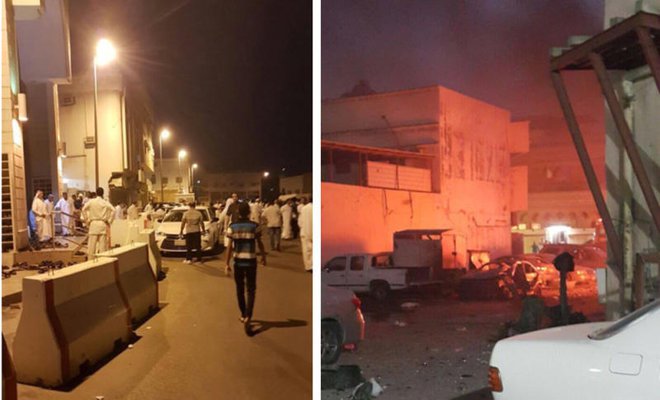
Four policemen were killed and five others were injured in Madinah when a suicide bomber struck in the vicinity of a police post outside the Prophet's Mosque, according to the interior ministry.

The bombing took place in a parking lot between the city court and the mosque, visited by millions every year.

When security officials became suspicious of an individual who was heading to the Prophet's Mosque they approached him resulting in him triggering his explosive belt killing four of the officers and injuring others.

The Prophet's Mosque is particularly crowded during the Muslim holy month of Ramadan, which is supposed to be a time of charity but has seen spectacular attacks around the region.

Earlier, in Qatif, two suicide bombers blew themselves up one after the other outside the Faraj Al-Omran Mosque. No casualties were reported. A witness said a car bomb was detonated near the mosque, which was followed by a suicide attack just before 7 p.m. Police have launched an investigation into the attack.

Before that at 2:15 a.m., a suicide bomber blew himself up near the US Consulate in Jeddah. Security officers confronted him as he moved suspiciously at a parking lot of the Dr. Soliman Fakeih Hospital. Two policemen were wounded lightly in the attack.

Maj. Gen. Mansour Al-Turki, Interior Ministry spokesman, said the bomber, in his 30s, was identified as an expatriate from the Pakistan.

Photos taken from the scene showed the bomber's body dismembered by the blast.

Daesh has carried out a series of bombing and shooting attacks in Saudi Arabia since 2014 that have killed scores of people, mostly Shiites and members of the security services. In January, a suicide bomber attacked a mosque in Al-Ahsa, killing four people before worshippers disarmed and tied up an accomplice who had shot at them.

In October last year, a gunman opened fire on worshippers in Qatif, killing five people before he was shot dead by police.

Also Read: 4 cops sacrifice their lives to prevent suicide bomber from entering Prophet's mosque
1blast

2madimah

1madinah 

Comments

Curious
 - 
Wednesday, 6 Jul 2016

Bopanna is currect ,because information he has is only from media. Media is dominated by westerns who are waging war with islam . Today's youth are dumb and def what they listen from media they believe. Only they don't believe is true message of Quran .

muhammed rafique
 - 
Tuesday, 5 Jul 2016

Bopanna ...your phrase is outdated.....

And mind you.... because of the Islamic country's Saudi;s sharia law you are highly secured in the Kingdom

probably Saudi is the only country to execute more terrorists than any other country

Bopanna
 - 
Tuesday, 5 Jul 2016

Nice try Ashish. Why is it that 99% of bombings are done by Muslims ? Immediately you guys say that they have nothing to do with Islam. Ye kab tak chalaoge ?

No Islam = Know Peace
Know Islam = No peace

Ashish
 - 
Tuesday, 5 Jul 2016

Mr. Bopanna,

Hinduism cannot be blamed for all the acts executed by hindutva activits(Self claimed). Similarly, Islam cannot be blamed for bunch of few extremist who doesn't have a basic humanity.

imtiaz
 - 
Tuesday, 5 Jul 2016

inna lillahi wa inna ilaihi raajiwoon.... may Allah protect us all from such bloody suicide bombers ...

Add new comment

  • Coastaldigest.com reserves the right to delete or block any comments.
  • Coastaldigset.com is not responsible for its readers’ comments.
  • Comments that are abusive, incendiary or irrelevant are strictly prohibited.
  • Please use a genuine email ID and provide your name to avoid reject.
Agencies
May 8,2020

Washington D.C., May 8: The prime time for brain development in a child's life is the first year, where the infant spends most of the time asleep. It is the time when neural connections form and sensory memories are encoded.

However, when sleep is disrupted, as occurs more often among children with autism, brain development may be affected, too.

New research led by the University of Washington finds that sleep problems in a baby's first 12 months may not only precede an autism diagnosis but also may be associated with altered growth trajectory in a key part of the brain, the hippocampus.

The study, which was published in the American Journal of Psychiatry, researchers report that in a sample of more than 400 taken of 6- to 12-month-old infants, those who were later diagnosed with autism were more likely to have had difficulty falling asleep.

It also states that this sleep difficulty was associated with altered growth trajectories in the hippocampus.

"The hippocampus is critical for learning and memory, and changes in the size of the hippocampus have been associated with poor sleep in adults and older children.

As many as 80 per cent of the children with autism spectrum disorder have sleep problems," said Annette Estes, director of the UW Autism Center and senior author of the study.

"In our clinical experience, parents have a lot of concerns about their children's sleep, and in our work on early autism intervention, we observed that sleep problems were holding children and families back," added Estes, who is also a UW professor of speech and hearing sciences.

"It could be that altered sleep is part-and-parcel of autism for some children. One clue is that behavioural interventions to improve sleep don't work for all children with autism, even when their parents are doing everything just right. This suggests that there may be a biological component to sleep problems for some children with autism," said Estes.

To consider links among sleep, brain development, and autism, researchers at the IBIS Network looked at MRI scans of 432 infants, surveyed parents about sleep patterns, and measured cognitive functioning using a standardized assessment.

At the outset of the study, infants were classified according to their risk for developing autism: Those who were at higher risk of developing autism -- about two-thirds of the study sample -- had an older sibling who had already been diagnosed.

Infant siblings of children with autism have a 20 per cent chance of developing autism spectrum disorder -- a much higher risk than children in the general population.

In the current study, 127 of the 432 infants were identified as "low risk" at the time the MRI scans were taken because they had no family history of autism.

They later evaluated all the participants at 24 months of age to determine whether they had developed autism. Of the roughly 300 children originally considered "high familial risk," 71 were diagnosed with autism spectrum disorder at that age.

Problems with sleep were more common among the infants later diagnosed with an autism spectrum disorder, as were larger hippocampi. No other subcortical brain structures were affected, including the amygdala, which is responsible for certain emotions and aspects of memory, or the thalamus, a signal transmitter from the spinal cord to the cerebral cortex.

The authors note that while parents reported more sleep difficulties among infants who developed autism compared to those who did not, the differences were very subtle and only observed when looking at group averages across hundreds of infants.

Sleep patterns in the first years of life change rapidly as infants transition from sleeping around the clock to a more adult-like sleep/wake cycle. Until further research is completed, Estes said, it is not possible to interpret challenges with sleep as an early sign of increased risk for autism.

Comments

Add new comment

  • Coastaldigest.com reserves the right to delete or block any comments.
  • Coastaldigset.com is not responsible for its readers’ comments.
  • Comments that are abusive, incendiary or irrelevant are strictly prohibited.
  • Please use a genuine email ID and provide your name to avoid reject.
Agencies
June 13,2020

New Delhi, Jun 13: Loss of smell or taste has been added to the list of COVID-19 symptoms, according to the revised clinical management protocols released by the Union Health Ministry on Saturday.

The ministry said that coronavirus-infected patients reporting to various COVID-19 treatment facilities have been reporting symptoms like fever, cough, fatigue, shortness of breath, expectoration, myalgia, rhinorrhea, sore throat and diarrhea.

They have also complained of loss of smell (anosmia) or loss of taste (ageusia) preceding the onset of respiratory symptoms.

Older people and immune-suppressed patients in particular may present with atypical symptoms such as fatigue, reduced alertness, reduced mobility, diarrhoea, loss of appetite, delirium, and absence of fever, the ministry said.

Children might not have reported fever or cough as frequently as adults.

The US's national public health institute, the Centers for Disease Control and Prevention (CDC), had in early May incorporated "a new loss of taste or smell" in the list of COVID-19 symptoms.

According to the data from Integrated Health Information Platform and Integrated Disease Surveillance Programme, portal case investigation forms for COVID 19 (n=15,366), the details on the signs and symptoms reported are (as on June 11), fever (27 per cent), cough (21 pc), sore throat (10 pc), breathlessness (8 pc), Weakness (7 pc), running nose (3pc ) and others 24 pc.

According to the health ministry, people infected by the novel coronavirus are the main source of infection.

Direct person-to-person transmission occurs through close contact, mainly through respiratory droplets that are released when the infected person coughs, sneezes, or talks.

These droplets may also land on surfaces, where the virus remains viable. Infection can also occur if a person touches an infected surface and then touches his or her eyes, nose, or mouth.

The median incubation period is 5.1 days (range 2–14 days). The precise interval during which an individual with COVID-19 is infectious is uncertain.

As per the current evidence, the period of infectivity starts 2 days prior to onset of symptoms and lasts up to 8 days.

The extent and role played by pre-clinical/ asymptomatic infections in transmission still remain under investigation.

Comments

Add new comment

  • Coastaldigest.com reserves the right to delete or block any comments.
  • Coastaldigset.com is not responsible for its readers’ comments.
  • Comments that are abusive, incendiary or irrelevant are strictly prohibited.
  • Please use a genuine email ID and provide your name to avoid reject.
coastaldigest.com news network
May 24,2020

Nanded, May 24: In a sensational incident, a Lingayat seer from Karnataka was found murdered in his mutt in the Nanded district of Marathwada region of Maharashtra on Sunday.

The seer, who was strangled to death, has been identified as Shivacharya Nirvanarudra Pashupatinath Maharaj, the founder-spiritual head of Nirvanji Pashupatinath Mutt.

Addressing media persons, Nanded Superintendent of Police Vijaykumar Magar, the prime suspect, Sainath Langote first killed his accomplice Bhagwan Shinde and then went to the ashram late on Saturday.

He entered Shivaharya Maharaj's bedroom where he was resting and threw chilli powder in his eyes, blinding him.

Then he quickly grabbed cash of Rs 69,000, his laptop and other valuables in the bedroom worth approximately Rs.1.50 lakh, besides the seer's car keys.

As Shivacharya Maharaj attempted to grapple with him, Langote pinned him down and strangled him, then dragged his body to the sadhu's car parked outside and dumped it into the boot.

"He started the car and sped off towards the road outside, but the car crashed into the main gate of the ashram creating a noise, alerting the other sevaks sleeping inside the ashram," Magar said.

Around 8-10 other ashram sevaks rushed outside to check the ruckus and when they saw their seer's belongings and his body in the car trunck, they attempted to stop Langote, but he gave them the slip.

A short distance away, Langote managed to steal a motorbike and sped off into the darkness and hours later, the police found the body of his accomplice Shinde from a nearby school premises, Magar said.

In view of the sensitivity of the incident, Magar said around five crack teams were formed which fanned out into the district and managed to catch Langote this afternoon.

"The prima facie motive for the seer's murder was clearly robbery and the second killing could be due to rivalry or some differences among them. The absconder suspect has been caught by a police team. We will interrogate him and get further details of the crime," Magar said.

Nanded Congress strongman and PWD Minister Ashok Chavan appealed that the murder should not be politicized, since the police investigations are underway and the autopsy report is awaited.

He said the deceased sadhu belonged to the Lingayat caste, and both Shinde and Langote who belonged to the same community were his followers.

Shivacharya Maharaj had come to Nanded over a decade ago and set up the ashram which he ran along with a band of followers.

Comments

Add new comment

  • Coastaldigest.com reserves the right to delete or block any comments.
  • Coastaldigset.com is not responsible for its readers’ comments.
  • Comments that are abusive, incendiary or irrelevant are strictly prohibited.
  • Please use a genuine email ID and provide your name to avoid reject.