Bomb explodes next to Prophet's Mosque as terrorists target Madinah after Jeddah, Qatif

[email protected] (CD Network)
July 4, 2016

Riyadh, Jul 4: Three suicide bombers struck in Saudi Arabia today in a rare incidence of multiple attacks in the kingdom where the anti-Islamic group called Islamic State' has previously staged deadly attacks. There were no immediate claims of responsibility.

1parking

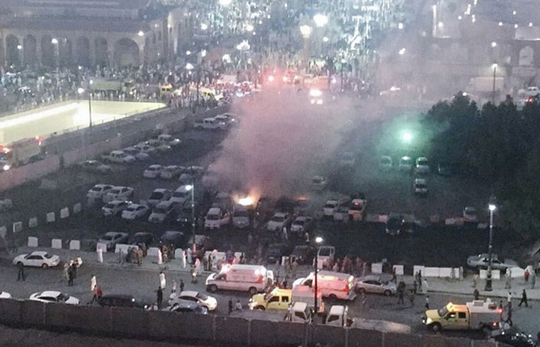
The latest explosion occurred outside of Islam's three holiest sites, the Prophet's Mosque (Masjid an-Nabawi) in Madinah in the kingdom's west where Muhammad (pbuh) established first Islamic society after migration from Makkah.

Al-Arabiya said the Madinah incident occurred during sunset prayers after which Muslims break their fast during the holy month of Ramadan, which ends Tuesday.

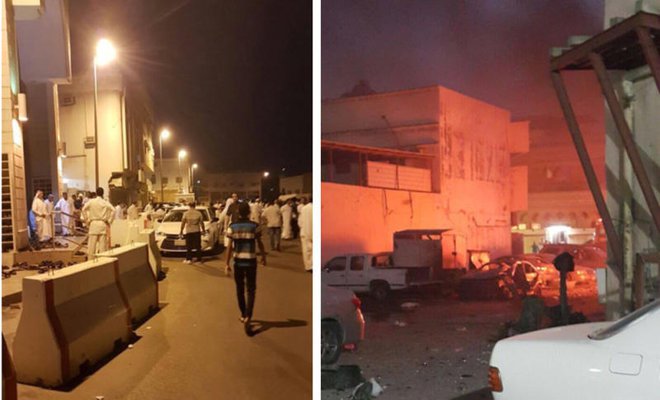
Four policemen were killed and five others were injured in Madinah when a suicide bomber struck in the vicinity of a police post outside the Prophet's Mosque, according to the interior ministry.

The bombing took place in a parking lot between the city court and the mosque, visited by millions every year.

When security officials became suspicious of an individual who was heading to the Prophet's Mosque they approached him resulting in him triggering his explosive belt killing four of the officers and injuring others.

The Prophet's Mosque is particularly crowded during the Muslim holy month of Ramadan, which is supposed to be a time of charity but has seen spectacular attacks around the region.

Earlier, in Qatif, two suicide bombers blew themselves up one after the other outside the Faraj Al-Omran Mosque. No casualties were reported. A witness said a car bomb was detonated near the mosque, which was followed by a suicide attack just before 7 p.m. Police have launched an investigation into the attack.

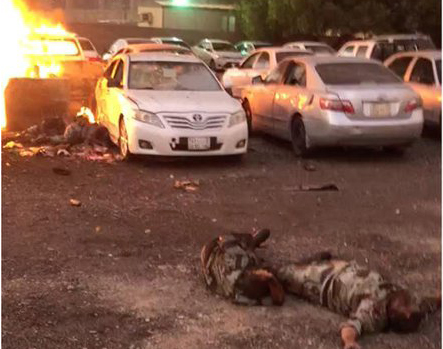
Before that at 2:15 a.m., a suicide bomber blew himself up near the US Consulate in Jeddah. Security officers confronted him as he moved suspiciously at a parking lot of the Dr. Soliman Fakeih Hospital. Two policemen were wounded lightly in the attack.

Maj. Gen. Mansour Al-Turki, Interior Ministry spokesman, said the bomber, in his 30s, was identified as an expatriate from the Pakistan.

Photos taken from the scene showed the bomber's body dismembered by the blast.

Daesh has carried out a series of bombing and shooting attacks in Saudi Arabia since 2014 that have killed scores of people, mostly Shiites and members of the security services. In January, a suicide bomber attacked a mosque in Al-Ahsa, killing four people before worshippers disarmed and tied up an accomplice who had shot at them.

In October last year, a gunman opened fire on worshippers in Qatif, killing five people before he was shot dead by police.

Also Read: 4 cops sacrifice their lives to prevent suicide bomber from entering Prophet's mosque

1blast

2madimah

1madinah 

Comments

Curious
 - 
Wednesday, 6 Jul 2016

Bopanna is currect ,because information he has is only from media. Media is dominated by westerns who are waging war with islam . Today's youth are dumb and def what they listen from media they believe. Only they don't believe is true message of Quran .

muhammed rafique
 - 
Tuesday, 5 Jul 2016

Bopanna ...your phrase is outdated.....

And mind you.... because of the Islamic country's Saudi;s sharia law you are highly secured in the Kingdom

probably Saudi is the only country to execute more terrorists than any other country

Bopanna
 - 
Tuesday, 5 Jul 2016

Nice try Ashish. Why is it that 99% of bombings are done by Muslims ? Immediately you guys say that they have nothing to do with Islam. Ye kab tak chalaoge ?

No Islam = Know Peace
Know Islam = No peace

Ashish
 - 
Tuesday, 5 Jul 2016

Mr. Bopanna,

Hinduism cannot be blamed for all the acts executed by hindutva activits(Self claimed). Similarly, Islam cannot be blamed for bunch of few extremist who doesn't have a basic humanity.

imtiaz
 - 
Tuesday, 5 Jul 2016

inna lillahi wa inna ilaihi raajiwoon.... may Allah protect us all from such bloody suicide bombers ...

Add new comment

  • Coastaldigest.com reserves the right to delete or block any comments.
  • Coastaldigset.com is not responsible for its readers’ comments.
  • Comments that are abusive, incendiary or irrelevant are strictly prohibited.
  • Please use a genuine email ID and provide your name to avoid reject.
News Network
January 25,2020

Mangaluru, Jan 25: Orange vendor Harekala Hajabba, popularly known as 'Akshara Santha' (the saint of alphabets), who went on to build a school at Newpadpu village on the city’s outskirts in 1999 is among this year’s Padma Shri awardees.

When Hajabba received the call on being nominated for the award, he was standing in a queue to buy rations.

As he is not fluent in Hindi, Hajabba handed over the phone to an auto driver, who conveyed the news that the Padma Shri award will be conferred on him.

The unlettered achiever set up a primary school from his meagre savings of Rs 150 per day,  selling oranges in Mangaluru. 

“The first time I felt bad for being an illiterate was when a foreigner enquired about the price of oranges in English. I did not know what he meant. So, I decided to start a school in my village,” Hajabba had said during a felicitation programme.

When Hajabba decided to start a school, he did not get any support. He started the school with 28 children.

The school today has been upgraded to a composite high school and is catering to the educational needs of hundreds of children in and around Newpadpu.

He ran from pillar to post in the Zilla Panchayat to make his dream come true. All cash awards he had received went into building the school. The United Christians Association, moved by the sight of his dilapidated house, built a 760-square-foot house costing Rs 15 lakh for him. 

Hajabba’s life was prescribed for the syllabus of three universities - Davangere, Kuvempu and Mangalore. His success story is also included in a Tulu textbook.

He won the Karnataka Rajyotsava award in 2013, Real Heroes award from TV channel CNN-IBN.

Hajabba, when contacted, said he could not believe his ears when told about the award.

New dreams

The frail vendor, in his 60s, humbly declared that he could achieve all this because of the support of all. Hajabba now dreams of upgrading the school into a full-fledged PU college.

Comments

Meethal Kasaragod
 - 
Sunday, 26 Jan 2020

A big Salute to him!

Great effort,

fairman
 - 
Sunday, 26 Jan 2020

Where there is will, there is way

May God help him.

Add new comment

  • Coastaldigest.com reserves the right to delete or block any comments.
  • Coastaldigset.com is not responsible for its readers’ comments.
  • Comments that are abusive, incendiary or irrelevant are strictly prohibited.
  • Please use a genuine email ID and provide your name to avoid reject.
News Network
January 1,2020

Kalaburagi, Jan 1: Fighting penury and partial blindness in one eye, a 39-year-old part-time Kannada lecturer from Kalaburagi district is set to become a commercial tax officer after cracking the Karnataka Administrative Services.

Ambadas Kamble, from Kotana Hipparaga village in Aland taluk, had to take a three-year gap during his school and college years - one-year break after completing Class VII and two years to clear subjects after he failed in II PU examinations. During those three years, he joined his brothers in masonry work to supplement the family's income.

Sweeping aside all hurdles with grit and determination, Ambadas studied Kannada literature for both undergraduate and postgraduate to land the post of a part-time lecturer in a Kalaburagi college. His father died when he was a child, and mother Chandamma supported her family of six - besides, Ambadas, she has two sons and two daughters - by working in houses in the neighbourhood.

Ambadas said he would like to dedicate his success to his mother, who died in the year 2012. "My mother encouraged me to chase my dream - financial difficulties notwithstanding - and allowed me to spend time in the library when my siblings were busy doing menial jobs to fund my education. I'm grateful to my brothers too," he said.

His two brothers are working as masons in Mumbai, having quit studies midway and deciding to support Ambadas - the first in the family to complete graduation. He did high school at Tadkal village in Aland taluk, and college in Kalaburagi.

The lecturer, who's 40% blind in the right eye, cracked the KAS examinations in his third attempt and stood 706th in the state. He has been selected for first-grade officer's post. Alongside, he's doing PhD in Kannada literature.

When his efforts finally paid off, Ambadas landed four job offers: Hostel warden at Morarji Desai hostel, at an SC/ST hostel, post of a lecturer and the tax officer's post. He picked the fourth to serve the state in right earnest.

Comments

Add new comment

  • Coastaldigest.com reserves the right to delete or block any comments.
  • Coastaldigset.com is not responsible for its readers’ comments.
  • Comments that are abusive, incendiary or irrelevant are strictly prohibited.
  • Please use a genuine email ID and provide your name to avoid reject.
Ram Puniyani
February 10,2020

Noam Chomsky is one of the leading peace workers in the world. In the wake of America’s attack on Vietnam, he brought out his classic formulation, ‘manufacturing consent’. The phrase explains the state manipulating public opinion to have the public approve of it policies—in this case, the attack of the American state on Vietnam, which was then struggling to free itself from French colonial rule.

In India, we are witness to manufactured hate against religious minorities. This hatred serves to enhance polarisation in society, which undermines India’s democracy and Constitution and promotes support for a Hindu nation. Hate is being manufactured through multiple mechanisms. For example, it manifests in violence against religious minorities. Some recent ghastly expressions of this manufactured hate was the massive communal violence witnessed in Mumbai (1992-93), Gujarat (2002), Kandhamal (2008) and Muzaffarnagar (2013). Its other manifestation was in the form of lynching of those accused of having killed a cow or consumed beef. A parallel phenomenon is the brutal flogging, often to death, of Dalits who deal with animal carcasses or leather.

Yet another form of this was seen when Shambhulal Regar, indoctrinated by the propaganda of Hindu nationalists, burned alive Afrazul Khan and shot the video of the heinous act. For his brutality, he was praised by many. Regar was incited into the act by the propaganda around love jihad. Lately, we have the same phenomenon of manufactured hate taking on even more dastardly proportions as youth related to Hindu nationalist organisations have been caught using pistols, while police authorities look on.

Anurag Thakur, a BJP minster in the central government recently incited a crowd in Delhi to complete his chant of what should happen to ‘traitors of the country...” with a “they should be shot”. Just two days later, a youth brought a pistol to the site of a protest at Jamia Millia Islamia university and shouted “take Azaadi!” and fired it. One bullet hit a student of Jamia. This happened on 30 January, the day Nathuram Godse had shot Mahatma Gandhi in 1948. A few days later, another youth fired near the site of protests against the CAA and NRC at Shaheen Bagh. Soon after, he said that in India, “only Hindus will rule”.

What is very obvious is that the shootings by those associated with Hindu nationalist organisations are the culmination of a long campaign of spreading hate against religious minorities in India in general and against Muslims in particular. The present phase is the outcome of a long and sustained hate campaign, the beginning of which lies in nationalism in the name of religion; Muslim nationalism and Hindu nationalism. This sectarian nationalism picked up the communal view of history and the communal historiography which the British introduced in order to pursue their ‘divide and rule’ policy.

In India what became part of “social common sense” was that Muslim kings had destroyed Hindu temples, that Islam was spread by force, and that it is a foreign religion, and so on. Campaigns, such as the one for a temple dedicated to the Hindu god Rama to be built at the site where the Babri masjid once stood, further deepened the idea of a Muslim as a “temple-destroyer”. Aurangzeb, Tipu Sultan and other Muslim kings were tarnished as the ones who spread Islam by force in the subcontinent. The tragic Partition, which was primarily due to British policies, and was well-supported by communal streams also, was entirely attributed to Muslims. The Kashmir conflict, which is the outcome of regional, ethnic and other historical issues, coupled with the American policy of supporting Pakistan’s ambitions of regional hegemony, (which also fostered the birth of Al-Qaeda), was also attributed to the Muslims.

With recurring incidents of communal violence, these falsehoods went on going deeper into the social thinking. Violence itself led to ghettoisation of Muslims and further broke inter-community social bonds. On the one hand, a ghettoised community is cut off from others and on the other hand the victims come to be presented as culprits. The percolation of this hate through word-of-mouth propaganda, media and re-writing of school curricula, had a strong impact on social attitudes towards the minorities.

In the last couple of decades, the process of manufacturing hate has been intensified by the social media platforms which are being cleverly used by the communal forces. Swati Chaturvedi’s book, I Am a Troll: Inside the Secret World of the BJP’s Digital Army, tells us how the BJP used social media to spread hate. Whatapp University became the source of understanding for large sections of society and hate for the ‘Other’, went up by leaps and bounds. To add on to this process, the phenomenon of fake news was shrewdly deployed to intensify divisiveness.

Currently, the Shaheen Bagh movement is a big uniting force for the country; but it is being demonised as a gathering of ‘anti-nationals’. Another BJP leader has said that these protesters will indulge in crimes like rape. This has intensified the prevalent hate.

While there is a general dominance of hate, the likes of Shambhulal Regar and the Jamia shooter do get taken in by the incitement and act out the violence that is constantly hinted at. The deeper issue involved is the prevalence of hate, misconceptions and biases, which have become the part of social thinking.

These misconceptions are undoing the amity between different religious communities which was built during the freedom movement. They are undoing the fraternity which emerged with the process of India as a nation in the making. The processes which brought these communities together broadly drew from Gandhi, Bhagat Singh and Ambedkar. It is these values which need to be rooted again in the society. The communal forces have resorted to false propaganda against the minorities, and that needs to be undone with sincerity.

Combating those foundational misconceptions which create hatred is a massive task which needs to be taken up by the social organisations and political parties which have faith in the Indian Constitution and values of freedom movement. It needs to be done right away as a priority issue in with a focus on cultivating Indian fraternity yet again.


Comments

Add new comment

  • Coastaldigest.com reserves the right to delete or block any comments.
  • Coastaldigset.com is not responsible for its readers’ comments.
  • Comments that are abusive, incendiary or irrelevant are strictly prohibited.
  • Please use a genuine email ID and provide your name to avoid reject.