


Born twice? PM Modi's MA document creates more controversy!

[email protected] (CD Network | Hamdan AbdurRahman)
May 1, 2016

A sudden disclosure of Gujarat University documents showing educational qualification of Indian Prime Minister Narendra Modi has created more controversy.
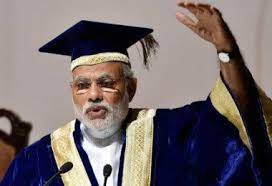
fekuWhile the University is yet formally produce' the copy of master's degree of Modi, a few newspapers belonging to the Times Group have claimed to have obtained the information on the PM's performance in his post-graduation exams.

Modi's official web site claims he cleared his BA from Delhi University in 1978 and later MA from Gujarat University. However, both universities have consistently rejected RTI applications seeking information about Modi's degrees. The Prime Minister's Office has consistently refused to furnish details of PM's educational qualifications demanded under RTIs so far.

The Central Information Commission (CIC) recently had directed Delhi and Gujarat Universities to provide information on Mr Modi's educational qualifications as per the request made by Delhi Chief Minister Arvind Kejriwal.

First Class!

According to media reports, Modi completed his masters in political science through correspondence with a score of 62.3 per cent in 1983. His subjects in the two-year course included European Politics, Indian Political Analysis and Psychology of Politics.

The university, however, has no information about the PM's graduation. Mr Modi completed his prescience from M N Science College, Visnagar. The college, however, has no records of how Mr Modi fared beyond the fact that he passed pre-science, which is a one-year course equivalent to class XII.
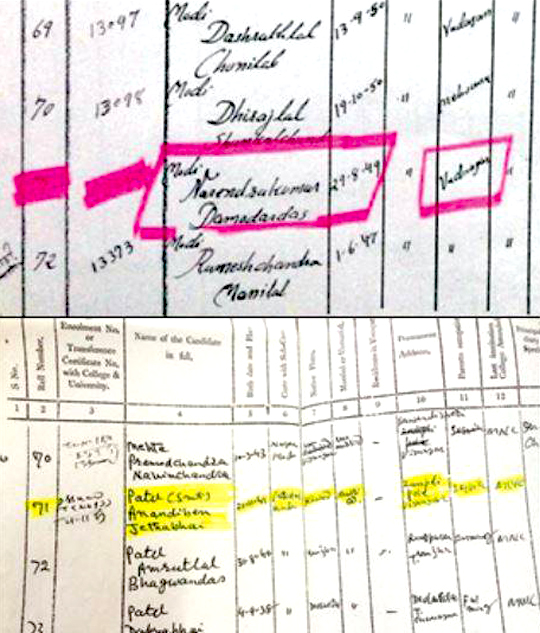
Modidegree

Two dates of birth!

Meanwhile, the leaked documents have brought to the fore a new date of birth of the prime minister. Modi's official date of birth on his official website is 17 September 1950. But, according to the document of Gujarat University carried by the media, Modi was born on 29 August 1949.

Many activists, who have been relentlessly pursuing information on Modi's educational qualification, have expressed suspicion of manipulation by the university.

“The paper from which picture is taken from is so white and seems to be recreated! After over three decades, paper will have yellow tint. Things can be fabricated easily and Gujarat has taken the lead. Delhi will follow,” an Ahmedabad based activist was quoted as saying by a news portal.

Same Roll Number for Modi and Anandiben!

Interestingly, while Modi was studying for his pre-science, his close political associate and current Chief Minister of Gujarat Anandiben Patel was a second year MSc student of Inorganic Chemistry in the same college. In fact, they shared the same roll number — 71.

Comments

SK
 - 
Monday, 2 May 2016

M A = Marriage Absconder......hey,hey.....

abdul
 - 
Sunday, 1 May 2016

WHAT A GREAT COUNTRY OUR INDIA IS. !
HIS BIRTH DATE FALSE.
HIS SSC SHOOLING IS FALSE.
HIS GRADUATION IS FALSE
HIS MASTER DEGREE IS FALSE.
HIS MARRIAGE IS FALSE.
HIS FOLLWING CHADDI PATH IS FALSE.
HIS POLITICAL CARRIER WITH CRIMANL RECORD
NOT LAST, BUT LEAST HIS PROMISES ARE FALSE
EVERYTHING IS FALSE AND FEKUS'
& WHAT HE HAS THE CORRECT THING IN HIS LIFE ?
IS THIS IS THE CRETERIA FOR P.M FOR COUNTRY LIKE INDIA ?LIKE
WOW----- GREAT INDIA'S GREAT PRIME MINISTER...!

REALITY
 - 
Sunday, 1 May 2016

I think Modi needs to change his hired IT professional who deceived many thru MEDIA. But their LIES are alwz caught in everything they DO>.. Modi should stop focusing on cheddi morals and start being a good human being not just in selfies but in REALITY

Rikaz
 - 
Sunday, 1 May 2016

Faku is faking.....again and again....shameless creature!

UMMAR
 - 
Sunday, 1 May 2016

AB KI BAAR FEKU SARKAAR...................

Sanam
 - 
Sunday, 1 May 2016

First prime minister of India who born twice! really great!! Jai Bhakt Gan

Narada
 - 
Sunday, 1 May 2016

Two things you can't find in this world.

1) Those who bought tea from Modi

2) Classmates of Modi

Add new comment

  • Coastaldigest.com reserves the right to delete or block any comments.
  • Coastaldigset.com is not responsible for its readers’ comments.
  • Comments that are abusive, incendiary or irrelevant are strictly prohibited.
  • Please use a genuine email ID and provide your name to avoid reject.
News Network
July 22,2020

New Delhi, Jul 22: Sir Philip Barton visited Bengaluru on Tuesday in the first of the series of virtual regional visits as the UK's new High Commissioner and called Chief Minister BS Yeddyurappa, business leaders, and startup community to pitch for new momentum in the already strong UK-Karnataka relationship.

During his virtual call, High Commissioner Barton got a 'real' taste of Bengaluru through a traditional Masala Dosa delivered to his residence in Delhi along with authentic south Indian filter coffee, which he relished over a chat with historian and commentator Ramachandra Guha. They discussed the unique UK-India "living bridge" across culture and cuisine, history and heritage, and sports and science.

Both Yeddyurappa and the British envoy restated their commitment to working together on the immediate challenges of Covid-19 and beyond.

Barton subsequently 'traveled' to Electronics City, where he met with a range of key business leaders to discuss deepening the UK-India tech partnership and opportunities for global investors in the UK.

Barton also met with a group of entrepreneurs, business founders and innovators, who were part of the first GoGlobal UK cohort to explore the dynamic UK market considered one of the best ecosystems for startups in the world. 

They had earlier attended a week-long boot-camp in London and Manchester in December 2019 that helped them bolster their business skills, build links with UK's thriving digital sector, and paved the way for future partnerships.

"I am delighted to make my first regional virtual visit to Bengaluru, the technology hub of India. My visit comes at a difficult time for everyone. So it is also a time when the excellent collaboration between the UK and Karnataka across technology and healthcare could not be important," Barton said.

"Making the most of those close links, and drawing on the great energy, innovation and entrepreneurship that Karnataka is famous for, will be central to ensuring we all recover from Covid-19 stronger than ever," he added.

Comments

Add new comment

  • Coastaldigest.com reserves the right to delete or block any comments.
  • Coastaldigset.com is not responsible for its readers’ comments.
  • Comments that are abusive, incendiary or irrelevant are strictly prohibited.
  • Please use a genuine email ID and provide your name to avoid reject.
News Network
April 8,2020

Bengaluru, Apr 8: A 65-year-old man from Kalaburagi district became the fifth COVID-19 fatality in Karnataka, where six new positive cases were confirmed, pushing the tally in the state to 181, the health department said on Wednesday.

The man with Severe Acute Respiratory Infection (SARI), died at a designated hospital in Kalaburagi on Tuesday, a day after being shifted from a private hospital where he was initially treated for two days.

"On April 4, he had got admitted to a private hospital, on April 6 he was shifted to ESI hospital, where he passed away," Primary and Secondary Education Minister Suresh Kumar told reporters here.

The private hospital had been locked and its entire medical team quarantined, he said, adding a notice had been served on it for act of "criminal negligence" (by not referring the patient to designated hospital) and will be followed with a police case.

"He was suffering from SARI, on collecting his sample, tests have revealed that he was positive....investigation is on to find how he got infected," the Minister said.

Noting that the hospital in this case did not refer the patient to the designated hospital and kept treating him for two days, he appealed to all private healthcare facilities to inform authorities if anyone showed any indications for COVID-19.

"As of 5 PM on April 8, cumulatively 181 COVID-19 positive cases have been confirmed in the state, it includes 5 deaths and 28 discharges," the health department said in a bulletin.

Out of the positive cases, 71 are those who had come back from foreign countries, while remaining 110 are contacts and those who had gone to Delhi, the Minister said.

Kumar also said an expert committee comprising Narayana Health founder-chairman Dr Devi Prasad Shetty and Jayadeva Institute of Cardiovascular Sciences director Dr C N Manjunath among others, constitutedto devise an exit strategy for the lockdown, has submitted its reports with various recommendations to Chief Minister B S Yediyurappa.

The chief minister and officials were examining it which was likely to come up before the cabinet meeting on Thursday after which the details will be shared, he added.

The health department said the six fresh cases reported on Wednesday included the elderly man from Kalaburagi who died.

Among the positive cases are a woman from Uttara Kannada with history of SARI and contact of a Dubai returnee, a 72- year-old woman from Kalaburagi, who is mother of a patient that tested positive for the disease; a man from Mandya with contact to two patients.

Others include a man from Chikkaballapura with travel history to Delhi and a woman from Bengaluru also with a travel history to the national capital.

Contact tracing is in progress for all the cases, the bulletin added.

The department said out of 148 active cases in the state, 146 COVID-19 positive patients (including 1 pregnant woman) are in isolation at designated hospitals are stable and two in ICU (one each on oxygen and ventilators).

It said out of total 181 cases in the state, six are transit passengers of Kerala.

Bengaluru accounted for the highest in the state with 63 cases, followed by Mysuru (35), Dakshina Kannada (12) Bidar (ten), Uttara Kannada and Kalaburagi (9 each), Chikkaballapur (8) Belagavi (7), Ballari (6), Bagalkote (5), Mandya (4) Davangere, Bengaluru Rural and Udupi (three each), and Kodagu, Tumakuru, Gadag and Dharwad one each.

Those discharged include 16 from Bengaluru, four from Dakshina Kannada, two each from Uttara Kannada, Kalaburagi and Davangere, and one from Bengaluru Rural; while among those dead are two from Kalaburgari and one each are reported from Bengaluru, Bagalkote and Tumakuru.

Comments

Add new comment

  • Coastaldigest.com reserves the right to delete or block any comments.
  • Coastaldigset.com is not responsible for its readers’ comments.
  • Comments that are abusive, incendiary or irrelevant are strictly prohibited.
  • Please use a genuine email ID and provide your name to avoid reject.
Ram Puniyani
February 4,2020

As democracy is seeping in slowly all over the world, there is an organization which is monitoring the degree of democracy in the individual countries, The Economist Intelligence Unit. As such in each country there are diverse factors which on one hand work to deepen it, while others weaken it. Overall there is a march from theoretical democracy to substantive one. The substantive democracy will herald not just the formal equality, freedom and community feeling in the country but will be founded on the substantive quality of these values. In India while the introduction of modern education, transport, communication laid the backdrop of beginning of the process, the direction towards deepening of the process begins with Mahatma Gandhi when he led the non-cooperation movement in 1920, in which average people participated. The movement of freedom for India went on to become the ‘greatest ever mass movement’ in the World.

The approval and standards for democracy were enshrined in Indian Constitution, which begins ‘We the people of India’, and was adopted on 26th January 1950. With this Constitution and the policies adopted by Nehru the process of democratization started seeping further, the dreaded Emergency in 1975, which was lifted later restored democratic freedoms in some degree. This process of democratisation is facing an opposition since the decade of 1990s after the launch of Ram Temple agitation, and has seen the further erosion with BJP led Government coming to power in 2014. The state has been proactively attacking civil liberties, pluralism and participative political culture with democracy becoming flawed in a serious way. And this is what got reflected in the slipping of India by ten places, to 51st, in 2019. On the index of democracy India slipped down from the score of 7.23 to 6.90. The impact of sectarian BJP politics is writ on the state of the nation, country.

Ironically this lowering of score has come at a time when the popular protests, the deepening of democracy has been given a boost and is picking up with the Shaheen Bagh protests. The protest which began in Shaheen Bagh, Delhi in the backdrop of this Government getting the Citizenship amendment Bill getting converted into an act and mercilessly attacking the students of Jamia Milia Islamia, Aligarh Muslim University along with high handed approach in Jamia Nagar and neighbouring areas.  From 15th December 2019, the laudable protest is on.

It is interesting to note that the lead in this protest has been taken by the Muslim women, from the Burqa-Hijab clad to ‘not looking Muslim’ women and was joined by students and youth from all the communities, and later by the people from all the communities. Interestingly this time around this Muslim women initiated protest has contrast from all the protests which earlier had begun by Muslims. The protests opposing Shah Bano Judgment, the protests opposing entry of women in Haji Ali, the protests opposing the Government move to abolish triple Talaq. So far the maulanas from top were initiating the protests, with beard and skull cap dominating the marches and protests. The protests were by and large for protecting Sharia, Islam and were restricted to Muslim community participating.

This time around while Narendra Modi pronounced that ‘protesters can be identified by their clothes’, those who can be identified by their external appearance are greatly outnumbered by all those identified or not identified by their appearance.

The protests are not to save Islam or any other religion but to protect Indian Constitution. The slogans are structured around ‘Defence of democracy and Indian Constitution’. The theme slogans are not Allahu Akbar’ or Nara-E-Tadbeer’ but around preamble of Indian Constitution. The lead songs have come to be Faiz Ahmad Faiz’s ‘Hum Dekhenge’, a protest against Zia Ul Haq’s attempts to crush democracy in the name of religion. Another leading protest song is from Varun Grover, ‘Tanashah Aayenge…Hum Kagaz nahin Dikhayenge’, a call to civil disobedience against the CAA-NRC exercise and characterising the dictatorial nature of the current ruling regime.

While BJP was telling us that primary problem of Muslim women is Triple talaq, the Muslim women led movements has articulated that primary problem is the very threat to Muslim community. All other communities, cutting across religious lines, those below poverty line, those landless and shelter less people also see that if the citizenship of Muslims can be threatened because of lack of some papers, they will be not far behind in the victimization process being unleashed by this Government.

While CAA-NRC has acted as the precipitating factor, the policies of Modi regime, starting from failure to fulfil the tall promises of bringing back black money, the cruel impact of demonetisation, the rising process of commodities, the rising unemployment, the divisive policies of the ruling dispensation are the base on which these protest movements are standing. The spread of the protest movement, spontaneous but having similar message is remarkable. Shaheen Bagh is no more just a physical space; it’s a symbol of resistance against the divisive policies, against the policies which are increasing the sufferings of poor workers, the farmers and the average sections of society.

What is clear is that as identity issues, emotive issues like Ram Temple, Cow Beef, Love Jihad and Ghar Wapasi aimed to divide the society, Shaheen Bagh is uniting the society like never before. The democratisation process which faced erosion is getting a boost through people coming together around the Preamble of Indian Constitution, singing of Jan Gan Man, waving of tricolour and upholding the national icons like Gandhi, Bhagat Singh, Ambedkar and Maulana Azad. One can feel the sentiments which built India; one can see the courage of people to protect what India’s freedom movement and Indian Constitution gave them.

Surely the communal forces are spreading canards and falsehood against the protests. As such these protests which is a solid foundation of our democracy. The spontaneity of the movement is a strength which needs to be channelized to uphold Indian Constitution and democratic ethos of our beloved country.

Comments

Add new comment

  • Coastaldigest.com reserves the right to delete or block any comments.
  • Coastaldigset.com is not responsible for its readers’ comments.
  • Comments that are abusive, incendiary or irrelevant are strictly prohibited.
  • Please use a genuine email ID and provide your name to avoid reject.