


British MPs may have to comply with Sharia law

January 30, 2016

London, Jan 30: British lawmakers may have to comply with the Sharia law including an alcohol ban when they move out of the Westminster Palace which is set to undergo much- needed repairs as the new complex they will shift into is governed by the Islamic law.parliamen
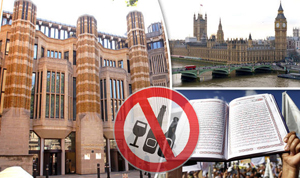
A UK parliamentary committee searching for a new temporary home for the House of Commons away from the Palace of Westminster has identified Richmond House, home to the UK's Department of Health, as a favoured option.

But the building in the Whitehall political hub of London was transferred to finance an Islamic bond scheme of "Sukuk" two years ago, and a condition of its lease is that it cannot be used for purposes not sanctioned by Sharia law.

An official told The Times newspaper that under terms of the deal agreed with the UK Treasury, the sale of alcohol is among activities explicitly forbidden.

"It is true. If MPs want to use Richmond House they'd better give up any hopes it will include a bar," he said.

MPs and peers were told this week that they are likely to have to move out of the Palace of Westminster entirely for at least six years to allow for a four-billion pounds overhaul of the crumbling neo-Gothic pile.

According to the newspaper, parliamentarians will have to leave behind at least 10 licensed bars and restaurants, each well-stocked with competitively priced drinks.

The Richmond House complex, just north of the existing parliamentary estate, has been narrowed down as a favoured options as it can easily be taken within a security cordon and could comfortably accommodate a temporary debating chamber.

In July 2014, UK Chancellor George Osborne had announced that the Treasury was launching the first Islamic bond in a western financial centre.

The 200 million pounds bonds, known as Sukuk, would help make Britain "the western hub of Islamic finance" and the "undisputed centre of the global financial system", he said.

The offer was more than 10 times oversubscribed as central banks and sovereign wealth funds in Gulf states snapped up bonds that pay just over two per cent annually for five years.

Devout Muslims cannot buy traditional government bonds because they pay interest.
Sukuk, an Islamic alternative, permit guaranteed returns if they are linked to rental payments.

In the Treasury version, three government buildings — including Richmond House — are being used to finance the products. To ensure that the Sukuk were fully compliant with Sharia, the Treasury agreed to conditions on the properties' use including a ban on the sale of alcohol.

"The committee is looking at a range of options and no final decision has been taken. It is aware that Richmond House is under a bond," a spokesperson for the joint committee on the Palace of Westminster said.

The 182-year-old Palace of Westminster currently has eight bars in its premises.

Comments

Add new comment

  • Coastaldigest.com reserves the right to delete or block any comments.
  • Coastaldigset.com is not responsible for its readers’ comments.
  • Comments that are abusive, incendiary or irrelevant are strictly prohibited.
  • Please use a genuine email ID and provide your name to avoid reject.
News Network
April 16,2020

Bengaluru, Apr 16: In view of the raging coronavirus pandemic, no public iftaar or sehri will be organized during Ramazan, the month of fasting for the Muslims, the Karnataka Minority Welfare Department announced here on Thursday.

"No public shall be allowed to perform five-time congregational prayers in mosques, across Karnataka during Ramazan in view of COVID-19 pandemic. No public address system to be used by the staff of mosques for offering namaz,'' the department said.

During the holy month of Ramazan, it is a tradition to organise iftaar feasts for large gatherings by different people, especially by politicians, celebrities and the common wealthy people for their friends and family.

Ramazan is to commence from the 24th or 25th of April this year, depending on the sighting of the moon.

The order stated that Azaan (the call for prayer) shall be given at low decibel and namaaz including Friday namaaz, will be performed by the imams, moazzins and the masjid staff only.
No public should be allowed to offer namaaz in the mosques as per government directions, it said.

The state government also cited an order by the Ministry of Home Affairs dated April 15, which stated that "All religious places/places of worship shall be closed for public. Religious congregations are strictly prohibited due to the outbreak of COVID-19 across the country."
Thirty-four more COVID-19 cases, including 17 cases from Belagavi, have been reported from Karnataka. The total number of coronavirus cases in the state now stands at 313.

The total number of cases in India has now climbed to 12,380. Out of these cases, 1489 have been cured/discharged/migrated while 414 deaths have been reported so far, as per the latest data provided by the Ministry of Health and Family Welfare.

Comments

Add new comment

  • Coastaldigest.com reserves the right to delete or block any comments.
  • Coastaldigset.com is not responsible for its readers’ comments.
  • Comments that are abusive, incendiary or irrelevant are strictly prohibited.
  • Please use a genuine email ID and provide your name to avoid reject.
News Network
May 13,2020

Bengaluru, May 13: The Karnataka Common Entrance Test (K-CET) 2020 will be held on July 30 and 31.

The test, earlier as scheduled to be held on April 22, 23 and 24, was postponed due to COVID-19 crisis and the nation-wide lockdown.

Now, considering the dates for National Eligibility cum Entrance Test (NEET) and Joint Entrance Examination (JEE) dates announced by the Union government, the state government has announced the revised dates on Wednesday.

Higher Education Minister Dr C N Ashwath Narayan announced this in a press conference. The test will be held online, the minister said. 

For CET 2020, over 1.90 lakh students registered for admission to undergraduate engineering, B Tech, Architecture, Agriculture and veterinary science courses.

Home quarantine for repatriated pregnant women, children, senior citizens if they test covid-19 negative 

The Union Health Ministry has revised its discharge guidelines for COVID-19 patients, stating that only those with severe illness need to be tested (through a swab test) and a negative report needs to be obtained before discharge.

The latest guideline adds that other categories of patients, including very mild, mild, pre-symptomatic and moderate cases, need not be tested before discharge.

Comments

Add new comment

  • Coastaldigest.com reserves the right to delete or block any comments.
  • Coastaldigset.com is not responsible for its readers’ comments.
  • Comments that are abusive, incendiary or irrelevant are strictly prohibited.
  • Please use a genuine email ID and provide your name to avoid reject.
News Network
January 21,2020

Bengaluru, Jan 21: A private hospital in Bengaluru, the capital of Karnataka, on Tuesday claimed that it has successfully performed a live liver transplant on a Jehovah's Witness from Nigeria, by not using blood or blood products, in order to protect the patient's religious beliefs.

It is said that Jehovah's Witnesses are followers of a Christian faith that prohibits the use of blood or blood products during their treatment. Gehojadak (37), a Jehovah's Witness follower, had developed decompensated liver disease and visited more than three countries seeking treatment over the last four years but was turned away by most doctors due to the highly risky nature of surgery, Aster CMI Hospital said.

The surgery was challenging compared to a normal liver transplant because in order to protect the patient's religious beliefs, the medical team could not use blood or blood products (Fresh frozen plasma, Cryoprecipitate, Platelets etc), it said in a release, adding that very few such surgeries have been successfully conducted worldwide.

The patient's brother was the donor, the hospital said, adding, without a liver transplant, Gehojadak's chances of survival were less than 10 per cent over the next two years. A team of liver specialists from the Hospital thoroughly reviewed the patient's medical history before recommending a bloodless liver transplant and charted out a feasible pathway to make the surgery a success.

"This transplant was especially challenging as we did not have the safety net (of using blood) even if the patient's life was at risk due to their advance directive. We have performed other non-transplant liver surgeries in Jehovah's Witnesses and this gave us the confidence to take on Gehojadak's transplant," Dr Rajiv Lochan, Consultant Liver Transplant Surgeon, said.

The critical surgery took a 12-hour period to complete where two teams of specialists with close to 25 doctors including anaesthetists, intensivists worked in absolute sync with each other and Gehojadak finally received a life-saving liver transplant, the Hospital said. In a period of two weeks, the patient and his brother were fit enough to go home and were discharged from the hospital.

"Even if their haemoglobin levels dropped to life-threatening levels, the patients were clear that they would not accept a blood transfusion. Keeping the limitations in mind, the most effective treatment path was planned, and we spent close to two months preparing the patients for surgery," Arun V, Consultant Anesthesiologist said. The hospital arranged customised artificial products like synthetic drug molecules, to conduct a bloodless liver transplant, he added.

Comments

Add new comment

  • Coastaldigest.com reserves the right to delete or block any comments.
  • Coastaldigset.com is not responsible for its readers’ comments.
  • Comments that are abusive, incendiary or irrelevant are strictly prohibited.
  • Please use a genuine email ID and provide your name to avoid reject.