


British MPs may have to comply with Sharia law

January 30, 2016

London, Jan 30: British lawmakers may have to comply with the Sharia law including an alcohol ban when they move out of the Westminster Palace which is set to undergo much- needed repairs as the new complex they will shift into is governed by the Islamic law.parliamen
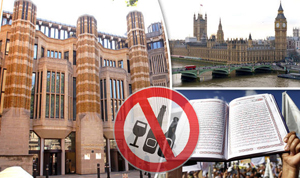
A UK parliamentary committee searching for a new temporary home for the House of Commons away from the Palace of Westminster has identified Richmond House, home to the UK's Department of Health, as a favoured option.

But the building in the Whitehall political hub of London was transferred to finance an Islamic bond scheme of "Sukuk" two years ago, and a condition of its lease is that it cannot be used for purposes not sanctioned by Sharia law.

An official told The Times newspaper that under terms of the deal agreed with the UK Treasury, the sale of alcohol is among activities explicitly forbidden.

"It is true. If MPs want to use Richmond House they'd better give up any hopes it will include a bar," he said.

MPs and peers were told this week that they are likely to have to move out of the Palace of Westminster entirely for at least six years to allow for a four-billion pounds overhaul of the crumbling neo-Gothic pile.

According to the newspaper, parliamentarians will have to leave behind at least 10 licensed bars and restaurants, each well-stocked with competitively priced drinks.

The Richmond House complex, just north of the existing parliamentary estate, has been narrowed down as a favoured options as it can easily be taken within a security cordon and could comfortably accommodate a temporary debating chamber.

In July 2014, UK Chancellor George Osborne had announced that the Treasury was launching the first Islamic bond in a western financial centre.

The 200 million pounds bonds, known as Sukuk, would help make Britain "the western hub of Islamic finance" and the "undisputed centre of the global financial system", he said.

The offer was more than 10 times oversubscribed as central banks and sovereign wealth funds in Gulf states snapped up bonds that pay just over two per cent annually for five years.

Devout Muslims cannot buy traditional government bonds because they pay interest.
Sukuk, an Islamic alternative, permit guaranteed returns if they are linked to rental payments.

In the Treasury version, three government buildings — including Richmond House — are being used to finance the products. To ensure that the Sukuk were fully compliant with Sharia, the Treasury agreed to conditions on the properties' use including a ban on the sale of alcohol.

"The committee is looking at a range of options and no final decision has been taken. It is aware that Richmond House is under a bond," a spokesperson for the joint committee on the Palace of Westminster said.

The 182-year-old Palace of Westminster currently has eight bars in its premises.

Comments

Add new comment

  • Coastaldigest.com reserves the right to delete or block any comments.
  • Coastaldigset.com is not responsible for its readers’ comments.
  • Comments that are abusive, incendiary or irrelevant are strictly prohibited.
  • Please use a genuine email ID and provide your name to avoid reject.
News Network
February 14,2020

Bhuj, Feb 14: In a horrifying incident, as many as 68 undergraduate girls were paraded through their college into the restroom and forced to individually remove their undergarments to prove that they were not menstruating. 

This shameful exercise was conducted at Shri Sahjanand Girls’ Institute (SSGI) in Gujarat’s Bhuj under the supervision of principal and other teachers. 

It all began after the hostel rector complained to the principal that some of the inmates had been violating the Hindu religious norms specifically for menstruating females.

According to the sect’s norms, menstruating females are barred from entering the temple and kitchen. They are even forbidden from touching other students. However, the hostel administration reportedly complained to principal Rita Raninga that some girls who were having their periods not just mingled with other hostel inmates, but also entered the kitchen and ventured near the temple on the premises. 

“It was sheer mental torture and we don’t have words to describe it,” a student who underwent the traumatic experience said, adding that there were total 68 girls who were forced to pass through the test.

“The hostel administration levelled this allegation and insulted us on Wednesday. On Thursday, when we were attending lectures, rector Anjaliben called the principal and complained about this. We were forced to leave our classrooms and queue up outside in the passage. The principal abused and insulted us, asking which of us were having our periods. Two of us who were menstruating stepped aside,” said another victim.

“Despite this, we were all taken to the washroom. There, female teachers asked us to individually remove our undergarments so they could check if we were menstruating,” she added.

Another teenage undergraduate said, “We come from farflung villages. The college campus houses a school that runs classes from Class 1to 12. They provide hostel facilities to the school students. The college does not have its own hostel. We live with the school-kids in their hostel.”

She added, “The principal, hostel rector and the trustees harass us regularly over the issue of menstruation. We are punished for having periods. This happens even if we follow their religious rules. They made us remove our undergarments because they thought some of us were lying about not having periods, and mingling with the others against rules. But the humiliation meted out to us on Thursday was the last straw. When we protested against this, trustee Pravin Pindoria told us that we could take legal action if we wanted but we would have to first leave the hostel. He also forced the students to sign a letter saying nothing happened in college. But enough is enough.”

Kutch University authorities have, meanwhile, swung into action and a five-member team including in-charge vice-chancellor, Darshna Dholakia, and two other senior female professors visited the college on Thursday. “We will speak to the students and the college authority and later initiate appropriate action based on the findings,” Dholakia said.

Run by followers of Swaminarayan Mandir, the college was set up in 2012 but moved into a new building on the premises of Shree Swaminarayan Kanya Mandir in 2014. The college which offers BCom, BA and BSc courses has about 1,500 students of which 68, who come from remote villages, stay in the hostel on campus. The college is known for its pro-Hindutva stance.

Comments

Add new comment

  • Coastaldigest.com reserves the right to delete or block any comments.
  • Coastaldigset.com is not responsible for its readers’ comments.
  • Comments that are abusive, incendiary or irrelevant are strictly prohibited.
  • Please use a genuine email ID and provide your name to avoid reject.
News Network
February 10,2020

Bengaluru, Feb 10: Two Iranian nationals have been arrested by the Karnataka police for allegedly stealing money from car showrooms by diverting cashiers’ attention in Mangaluru, Udupi and Bengaluru.

The arrested are Saeed Rostami, 26 and his friend Saber Hossein Eghbalzadeh, 35, are both residents of Tehran and in India on tourist visa. They were caught by the sleuths of Bengaluru’s RMC Yard police station.

The accused would approach the cashiers, asking for change for Rs 2000 notes to divert their attention and flee with cash from the showroom. 

The duo landed in New Delhi on January 16. Later, they arrived in coastal Karnataka before reaching Bengaluru on February 1. 

The same day around 4pm, the two visited Trident Automobile Pvt Ltd’s service centre in RMC Yard. They went to cashier Kiran and sought change for Rs 2000. One of them dropped the note and Kiran picked it up for him. Meanwhile, Kiran also noticed there was no change in his cash box and informed the duo accordingly. 

“Kiran later realised Rs 44,000 was missing from the cash box. He verified CCTV footage and found the two visitors stole the money when he bent down to pick up the Rs 2000 note,” a police officer said.

Kiran filed a theft and cheating case against the men. RMC Yard police suggested Kiran circulate the footage at other car showrooms and service centres as they had heard about similar incidents being reported from Udupi, Mangaluru and other places in Bengaluru.

“Sharing of CCTV footage helped us nab the suspects. They visited a showroom near Cauvery junction on Ballari Road on February 6. The staff noticed the duo and realised they were the same guys, who had stolen the money at RMC Yard and informed us,” said police.

Comments

Add new comment

  • Coastaldigest.com reserves the right to delete or block any comments.
  • Coastaldigset.com is not responsible for its readers’ comments.
  • Comments that are abusive, incendiary or irrelevant are strictly prohibited.
  • Please use a genuine email ID and provide your name to avoid reject.
News Network
June 20,2020

Bengaluru, Jun 20: The Karnataka Health Department has issued guidelines on the admission of COVID-19 patients in private hospitals after clinical assessment, mandating that the district surveillance officer (DSO) should be first informed to initiate further procedures, an official said on Friday.

"A health team sent by the DSO should visit the home or hospital where the patient is staying. The team should conduct a rapid assessment of his or her health condition," said Karnataka's Additional Chief Secretary Jawaid Akhtar.

In the rapid health condition assessment, the team should first check the patient's body temperature, followed by SpO2 (oxygen saturation) level and confirm if there are any comorbidities such as hypertension, diabetes, tuberculosis, HIV, cancer, stroke etc.

Depending on the health condition of patients, Akhtar said, two categories have been made.

"Those who have body temperature greater than 37.5 degrees Celsius, SpO2 level below 94 percent, elderly (above 60 years) and suffering from known comorbid conditions should be taken to a dedicated Covid hospital (DCH)," he said.

"All other patients, even if older but not suffering from co-morbidities, those below 60 and suffering from co-morbidities and asymptomatic cases should be taken to a dedicated Covid health centre (DCHC) or a private hospital as opted by the patient," he added.

Private hospitals have been asked to pitch in due to the rising number of cases in Karnataka. Currently, there are 2943 active cases in the state after 337 cases were reported on Friday.

"The patients are assessed clinically and evaluated at DCHCs or private hospitals with appropriate diagnostic tests. After evaluation, if the patients are asymptomatic, they are shifted to a COVID Care Centre (CCC) for further management," said Akhtar.

CCCs are expected to be equipped with ventilated rooms, pulse oximeters, handheld thermal scanners and blood pressure apparatus.

A nurse has to be present round the clock for every 50 patients and should visit each patient twice a day for assessment whereas the medical officer has to visit the CCC once a day. He should also be available on call in case of an emergency.

Staff serving food and others should wear personal protective equipment and an N-95 mask. Explaining the procedures at DCHCs, Akhtar said general examinations for medical conditions like body temperature, BP, pulse, oxygen saturation and urine output should be in place.

Investigations such as complete blood count, fasting blood sugar, random blood sugar, liver function tests, renal function tests, ECG and chest X-ray facilities should be available.

"DCHCs should ensure that above examinations are over in an orderly timeline of 24 hours and depending on the examination, the patient is continued to be lodged at the DCHC or sent to DCH or CCC," said the senior officer.

Likewise, the discharge policy should be done as per the protocols issued by the Health Department from time to time.

The Karnataka government is yet to fix an upper limit on the cost of treating COVID-19 patients in private hospitals. While reports indicated that this could be capped at Rs 5200 per day, health officials are yet to specify this is the case. Private hospitals in the state have asked the government to take a collaborative approach in deciding the fixed cap on treatment cost.

Comments

Add new comment

  • Coastaldigest.com reserves the right to delete or block any comments.
  • Coastaldigset.com is not responsible for its readers’ comments.
  • Comments that are abusive, incendiary or irrelevant are strictly prohibited.
  • Please use a genuine email ID and provide your name to avoid reject.