British MPs may have to comply with Sharia law

January 30, 2016

London, Jan 30: British lawmakers may have to comply with the Sharia law including an alcohol ban when they move out of the Westminster Palace which is set to undergo much- needed repairs as the new complex they will shift into is governed by the Islamic law.parliamen
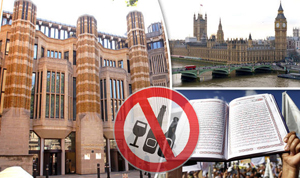
A UK parliamentary committee searching for a new temporary home for the House of Commons away from the Palace of Westminster has identified Richmond House, home to the UK's Department of Health, as a favoured option.

But the building in the Whitehall political hub of London was transferred to finance an Islamic bond scheme of "Sukuk" two years ago, and a condition of its lease is that it cannot be used for purposes not sanctioned by Sharia law.

An official told The Times newspaper that under terms of the deal agreed with the UK Treasury, the sale of alcohol is among activities explicitly forbidden.

"It is true. If MPs want to use Richmond House they'd better give up any hopes it will include a bar," he said.

MPs and peers were told this week that they are likely to have to move out of the Palace of Westminster entirely for at least six years to allow for a four-billion pounds overhaul of the crumbling neo-Gothic pile.

According to the newspaper, parliamentarians will have to leave behind at least 10 licensed bars and restaurants, each well-stocked with competitively priced drinks.

The Richmond House complex, just north of the existing parliamentary estate, has been narrowed down as a favoured options as it can easily be taken within a security cordon and could comfortably accommodate a temporary debating chamber.

In July 2014, UK Chancellor George Osborne had announced that the Treasury was launching the first Islamic bond in a western financial centre.

The 200 million pounds bonds, known as Sukuk, would help make Britain "the western hub of Islamic finance" and the "undisputed centre of the global financial system", he said.

The offer was more than 10 times oversubscribed as central banks and sovereign wealth funds in Gulf states snapped up bonds that pay just over two per cent annually for five years.

Devout Muslims cannot buy traditional government bonds because they pay interest.
Sukuk, an Islamic alternative, permit guaranteed returns if they are linked to rental payments.

In the Treasury version, three government buildings — including Richmond House — are being used to finance the products. To ensure that the Sukuk were fully compliant with Sharia, the Treasury agreed to conditions on the properties' use including a ban on the sale of alcohol.

"The committee is looking at a range of options and no final decision has been taken. It is aware that Richmond House is under a bond," a spokesperson for the joint committee on the Palace of Westminster said.

The 182-year-old Palace of Westminster currently has eight bars in its premises.

Comments

Add new comment

  • Coastaldigest.com reserves the right to delete or block any comments.
  • Coastaldigset.com is not responsible for its readers’ comments.
  • Comments that are abusive, incendiary or irrelevant are strictly prohibited.
  • Please use a genuine email ID and provide your name to avoid reject.
News Network
April 7,2020

Bengaluru, April 7: Karnataka government on Monday allowed bakeries and related product food units in the state to open and function with minimum staff amid a coronavirus nation-wide lockdown.

A circular issued by Rajendar Kumar Kataria, Secretary to the government said, "The Central government has permitted the functioning of food units engaged in bakery and biscuit, condiments, confectionery and sweet for manufacturing, supply and operating retail outlets with minimum staff/labour."

The circular said these units shall strictly follow the guidelines issued by the Ministry of Health and Family Welfare and Department of Health and Family Welfare, Karnataka government with regard to the preventive measures to be ensured for combating COVID-19.

"It is stated that all employers shall ensure that these units maintain high standard of health, hygiene, sanitation and social distancing. The units shall not permit serving/dining in the premises and only parcel/takeaways are permitted," the circular added.

Comments

Add new comment

  • Coastaldigest.com reserves the right to delete or block any comments.
  • Coastaldigset.com is not responsible for its readers’ comments.
  • Comments that are abusive, incendiary or irrelevant are strictly prohibited.
  • Please use a genuine email ID and provide your name to avoid reject.
News Network
July 29,2020

New Delhi, July 29: The government of India today announced Unlock 3.0, lifting of night curfew from August 1 and opening of yoga institutes and gymnasiums from August 5 while educational institutes will remain closed throughout August.

According to the Unlock 3.0 guidelines issued by the Ministry of Home Affairs (MHA), the lockdown in containment zones will be extended until August 30. The new guidelines will be in effect from August 1.

The operation of Metro rail and international flights will remain suspended. Cinema halls, swimming pools, entertainment parks, theatres, bars, auditoriums, assembly halls and similar places will remain shut. Large gatherings are also prohibited.

Yoga institutes and gymnasiums will start operating from August 5 for which the Ministry of Health and Family Welfare will be issuing Standard Operating Procedures. 

Independence Day celebrations will be held with social distancing norms in place.

Restrictions on the movement of individuals during the night (Night curfew between 10 PM and 5 AM) have been removed.

According to the order, states have been given powers to prohibit certain activities outside containment zones or impose such restrictions as deemed necessary based on their assessment of the situation.

"However, there shall be no restriction on inter-state and intra-state movement of persons and goods. No separate permission/approval/e-permit will be required for such movements," the order said. 

In the previous two Unlock guidelines, the government had substantially opened various activities.

Comments

Add new comment

  • Coastaldigest.com reserves the right to delete or block any comments.
  • Coastaldigset.com is not responsible for its readers’ comments.
  • Comments that are abusive, incendiary or irrelevant are strictly prohibited.
  • Please use a genuine email ID and provide your name to avoid reject.
Agencies
February 20,2020

New Delhi, Feb 20: Microsoft has begun testing its free open-source software called "ElectionGuard" in a small Wisconsin town in the US that aims to make voting more secure, verifiable and efficient.

"ElectionGuard" will enable end-to-end verification of elections, open results to third-party organisations for secure validation, and allow individual voters to confirm their votes were correctly counted.

It enables government entities, news outlets, human rights organisations or anyone else to build additional verifiers that independently can certify election results have been accurately counted and have not been altered, according to the company.

The software would create a paper trail and assure voters their votes were properly tallied.

"On Tuesday, Fulton residents are using the technology while choosing who will join the local school board and hold a seat on Wisconsin's state Supreme Court," reports CNBC.

With the test, the company aims to see if voters like the experience and make sure everything works fine.

In May last year, Microsoft CEO Satya Nadella announced "ElectionGuard".

According to Tom Burt, Corporate Vice President, Customer Security and Trust, voting system manufacturers will be free to build ElectionGuard into their systems in a variety of ways.

"These are exciting steps that enable individual voters to confirm their vote was properly counted, and assures those voters using an ElectionGuard system of the most secure and trustworthy vote in the history of the US," Burt said in a recent blog post.

"ElectionGuard" is not intended to replace paper ballots but rather to supplement and improve systems that rely on them, and it is not designed to support internet voting.

The software provides each voter a tracker with a unique code that can be used to follow an encrypted version of the vote through the entire election process via a web portal provided by election authorities.

During the process of vote-casting, voters have an optional step that allows them to confirm that their trackers and encrypted votes accurately reflect their selections.

But once a vote is cast, neither the tracker nor any data provided through the web portal can be used to reveal the contents of the vote.

After the election is complete, the tracker codes can be used by voters to confirm that their votes were not altered or tampered with and that they were properly counted, said Microsoft.

On the security front, "ElectionGuard" uses something called homomorphic encryption - which enables mathematical procedures "like counting - to be done with fully encrypted data".

Comments

Add new comment

  • Coastaldigest.com reserves the right to delete or block any comments.
  • Coastaldigset.com is not responsible for its readers’ comments.
  • Comments that are abusive, incendiary or irrelevant are strictly prohibited.
  • Please use a genuine email ID and provide your name to avoid reject.