



British MPs may have to comply with Sharia law

January 30, 2016

London, Jan 30: British lawmakers may have to comply with the Sharia law including an alcohol ban when they move out of the Westminster Palace which is set to undergo much- needed repairs as the new complex they will shift into is governed by the Islamic law.parliamen
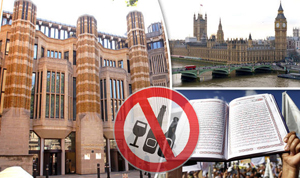
A UK parliamentary committee searching for a new temporary home for the House of Commons away from the Palace of Westminster has identified Richmond House, home to the UK's Department of Health, as a favoured option.

But the building in the Whitehall political hub of London was transferred to finance an Islamic bond scheme of "Sukuk" two years ago, and a condition of its lease is that it cannot be used for purposes not sanctioned by Sharia law.

An official told The Times newspaper that under terms of the deal agreed with the UK Treasury, the sale of alcohol is among activities explicitly forbidden.

"It is true. If MPs want to use Richmond House they'd better give up any hopes it will include a bar," he said.

MPs and peers were told this week that they are likely to have to move out of the Palace of Westminster entirely for at least six years to allow for a four-billion pounds overhaul of the crumbling neo-Gothic pile.

According to the newspaper, parliamentarians will have to leave behind at least 10 licensed bars and restaurants, each well-stocked with competitively priced drinks.

The Richmond House complex, just north of the existing parliamentary estate, has been narrowed down as a favoured options as it can easily be taken within a security cordon and could comfortably accommodate a temporary debating chamber.

In July 2014, UK Chancellor George Osborne had announced that the Treasury was launching the first Islamic bond in a western financial centre.

The 200 million pounds bonds, known as Sukuk, would help make Britain "the western hub of Islamic finance" and the "undisputed centre of the global financial system", he said.

The offer was more than 10 times oversubscribed as central banks and sovereign wealth funds in Gulf states snapped up bonds that pay just over two per cent annually for five years.

Devout Muslims cannot buy traditional government bonds because they pay interest.
Sukuk, an Islamic alternative, permit guaranteed returns if they are linked to rental payments.

In the Treasury version, three government buildings — including Richmond House — are being used to finance the products. To ensure that the Sukuk were fully compliant with Sharia, the Treasury agreed to conditions on the properties' use including a ban on the sale of alcohol.

"The committee is looking at a range of options and no final decision has been taken. It is aware that Richmond House is under a bond," a spokesperson for the joint committee on the Palace of Westminster said.

The 182-year-old Palace of Westminster currently has eight bars in its premises.

Comments

Add new comment

  • Coastaldigest.com reserves the right to delete or block any comments.
  • Coastaldigset.com is not responsible for its readers’ comments.
  • Comments that are abusive, incendiary or irrelevant are strictly prohibited.
  • Please use a genuine email ID and provide your name to avoid reject.
News Network
May 10,2020

May 10: Azaan is an integral part of the faith, not the gadget, says veteran writer-lyricist Javed Akhtar, asking that the Islamic call to prayer on loudspeakers should be stopped as it causes "discomfort" to others.

In a tweet on Saturday, Akhtar wondered why the practice was 'halaal' (allowed) when it was, for nearly half a century in the country, considered 'haraam' or forbidden.

"In India for almost 50 years Azaan on the loud speak was Haraam. Then it became Halaal and so halaal that there is no end to it, but there should be an end to it. Azaan is fine but loud speaker does cause of discomfort for others. I hope that atleast this time they will do it themselves (sic)," Akhtar tweeted.

When a user asked his opinion on loudspeakers being used in temples, the 75-year-old writer said everyday use of speakers is a cause of concern.

"Whether it's a temple or a mosque, if you're using loudspeakers during a festival, it's fine. But it shouldn't be used everyday in either temples or mosques.

"For more than thousand years Azaan was given without the loud speaker. Azaan is the integral part of your faith, not this gadget," he replied.

Earlier in March, Akhtar had supported the demand to shut mosques amid the coronavirus outbreak in the country, saying even Kaaba and Medina have been closed due to the pandemic.

He had also appealed to the Muslim community to offer prayers from home in the holy month of Ramzan, which began on April 24.

"I request all the Muslim brothers that now that Ramzan is coming, please say your prayers but make sure that this doesn't cause problems to anyone else. The prayers that you do in the mosque, you can do that at home. According to you, the house, the ground, this all has been made by Him. Then you can do your prayers anywhere," he had said.

Comments

Add new comment

  • Coastaldigest.com reserves the right to delete or block any comments.
  • Coastaldigset.com is not responsible for its readers’ comments.
  • Comments that are abusive, incendiary or irrelevant are strictly prohibited.
  • Please use a genuine email ID and provide your name to avoid reject.
coastaldigest.com news network
May 4,2020

Mangaluru, May 4: As the coronavirus lockdown norms have been relaxed in the coastal district of Dakshina Kannada, people will be able venture out for essential activities from 7 a.m to 7 p.m.

The lockdown was imposed in the coastal district on March 22 midnight to prevent the spread of Covid-19. Initially it did not apply to essential services such as sale of food, groceries, milk, vegetables, fruits, and meat and fish. Gradually the administration had to intensify the lockdown and allow those shops to remain open between 7 a.m. and 12 noon. However, today (May 4) onwards there will be relaxation of lockdown between 7 am to 7 pm. 

Precautionary measures like maintaining social distancing has been urged and use of face masks has been made mandatory.

Permitted activities

• Permission for plying of auto-rickshaws, cabs, private vehicles and bikes has been given. However only three occupants, including the driver will be allowed and no pillion rule is applicable for two-wheelers.

• OPDs, medical clinics are permitted to operate.

• Standalone shops, shops located in neighbourhood colony, residential complex will be allowed to operate.

• Private organisations can function with 33% staff capacity while allowing work from home for rest of staff.

• E-commerce activities only for essential goods permitted.

• In site construction activities in urban areas, rural areas including MNREGA works.

• Permission is only available to open the shop in the market and in the market complex.

Prohibited activities:

• Movement of individuals is not permitted for all non-essential activities.

• Travel by air, rail and inter-State movement by road.

• Functioning of schools, colleges, and other educational and training/ coaching institutions.

• Hospitality services, including hotels and restaurants.

• Cinema halls, malls, gymnasiums, sports complexes, bars, clubs, swimming pool, entertainment parks, assembly halls, etc; barber shops, spas and salons, textile and apparel(clothes) shops.

• Social, political, cultural, academic, entertainment, religious and other kinds of gatherings; and, religious places/ places of worship for public. 

• Shops in urban and rural areas, for non-essential goods not allowed in malls, markets and Market Complexes.

• All types of traffic movements will be prohibited after evening (7 pm to 7 am)

Comments

Add new comment

  • Coastaldigest.com reserves the right to delete or block any comments.
  • Coastaldigset.com is not responsible for its readers’ comments.
  • Comments that are abusive, incendiary or irrelevant are strictly prohibited.
  • Please use a genuine email ID and provide your name to avoid reject.
News Network
April 19,2020

Kasaragod, Apr 19: Kasaragod, Kerala's COVID-19 hotspot, is the only district in the southern state lacking adequate health infrastructure.

In spite of treating the highest number of COVID-19 patients in the state with meagre infrastructural facilities and even without the support of a medical college in the north Kerala district, no deaths have been reported due to coronavirus.

The state health department views the performance of M Kunhiraman and his team, consisting of Janardhana Naik and Krishna Naik, at the General hospital in Kasaragod as a success story.

"Not only did they control the situation quickly with minimum infrastructure, they also started turning out a large number of negative cases within a few weeks and creditably ensured zero mortality.

This can be showcased as a best global model," Chairman of the Information Education and Communication (IEC) Committee and Project Director Kerala State Aids Control Society, R Ramesh said.

Recalling the ordeal, Janardhana Naik said his first major challenge was the physical examination of a patient with suspected COVID-19.

"Even with the PPE kit, nobody knew how effective they were and it took a whole 30 minutes to wear them properly.

But as time passed, we got accustomed to it," he said.

The traditional method of dealing with a patient involved knowing his or her history, observation and physical examination.

For hundreds of years, the hands-on body approach has been the soul of the doctor-patient relationship -- taking the pulse, tapping on and listening to the chest, feeling lumps.

With the onset of COVID-19 all that has changed.

"In fact, the whole exercise was fraught with grave risks because everything connected with COVID-19 was new.

Doctors have to keep a distance even though the physical examination wearing a Personal Protective Equipment (PPE) is difficult.

Sounds from the body are inaudible, vision is blurred through the smog-covered goggles and a stethoscope seldom has any use," Janardhana Naik said.

It was from March 15 that the hospital started receiving COVID-19 patients, primarily from Dubai.

By the time the first person came, the hospital was ready for him.

Soon, patient numbers began to swell and in a couple of weeks they reached about 91.

From then on, it was teamwork.

Committees were formed for each and every task, including the help desk, IT, treatment, medical board, training, food, waste disposal and data maintenance.

Initially, patients had many misgivings about the hospital.

"Some were disillusioned and even aggressive. Some were not happy with the facilities the hospital had to offer.

But gradually through good treatment and counselling by a psychiatrist, who visited the hospital on alternate days, the confidence and mood of the patients changed and they became friendly with the staff," Naik elaborated.

Counselling was also given to the concerned family members of the patients.

Besides treatment, the medical staff had to spend a considerable amount of time clearing the doubts of patients.

When they got discharged some patients insisted on seeing the faces of the medical staff, who till then were anonymous entities covered from head to toe.

Some even wanted to take selfies with them.

However, the medical team politely turned down their requests and preferred to remain hidden in their work attires.

The mood of the patients also rubbed off on the doctors and hospital staff.

All the physicians and hospital staff are now more confident of dealing with contagious diseases after treating COVID-19 patients.

"Our previous experience of treating H1N1, Chikungunya and Dengue cases helped us a lot.

Words of encouragement from the Health Minister K K Shailaja, Health Principal Secretary Dr Rajan N Khobragade and Health Services Director Dr Sarita R L gave us the impetus to build up confidence.

Moreover, the field health workers did a wonderful job in containing the viral spread," Naik added.

As the number of coronavirus cases rose, the state government on April 5 deputed a 26-member medical team from Thiruvananthapuram to set up a COVID-19 hospital in the district.

They turned a block of the under construction Government Medical College as a hospital-like facility, setting up a 200 bed facility to treat coronavirus patients.

Comments

Add new comment

  • Coastaldigest.com reserves the right to delete or block any comments.
  • Coastaldigset.com is not responsible for its readers’ comments.
  • Comments that are abusive, incendiary or irrelevant are strictly prohibited.
  • Please use a genuine email ID and provide your name to avoid reject.