


British MPs may have to comply with Sharia law

January 30, 2016

London, Jan 30: British lawmakers may have to comply with the Sharia law including an alcohol ban when they move out of the Westminster Palace which is set to undergo much- needed repairs as the new complex they will shift into is governed by the Islamic law.parliamen
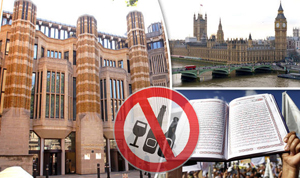
A UK parliamentary committee searching for a new temporary home for the House of Commons away from the Palace of Westminster has identified Richmond House, home to the UK's Department of Health, as a favoured option.

But the building in the Whitehall political hub of London was transferred to finance an Islamic bond scheme of "Sukuk" two years ago, and a condition of its lease is that it cannot be used for purposes not sanctioned by Sharia law.

An official told The Times newspaper that under terms of the deal agreed with the UK Treasury, the sale of alcohol is among activities explicitly forbidden.

"It is true. If MPs want to use Richmond House they'd better give up any hopes it will include a bar," he said.

MPs and peers were told this week that they are likely to have to move out of the Palace of Westminster entirely for at least six years to allow for a four-billion pounds overhaul of the crumbling neo-Gothic pile.

According to the newspaper, parliamentarians will have to leave behind at least 10 licensed bars and restaurants, each well-stocked with competitively priced drinks.

The Richmond House complex, just north of the existing parliamentary estate, has been narrowed down as a favoured options as it can easily be taken within a security cordon and could comfortably accommodate a temporary debating chamber.

In July 2014, UK Chancellor George Osborne had announced that the Treasury was launching the first Islamic bond in a western financial centre.

The 200 million pounds bonds, known as Sukuk, would help make Britain "the western hub of Islamic finance" and the "undisputed centre of the global financial system", he said.

The offer was more than 10 times oversubscribed as central banks and sovereign wealth funds in Gulf states snapped up bonds that pay just over two per cent annually for five years.

Devout Muslims cannot buy traditional government bonds because they pay interest.
Sukuk, an Islamic alternative, permit guaranteed returns if they are linked to rental payments.

In the Treasury version, three government buildings — including Richmond House — are being used to finance the products. To ensure that the Sukuk were fully compliant with Sharia, the Treasury agreed to conditions on the properties' use including a ban on the sale of alcohol.

"The committee is looking at a range of options and no final decision has been taken. It is aware that Richmond House is under a bond," a spokesperson for the joint committee on the Palace of Westminster said.

The 182-year-old Palace of Westminster currently has eight bars in its premises.

Comments

Add new comment

  • Coastaldigest.com reserves the right to delete or block any comments.
  • Coastaldigset.com is not responsible for its readers’ comments.
  • Comments that are abusive, incendiary or irrelevant are strictly prohibited.
  • Please use a genuine email ID and provide your name to avoid reject.
coastaldigest.com news network
July 17,2020

Udupi, July 17: An Indian expatriate from coastal Karnataka who was working in Kuwait passed away in a hospital in the oil-rich country reportedly due to covid-19.

Sheikh Mohammed Syed (54) was a native of Kharvi in Kundapura taluk of Udupi district. He is survived by his mother, wife and three daughters. 

An ex athletic champion from Bhandarkars' Arts & Science College, he was a well-known Volleyball and Kabaddi player in Kundapur.  He was associated with many sports associations in Udupi. 

An employee of KRH firm, he was hospitalized in Kuwait three weeks ago due to ill health. He was tested positive for covid-19.

He breathed his last yesterday without responding to any treatment. Final rites were held in Kuwait. 

Prior to migrating to Kuwait, he had worked in United Arab Emirates for several years. A sports enthusiast, he had trained many athletes in Udupi.

Comments

Add new comment

  • Coastaldigest.com reserves the right to delete or block any comments.
  • Coastaldigset.com is not responsible for its readers’ comments.
  • Comments that are abusive, incendiary or irrelevant are strictly prohibited.
  • Please use a genuine email ID and provide your name to avoid reject.
News Network
July 4,2020

Bengaluru, Jul 4: With the increasing number of COVID-19 cases in Bengaluru, the state government has decided to impose a total lockdown in Bruhat Bengaluru Mahanagara Palike (BBMP) limits.

The lockdown will start from 8 pm today till 5 am on Monday. The sale of essential items will only be allowed during the total lockdown.

"Complete lockdown to be imposed from 8 pm today till 5 am on Monday in Bruhat Bengaluru Mahanagara Palike (BBMP) limits, as per instructions by Karnataka Chief Minister BS Yediyurappa in view of COVID-19," BBMP Commissioner Anil Kumar said on Saturday.

"Sale of essential items will be allowed during the lockdown, including meat shops. Police action will be taken against people found roaming outside unnecessarily," he said.

With the number of cases increasing by 994 in the last 24 hours, the total of cases in the city now stands at 7,713. Of these, 6,297 are active cases.

So far, Karnataka has 19,710 cases with 293 deaths. While 8,805 people have recovered from the deadly virus.

At the national level, the total number of cases have now surged to 6, 48,315 out of which 3, 94,227 patients have recorded, while 18,655 have lost their lives.

Comments

Add new comment

  • Coastaldigest.com reserves the right to delete or block any comments.
  • Coastaldigset.com is not responsible for its readers’ comments.
  • Comments that are abusive, incendiary or irrelevant are strictly prohibited.
  • Please use a genuine email ID and provide your name to avoid reject.
News Network
June 26,2020

Bengaluru, Jun 26: The National Restaurant Association of India (NRAI) on Thursday came up with a Standard Operating Procedure (SOP) for restaurants whereby among other physical distancing norms, it has suggested a 2-metre gap between tables.

Formulated in partnership with Releski, a Bengaluru based skill-tech company, the SoP suggests that in case of back-to-back seating, people sitting with their backs towards each other will have their seats divided by 'Plexiglass' divider raised up to 2 meters from the ground.

"In a typical restaurant, the improvised seating plan should have a minimum distance of 2 metres between tables. The distance of 2 metres (6 feet) between tables should measure from one edge of the table to the other table's edge," it said.

In case of loose or free seating such as in banquet style or food court style seating, a minimum 2 meters of distance should be maintained between tables.

The guidelines noted that, to encourage physical distancing, restaurants have to sacrifice their seating capacity, to promote health and safety, and also to gain trust from their patrons.

"In order to perform this, divide your restaurants under different sectors. Pull out your restaurant's floor plan and colour code different sections red and yellow. Red sections are potential areas where maximum footfall or traffic is observed. Yellow sections are areas where the footfalls are average," it said.

All the red sections are encircled or bordered by placing barricades or Q manager and will open at specific points to access the yellow section and all the opening points will have hand sanitisers and sprays, and every guest who walks from red zones to yellow zones will sanitise himself/herself to reduce the chances of contamination.

For air conditioning, the guidelines of CPWD shall be followed which inter alia emphasises that the temperature setting of all air conditioning devices should be in the range of 24-30 degree Celsius, relative humidity should be in the range of 40- 65 per cent, intake of fresh air should be as much as possible and cross ventilation should be adequate, the guidelines suggested.

The industry body has also suggested appointment of a COVID-free Ambassador who would operate as the Chief Health Officer within the restaurant team, preferably from the management team in each shift.

The ambassador's would put the new daily work routines into practice, to monitor compliance with good practice and to lead the preventative measures, adapt to health & safety recommendations and requirements of the restaurant and oversee the implementation of the norms.

Anurag Katriar, President of NRAI and CEO & Executive Director of deGustibus Hospitality, said: "Every restaurant cutting across formats is facing the harsh reality of subdued to shut business volumes in the present and the uncertainty of business environment in the future. One thing is certain that hygiene and safety will be a key differentiator in the post-pandemic restaurant operations."

Comments

Add new comment

  • Coastaldigest.com reserves the right to delete or block any comments.
  • Coastaldigset.com is not responsible for its readers’ comments.
  • Comments that are abusive, incendiary or irrelevant are strictly prohibited.
  • Please use a genuine email ID and provide your name to avoid reject.