


British MPs may have to comply with Sharia law

January 30, 2016

London, Jan 30: British lawmakers may have to comply with the Sharia law including an alcohol ban when they move out of the Westminster Palace which is set to undergo much- needed repairs as the new complex they will shift into is governed by the Islamic law.parliamen
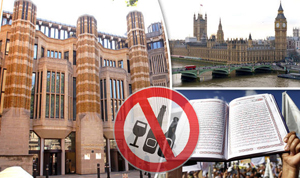
A UK parliamentary committee searching for a new temporary home for the House of Commons away from the Palace of Westminster has identified Richmond House, home to the UK's Department of Health, as a favoured option.

But the building in the Whitehall political hub of London was transferred to finance an Islamic bond scheme of "Sukuk" two years ago, and a condition of its lease is that it cannot be used for purposes not sanctioned by Sharia law.

An official told The Times newspaper that under terms of the deal agreed with the UK Treasury, the sale of alcohol is among activities explicitly forbidden.

"It is true. If MPs want to use Richmond House they'd better give up any hopes it will include a bar," he said.

MPs and peers were told this week that they are likely to have to move out of the Palace of Westminster entirely for at least six years to allow for a four-billion pounds overhaul of the crumbling neo-Gothic pile.

According to the newspaper, parliamentarians will have to leave behind at least 10 licensed bars and restaurants, each well-stocked with competitively priced drinks.

The Richmond House complex, just north of the existing parliamentary estate, has been narrowed down as a favoured options as it can easily be taken within a security cordon and could comfortably accommodate a temporary debating chamber.

In July 2014, UK Chancellor George Osborne had announced that the Treasury was launching the first Islamic bond in a western financial centre.

The 200 million pounds bonds, known as Sukuk, would help make Britain "the western hub of Islamic finance" and the "undisputed centre of the global financial system", he said.

The offer was more than 10 times oversubscribed as central banks and sovereign wealth funds in Gulf states snapped up bonds that pay just over two per cent annually for five years.

Devout Muslims cannot buy traditional government bonds because they pay interest.
Sukuk, an Islamic alternative, permit guaranteed returns if they are linked to rental payments.

In the Treasury version, three government buildings — including Richmond House — are being used to finance the products. To ensure that the Sukuk were fully compliant with Sharia, the Treasury agreed to conditions on the properties' use including a ban on the sale of alcohol.

"The committee is looking at a range of options and no final decision has been taken. It is aware that Richmond House is under a bond," a spokesperson for the joint committee on the Palace of Westminster said.

The 182-year-old Palace of Westminster currently has eight bars in its premises.

Comments

Add new comment

  • Coastaldigest.com reserves the right to delete or block any comments.
  • Coastaldigset.com is not responsible for its readers’ comments.
  • Comments that are abusive, incendiary or irrelevant are strictly prohibited.
  • Please use a genuine email ID and provide your name to avoid reject.
News Network
July 17,2020

Bengaluru, Jul 17: Karnataka Minister for Health and Family Welfare B Sriramulu on Thursday clarified that his remarks have been misinterpreted, wherein he apparently said that ''only God can save people from Covid''.

The Bharatiya Janata Party leader slammed KPCC President D K Shivakumar for spreading false information and said that my words were not meant to cause panic among the masses.

''Respected Shivakumar, this is a clarification regarding my words that have been misinterpreted and misunderstood.

While responding to claims of the opposition that the government’s negligence, irresponsibility and the lack of coordination among ministers are responsible for the rise in cases in the state, I stated that ‘these accusations are far from the truth. People need to be aware and cautious to avoid the spread of the virus. This plays a vital role in controlling the pandemic. If we fail at this crucial step the situation can get complicated. And if things go worse, then only God can save us'', Mr Sriramulu said in a series of posts on Twitter

Comments

Add new comment

  • Coastaldigest.com reserves the right to delete or block any comments.
  • Coastaldigset.com is not responsible for its readers’ comments.
  • Comments that are abusive, incendiary or irrelevant are strictly prohibited.
  • Please use a genuine email ID and provide your name to avoid reject.
News Network
January 18,2020

Bengaluru, Jan 18: Amidst the ongoing probe into the multi-billion IMA ponzi scam, another similar scam has come to light in the city wherein around 2500 depositors, most of them Muslims, are fearing that them may lose Rs 350 crore.

Shockingly, Shafiullah, Rafiullah, and Zabiullah, three brothers who run the Baraka Investment Consultant Private Limited, have accused the police of taking over 10 crore rupees bribe from them.

The depositors say that when they recently demanded their investments back from the accused the trio, they allegedly told them that they had paid the Central Crime Branch (CCB) and the RT Nagar police over 10 crores and they could collect that money from the police.

The aggrieved investors alleges that the RT Nagar police have charge-sheeted the three accused only on the complaints of 13 affected depositors who lost precisely Rs 97 lakh and the case is being probed under the Prize Chits and Money Circulation Schemes (Banning) Act, 1978 instead of Karnataka Protection of Interest of Depositors in Financial Institutions Act, 2004 (KPID Act) or the Banning of Unregulated Deposit Schemes Ordinance, 2019 (BUDS) Ordinance.

Aggrieved victims alleged that when the Baraka Investment Consultants had a Registration Certificate of Establishments from Department of Labour issued on November 28, 2017. The CCB took up a suo-motu case against Tellnet Computers on August 16, 2018, after they received complaints from Baraka investors.

Apparently, the CCB knew that Baraka Investment Consultants and Tellnet Computers was one and the same and operating from the same office, but they did not mention the name of Baraka in the case initially for reasons best known to them, said the victims of the Ponzi scheme. A few victims who wished to remain anonymous told BM that a CCB police inspector and one of the accused, Zabiullah, were childhood friends, neighbours and both hailed from Chikkaballapur. This is one of the reasons, they allege, the inspector has protected the accused by downplaying the scam.

The case registered by the CCB states that there are only 500 to 600 depositors who deposited amounts between Rs 50,000 to Rs 1 lakh expecting returns ranging from Rs 5000 to Rs 7000 a month, but in reality there are more than 2500 investors who have deposited amounts ranging from Rs 50,000 to Rs 50 lakh, expecting returns between 12% to 24%, said the victims. Despite this, the CCB was sitting on the case and making no investigations, the victims alleged.

It was later on in May 9, 2019, an FIR was registered by the RT Nagar police when many victims approached the police commissioner and petitioned him. “Even in this case, the accused Zabiullah was not arrested. Zabiullah’s two brothers, Shafiullah and Rafiullah, and his father Abdul Rahman were arrested, but were later granted conditional bails,” one of the victims Mohammed Yahya (42), a software engineer said.

Yahya had invested Rs 10 lakh with Baraka. “Though this case has been charge-sheeted, the police have not made any recoveries or they have not confiscated any properties of the accused,” alleged victim Habibur Rehman (42) who had invested Rs 5 lakh in Baraka. “There is clear-cut evidence that the accused was dealing in foreign exchange using the investors’ money without their knowledge and was offshoring and parking crores and crores in countries like Russia, Dubai, Malaysia, and Singapore. Though the police knew about this, they did nothing to stop it or bring it back,” said Azgar Pasha (44), a businessman who had invested Rs 41 lakh.

Comments

Add new comment

  • Coastaldigest.com reserves the right to delete or block any comments.
  • Coastaldigset.com is not responsible for its readers’ comments.
  • Comments that are abusive, incendiary or irrelevant are strictly prohibited.
  • Please use a genuine email ID and provide your name to avoid reject.
News Network
January 27,2020

New Delhi, Jan 27: Non-Muslim refugees from Pakistan, Bangladesh and Afghanistan will have to provide proofs of their religious beliefs while applying for Indian citizenship under the controversial Citizenship Amendment Bill (CAA), officials said on Monday.

The applicants belonging to Hindu, Sikh, Christian, Buddhist, Jain or Parsi faiths will also have to furnish documents to prove that they entered India on or before December 31, 2014.

Those who will seek Indian citizenship under the CAA will have to provide proofs of their religious beliefs and this will be mentioned in the rules to be issued under the CAA, a government official said.

According to the CAA, members of Hindu, Sikh, Buddhist, Jain, Parsi and Christian communities who have come from Pakistan, Bangladesh and Afghanistan till December 31, 2014, due to religious persecution there will not be treated as illegal immigrants and will be given Indian citizenship.

The central government is also likely to give a relatively smaller window of just three months to those who want to apply for Indian citizenship in Assam under the CAA, another official said.

Some Assam-specific provisions are expected to be incorporated in the rules to be issued for the implementation of the CAA.

Assam chief minister Sarbananda Sonowal and his finance minister Himanta Biswa Sarma had made a request about a fortnight ago to keep a limited period window for applying under the CAA and also incorporate some other Assam-specific provisions in the CAA rules.

The move comes in view of continuing protests against the CAA in Assam that have been going on since the legislation was passed by Parliament in December last year.

There has been a growing feeling among the indigenous people of Assam that the newly enacted legislation will hurt their interests politically, culturally as well as socially.

The Assam Accord provides for detection and deportation of all illegal immigrants who have entered the country after 1971 and are living in the state, irrespective of their religion.

The protesters in Assam say that the CAA violates the provisions of the Assam Accord.

Comments

Add new comment

  • Coastaldigest.com reserves the right to delete or block any comments.
  • Coastaldigset.com is not responsible for its readers’ comments.
  • Comments that are abusive, incendiary or irrelevant are strictly prohibited.
  • Please use a genuine email ID and provide your name to avoid reject.