BSY takes charge as state BJP chief, sets 150 seat target

[email protected] (News Network)
April 14, 2016

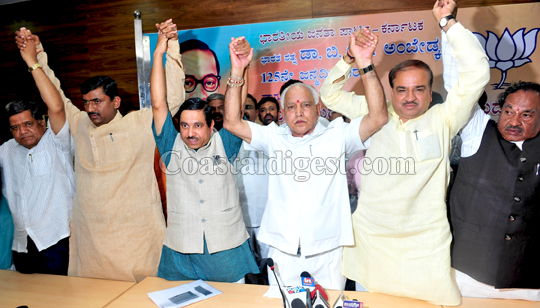
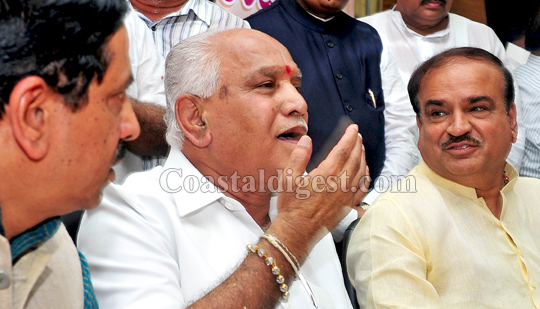
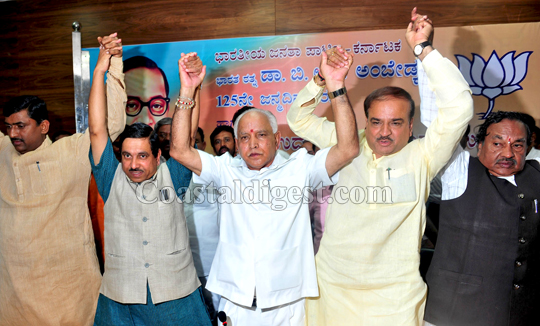
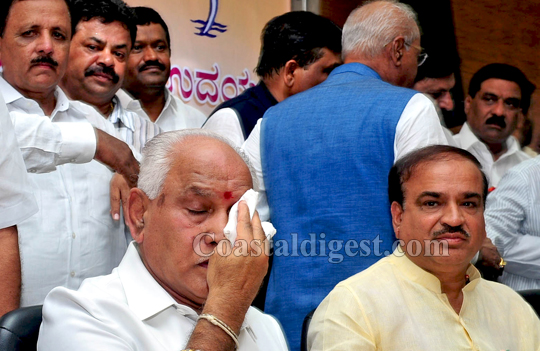
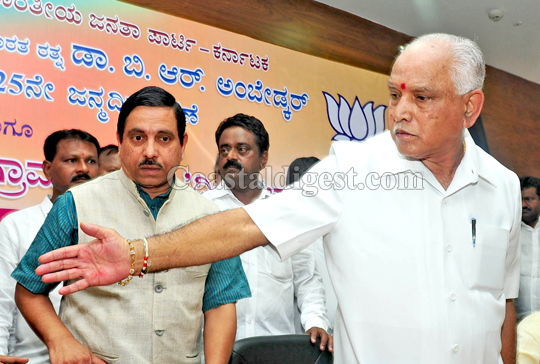
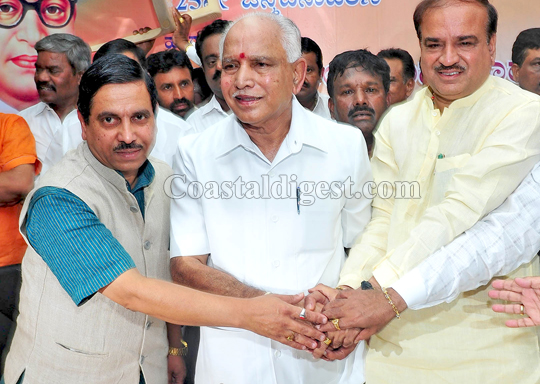
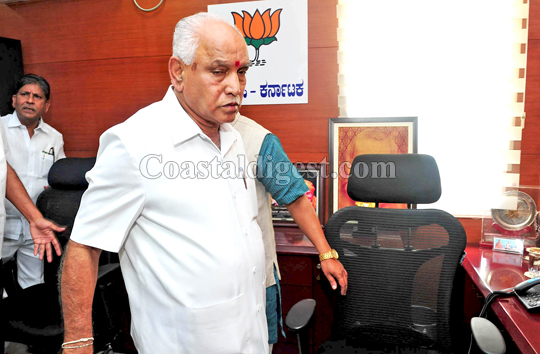
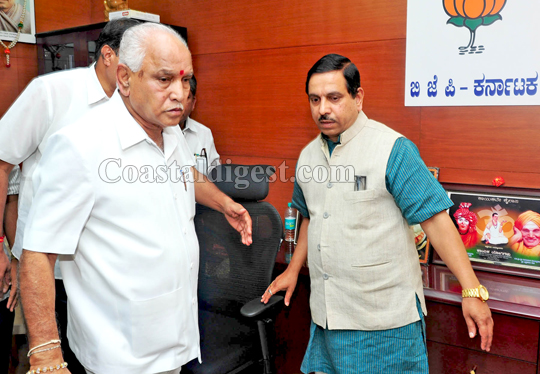
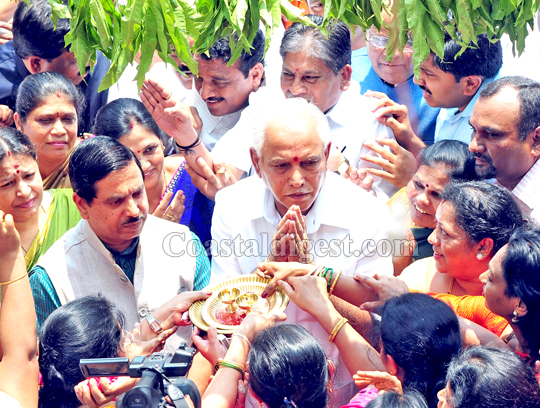
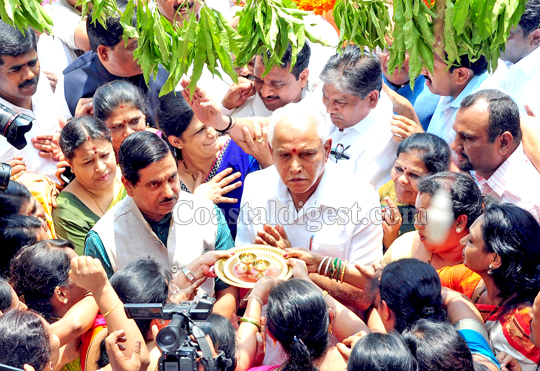
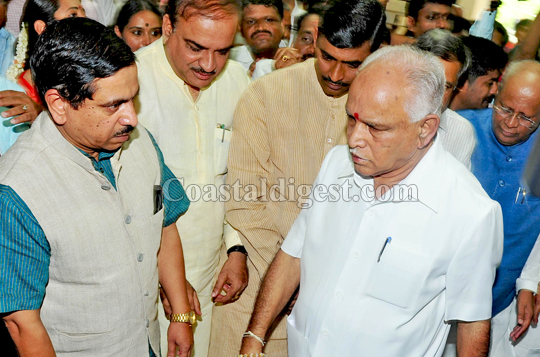
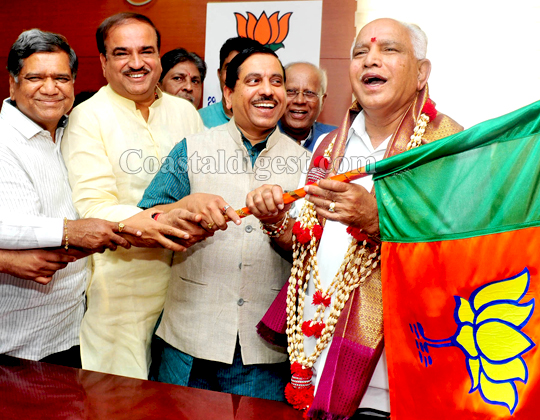
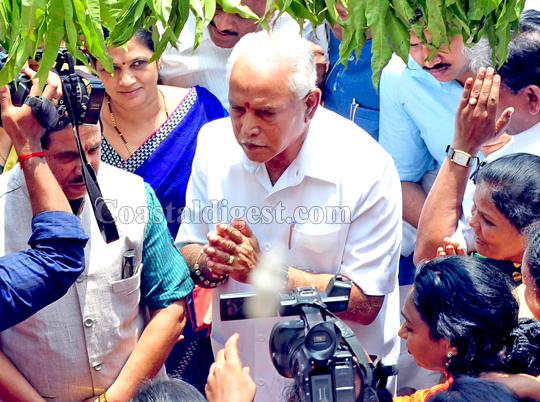
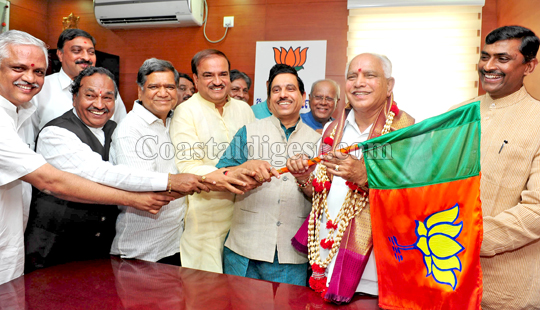
Bengaluru, Apr 14: Former Karnataka chief minister B S Yeddyurappa today assumed charge as state BJP President and set an ambitious target of having an absolute majority by winning 150 seats in the 224-member House in the 2018 Assembly polls.
yeddyapp 1

Taking over the mantle of Presidentship for the fourth time, he termed the Congress a "sinking ship" and asked his party men to work hard to realise Prime Minister Narendra Modi's dream of "Congress-free India" by achieving the goal of "Congress-free Karnataka".

"I assure you, I have no personal matters here on...I will not let you sit silent, we all party workers have to put in our best efforts. At present we have 47 MLAs, we have to make it 150," Yeddyurappa, known for his combative style of leadership, said.

Speaking at a party event organised to commemorate 125th birth anniversary of B R Ambedkar after assuming charge, he said in nine districts, BJP has no prominence, in 13 districts it has one MLA and in Bengaluru and Belagavi 21 MLAs.

"Think about it, where we are and where we have to reach...," said Yeddyurappa, who was largely credited for having brought BJP to power in 2008, the party's first government in the South.

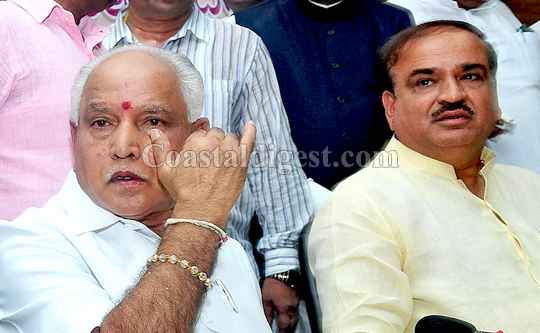
The Lingayat strongman, whose appointment was announced by the party leadership on April 8, took charge from Prahlad Joshi, a Lok Sabha member, in the presence of Union ministers Ananth Kumar and Siddeshwar, party's state in charge Muralidhar Rao, Opposition Leader Jagadish Shettar and other state leaders.

Yeddyurappa alleged that Sangh Parivar workers were being killed in Kerala and said, "There is not even a single MLA but despite all this, best efforts are being put in to strengthen the organisation. We will have to take Kerala as an example."

"There is no Kerala-like situation in any of our districts. If we make up our mind and put in efforts and work together we can reach our goal," he added.

Yeddyurappa was forced to resign as Chief Minister in 2011 over graft charges, following which he quit the party to form his own outfit, Karnataka Janata Party, which failed to make a mark except to cause damage to BJP in 2013 polls.

He returned to BJP following the announcement of Modi as party's prime ministerial candidate ahead of 2014 Lok Sabha polls.

Yeddyurappa announced that BJP would contest all 224 assembly seats and said, "There is not much time...Under collective leadership we will work in unity to strengthen the party."

While listing the "failures" of Siddaramaiah-led Congress government, he said, "We will have to make people aware of achievements and programmes of the central government."

Congratulating Yeddyurappa, outgoing President Joshi said his assuming charge on the birth anniversary of Ambedkar was a "good sign...Let us all pledge ourselves to work hard to bring the party back to power under Yeddyurappa's leadership".

Recalling Yeddyurappa's "struggle" for justice for downtrodden and bonded laborers during his early days of politics in Shivamogga, Union Minister Ananth Kumar said it is befitting that he is assuming charge today.

Calling for uprooting of Congress from Karnataka, Muralidhar Rao said under Yedyurappa's leadership, there is no other goal or political objective other than making Karnataka free from Congress' "misrule...We are ready for the fight". Rao also congratulated Joshi for providing "able" leadership to the party during his tenure.
yeddyapp 2

yeddyapp 3

yeddyapp 4

yeddyapp 5

yeddyapp 6

yeddyapp 7

yeddyapp 8

yeddyapp 9

yeddyapp 10

yeddyapp 11

yeddyapp 12

yeddyapp 13

yeddyapp 14

yeddyapp 15

Comments

MOHAMMAD
 - 
Thursday, 14 Apr 2016

shobakka missing in the picture....

THINKERS
 - 
Thursday, 14 Apr 2016

Do the BJP thinks We the kannadigas forgot
The land looters
The resort enjoyers
The drama acting
When BSY was in office earlier

Rikaz
 - 
Thursday, 14 Apr 2016

Big No.....people know your history (corrupt) better....they will give you middle finger this time.....better you give up politics....live with your little bit of respect nicely somewhere in forest area....

shanu
 - 
Thursday, 14 Apr 2016

could c some strange faces,
chamcha Chumbanacharya .....was bz with bottle business ..
one face is missing here.....can anybody guess....
shobaaaaaaa bega baaaaaaaa....kaadiruve ninagagi.....

Add new comment

  • Coastaldigest.com reserves the right to delete or block any comments.
  • Coastaldigset.com is not responsible for its readers’ comments.
  • Comments that are abusive, incendiary or irrelevant are strictly prohibited.
  • Please use a genuine email ID and provide your name to avoid reject.
News Network
February 13,2020

New Delhi, Feb 13: Ashoka Buildcon on Thursday said it has emerged as the lower bidder for a highway project worth Rs 1,035.5 crore in Karnataka.

The project entails four laning of a section of NH-206 in the state.

Ashoka Buildcon had submitted its bid to National Highways Authority of India for the project to be built on hybrid annuity mode under Bharatmala Pariyojana, it said in a BSE filing.

"The company emerged as the lowest bidder at the financial bid opening meeting held on February 13," Ashoka Buildcon said.

The quoted bid project cost for the project is Rs 1,035.50 crore, it added.

The company's stock was trading at Rs 103.05, down 2.78 per cent, on the BSE.

Comments

Add new comment

  • Coastaldigest.com reserves the right to delete or block any comments.
  • Coastaldigset.com is not responsible for its readers’ comments.
  • Comments that are abusive, incendiary or irrelevant are strictly prohibited.
  • Please use a genuine email ID and provide your name to avoid reject.
Ram Puniyani
February 10,2020

Noam Chomsky is one of the leading peace workers in the world. In the wake of America’s attack on Vietnam, he brought out his classic formulation, ‘manufacturing consent’. The phrase explains the state manipulating public opinion to have the public approve of it policies—in this case, the attack of the American state on Vietnam, which was then struggling to free itself from French colonial rule.

In India, we are witness to manufactured hate against religious minorities. This hatred serves to enhance polarisation in society, which undermines India’s democracy and Constitution and promotes support for a Hindu nation. Hate is being manufactured through multiple mechanisms. For example, it manifests in violence against religious minorities. Some recent ghastly expressions of this manufactured hate was the massive communal violence witnessed in Mumbai (1992-93), Gujarat (2002), Kandhamal (2008) and Muzaffarnagar (2013). Its other manifestation was in the form of lynching of those accused of having killed a cow or consumed beef. A parallel phenomenon is the brutal flogging, often to death, of Dalits who deal with animal carcasses or leather.

Yet another form of this was seen when Shambhulal Regar, indoctrinated by the propaganda of Hindu nationalists, burned alive Afrazul Khan and shot the video of the heinous act. For his brutality, he was praised by many. Regar was incited into the act by the propaganda around love jihad. Lately, we have the same phenomenon of manufactured hate taking on even more dastardly proportions as youth related to Hindu nationalist organisations have been caught using pistols, while police authorities look on.

Anurag Thakur, a BJP minster in the central government recently incited a crowd in Delhi to complete his chant of what should happen to ‘traitors of the country...” with a “they should be shot”. Just two days later, a youth brought a pistol to the site of a protest at Jamia Millia Islamia university and shouted “take Azaadi!” and fired it. One bullet hit a student of Jamia. This happened on 30 January, the day Nathuram Godse had shot Mahatma Gandhi in 1948. A few days later, another youth fired near the site of protests against the CAA and NRC at Shaheen Bagh. Soon after, he said that in India, “only Hindus will rule”.

What is very obvious is that the shootings by those associated with Hindu nationalist organisations are the culmination of a long campaign of spreading hate against religious minorities in India in general and against Muslims in particular. The present phase is the outcome of a long and sustained hate campaign, the beginning of which lies in nationalism in the name of religion; Muslim nationalism and Hindu nationalism. This sectarian nationalism picked up the communal view of history and the communal historiography which the British introduced in order to pursue their ‘divide and rule’ policy.

In India what became part of “social common sense” was that Muslim kings had destroyed Hindu temples, that Islam was spread by force, and that it is a foreign religion, and so on. Campaigns, such as the one for a temple dedicated to the Hindu god Rama to be built at the site where the Babri masjid once stood, further deepened the idea of a Muslim as a “temple-destroyer”. Aurangzeb, Tipu Sultan and other Muslim kings were tarnished as the ones who spread Islam by force in the subcontinent. The tragic Partition, which was primarily due to British policies, and was well-supported by communal streams also, was entirely attributed to Muslims. The Kashmir conflict, which is the outcome of regional, ethnic and other historical issues, coupled with the American policy of supporting Pakistan’s ambitions of regional hegemony, (which also fostered the birth of Al-Qaeda), was also attributed to the Muslims.

With recurring incidents of communal violence, these falsehoods went on going deeper into the social thinking. Violence itself led to ghettoisation of Muslims and further broke inter-community social bonds. On the one hand, a ghettoised community is cut off from others and on the other hand the victims come to be presented as culprits. The percolation of this hate through word-of-mouth propaganda, media and re-writing of school curricula, had a strong impact on social attitudes towards the minorities.

In the last couple of decades, the process of manufacturing hate has been intensified by the social media platforms which are being cleverly used by the communal forces. Swati Chaturvedi’s book, I Am a Troll: Inside the Secret World of the BJP’s Digital Army, tells us how the BJP used social media to spread hate. Whatapp University became the source of understanding for large sections of society and hate for the ‘Other’, went up by leaps and bounds. To add on to this process, the phenomenon of fake news was shrewdly deployed to intensify divisiveness.

Currently, the Shaheen Bagh movement is a big uniting force for the country; but it is being demonised as a gathering of ‘anti-nationals’. Another BJP leader has said that these protesters will indulge in crimes like rape. This has intensified the prevalent hate.

While there is a general dominance of hate, the likes of Shambhulal Regar and the Jamia shooter do get taken in by the incitement and act out the violence that is constantly hinted at. The deeper issue involved is the prevalence of hate, misconceptions and biases, which have become the part of social thinking.

These misconceptions are undoing the amity between different religious communities which was built during the freedom movement. They are undoing the fraternity which emerged with the process of India as a nation in the making. The processes which brought these communities together broadly drew from Gandhi, Bhagat Singh and Ambedkar. It is these values which need to be rooted again in the society. The communal forces have resorted to false propaganda against the minorities, and that needs to be undone with sincerity.

Combating those foundational misconceptions which create hatred is a massive task which needs to be taken up by the social organisations and political parties which have faith in the Indian Constitution and values of freedom movement. It needs to be done right away as a priority issue in with a focus on cultivating Indian fraternity yet again.

Comments

Add new comment

  • Coastaldigest.com reserves the right to delete or block any comments.
  • Coastaldigset.com is not responsible for its readers’ comments.
  • Comments that are abusive, incendiary or irrelevant are strictly prohibited.
  • Please use a genuine email ID and provide your name to avoid reject.
News Network
March 28,2020

Bengaluru, Mar 28: Karnataka government on Saturday launched a food helpline number --155214-- for the labourers who have been affected due to lockdown imposed by the central government to prevent the spread of the coronavirus.

This came after Prime Minister Narendra Modi had on Tuesday announced a 21-day lockdown in the entire country effective from midnight to deal with the spread of the coronavirus, saying that " social distancing" is the only option to deal with the disease, which spreads rapidly.
Similarly, other states including Delhi have started both official and non-official helpline numbers for necessary assistance.
Both the government institutions and social organizations are contributing together in the fight against coronavirus during the lockdown.
According to the Ministry of Health and Family Welfare (MoHFW), there are 918 confirmed cases of coronavirus cases in the country and 19 fatalities have been reported.

Comments

Add new comment

  • Coastaldigest.com reserves the right to delete or block any comments.
  • Coastaldigset.com is not responsible for its readers’ comments.
  • Comments that are abusive, incendiary or irrelevant are strictly prohibited.
  • Please use a genuine email ID and provide your name to avoid reject.