



Budget session: All you need to know about the schedule, agenda, hurdles ahead

February 23, 2015

New Delhi, Delhi 23: The government, which is looking to pass key legislation, is set to face a stormy Budget session starting Monday despite its promise to walk the “extra mile” to accommodate the opposition’s concerns.
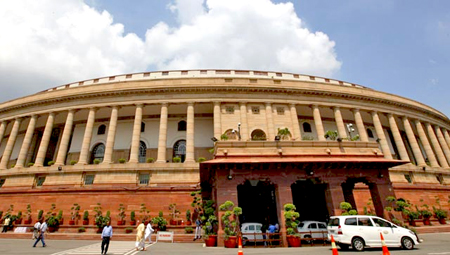
Budget sessionOn Sunday, Prime Minister Narendra Modi assured the Opposition of addressing all its concerns as his government sought support for the bills that will replace six ordinances, including the one that aims to overhaul the land law.

Parliament opens on Monday for what will be the first full budget session of the Modi government. The budget -- to be presented on February 28 -- will be closely watched for the economic path the government charts. The session will be a test of the NDA's floor management skills with a heavy legislative agenda lined up.

The session will begin with President Pranab Mukherjee's address to members of both Houses of Parliament that will indicate the government's agenda for the session.

"I can assure you that all the issues you have referred to will be discussed adequately and appropriately," the PM told an all-party meet Sunday evening.

Modi's reach-out mission started hours earlier when parliamentary affairs minister Venkaiah Naidu drove to the 10 Janpath residence of Congress chief Sonia Gandhi in the morning.

The Congress, however, remained non-committal, saying it couldn't back bills that were "anti-people".

"We have some concerns about the land law amendments," sources quoted Sonia as telling Naidu.

It was the first official engagement between the Modi government and the Congress president.

HT reported on February 20 that a senior Modi minister may meet Sonia to end the ordinance logjam, with the government planning to bring in the bills on Day 1 itself.

Farmers and social activists, led by Anna Hazare, are planning a sit-in against the land bill, which aims to make land acquisition easy for industry, to coincide with the opening day of the session.  

While another contentious legislation — the insurance bill — wasn't discussed, Sonia did tell Naidu that it would be "good" to have detailed discussion on other ordinances as well, sources said.

At the all-party meeting, Modi said it was the collective responsibility of leaders of all parties to ensure that the session ran smoothly.

"…Hope we can collectively work for the benefit of common man," he said.

Congress leader in Lok Sabha Mallikarjun Kharge, who was also present during the Sonia-Naidu meeting, and party colleague Ghulam Nabi Azad, leader of the Opposition in Rajya Sabha, did not promise anything. The Congress parliamentary party had not met for the session, they said.

Janata Dal (United) chief Sharad Yadav said the land proposals were worse than what existed during the British time.

During the session, the focus should be on financial matters and "we must discuss the special category status for different states," Biju Janata Dal leader Bhartruhari Mahtab said.

The opposition leaders also demanded that the PM repeat on the floor of the House the remarks about the government's commitment to religious tolerance and freedom.

Agenda in Parliament

The government enjoys a brute majority in Lok Sabha but in Rajya Sabha it is outnumbered by the Opposition, whose support is critical for law-making.

Naidu, interestingly, said there was a broad consensus on "five out of six" ordinances, indicating the government's willingness to negotiate a dilution of its land ordinance.

HT wrote on Sunday that the government may water down some clauses of the land bill, dubbed anti-farmer by opposition and various social groups.

The government aims to get Parliament's nod for 44 bills during the session. The coal block auction, insurance and motor vehicles law amendment (e-rickshaw) bills will be tabled in Rajya Sabha. The land bill will come up first in Lok Sabha.

The Rail Budget will be presented February 26, Economic Survey February 27 and General Budget February 28.

An official release said the financial business (11 items) includes presentation of and discussion on General and Railway Budget, voting on demands for grants, supplementary demands for grants for 2014-15 and excess demands, if any, for 2013-14.

The legislative agenda comprises introduction, consideration and passing of seven new bills by both the houses including the finance bill, 2015, and bills replacing the six ordinances.

While 10 new bills are slated to be introduced, the government's agenda includes passing of 3 bills pending in Lok Sabha and 7 in Rajya Sabha.

Those pending in the Lok Sabha are: The Constitution (122nd Amendment) Bill, 2014 relating to introduction of GST, The Lok Pal and Lok Ayuktas and other Related Law (Amendment) Bill, 2014 and The Repealing and Amending Bill, 2014. After being passed by Lok Sabha, these bills will be taken up by Rajya Sabha.

Bills pending in Rajya Sabha include 4 bills already passed by Lok Sabha - The Companies (Amendment) Bill, 2014, The Public Premises Eviction of Unauthorised Occupants) Amendment Bill, 2014, The Regional Rural Banks (Amendment) Bill, 2014, The Repealing and Amending (Second) Bill, 2014, and the Payments and Settlement Systems(Amendment) Bill, 2014.

Other pending bills are: The Prevention of Corruption (Amendment) Bill, 2013 and The Constitution (Scheduled Casts) Orders (Amendment) Bill, 2014.

The new bills pertain to on the National Cooperative Development Corporation, the Warehousing Corporation, Andhra Pradesh reorganisation, arbitration and conciliation, repeal of appropriation acts, registration of births and deaths, whistle blowers protection, Indian Institutes of Management, National Academic Depository and Identification of Scheduled Castes.

The non-legislative business for the session includes discussion on the motion of thanks to the President's address.

There will be 20 working days during the first half of Budget session and 13 in the second half.

During the intervening recess, standing committees will take up detailed examination of the demands for grants of different ministries.

 

Comments

Add new comment

  • Coastaldigest.com reserves the right to delete or block any comments.
  • Coastaldigset.com is not responsible for its readers’ comments.
  • Comments that are abusive, incendiary or irrelevant are strictly prohibited.
  • Please use a genuine email ID and provide your name to avoid reject.
News Network
July 10,2020

New Delhi, Jul 10: With the highest single-day spike of 26,506 COVID-19 cases and 475 deaths reported in the last 24 hours, the total number of COVID-19 cases in India reached 7,93,802 on Friday, according to the Union Ministry of Health and Family Welfare.

Out of the total number of cases, 2,76,685 are active, 4,95,513 have been cured/discharged/migrated and 21,604 have died so far due to the infection.

With as many as 2,30,599 COVID-19 cases, Maharashtra continues to remain the worst-affected state, followed by Tamil Nadu (1,26,581) and Delhi (1,07,051).

Meanwhile, 2,83,659 samples were tested for coronavirus on Thursday, taking the total number of samples tested up to July 9 to 1,10,24,491, according to the Indian Council of Medical Research (ICMR).

Comments

Add new comment

  • Coastaldigest.com reserves the right to delete or block any comments.
  • Coastaldigset.com is not responsible for its readers’ comments.
  • Comments that are abusive, incendiary or irrelevant are strictly prohibited.
  • Please use a genuine email ID and provide your name to avoid reject.
Agencies
August 7,2020

Kottayam, Aug 7: A trial court in Kottayam on Friday granted bail to Bishop Franco Mulakkal, accused of raping a nun in Kerala, with stringent conditions and directed him to be present on the dates of hearing of the case.

The Additional Sessions Court had cancelled the bail granted to the Bishop on July 13 for failing to appear for the trial and issued a Non Bailable Warrant against him.

Mulakkal was present in the Court on Friday when it considered the matter.

Granting bail, the court directed him not to leave the state till the chargesheet is read out to him on August 13 and to be present in court on the dates of hearing of the case.

The Court also directed him to offer fresh sureties and bail bonds.

On July 13, Mulakkal’s counsel had informed the court that his client could not appear as he had been in self quarantine due to his primary contact with a COVID-19 infected person.

The next day, the former Jalandhar Bishop had tested positive for coronavirus.

The prosecution informed the Court that Mulakkal had not produced the COVID negative certificate, to which the Court observed that the state Health Department can take necessary action on this issue.

The Supreme Court on Wednesday had directed Mulakkal to face trial as it dismissed his plea seeking discharge in the rape case lodged against him by the nun belonging to a congregation under Jalandhar diocese, saying there was no merit in his petition.

A bench of Chief Justice S A Bobde, A S Bopanna and V Ramasubramanian had told the counsel for Bishop that the court is not saying anything on merit, but is dismissing the plea on the issue of discharge from the case.

Mulakkal, in his plea had challenged the July 7 Kerala High Court order, dismissing his discharge plea in the rape case filed by the nun.

The High Court had asked the deposed Bishop of Jalandhar diocese to stand for trial in the rape case, which was registered on the basis of a complaint filed by the nun.

The senior priest of the Roman Catholic Church had filed the revision petition following the dismissal of his discharge plea by a trial court in March this year.

The rape case against the Bishop was registered by police in Kottayam district.

In her complaint to the police in June, 2018, the nun had alleged that she was subjected to sexual abuse by the bishop during the period between 2014 and 2016.

The bishop, who was arrested by the Special Investigation team, which probed the case, charged him with wrongful confinement, rape, unnatural sex and criminal intimidation.

Comments

Add new comment

  • Coastaldigest.com reserves the right to delete or block any comments.
  • Coastaldigset.com is not responsible for its readers’ comments.
  • Comments that are abusive, incendiary or irrelevant are strictly prohibited.
  • Please use a genuine email ID and provide your name to avoid reject.
News Network
May 6,2020

New Delhi, May 6: Taking a cue from states, the Centre announced one of the steepest hikes in duties on petrol and diesel in the recent past, by raising it by Rs 10 and Rs 13 per litre, respectively, in a notification issued late on Tuesday.

Retail prices, however, will see no change as the price hike will be absorbed by oil marketing companies against the fall in crude prices.

Road and infrastructure cess was hiked by Rs 8 for petrol and diesel and the special additional excise duty (SAED) was hiked by Rs 2 per litre and Rs 5 per litre, respectively. While the road cess will only go into the Centre’s coffers, the hike on account of SAED will be passed on to states via devolution at 42 per cent. Hence, the states will get only Rs 0.84 per litre in case of petrol and Rs 2.1 in case of diesel.

The decision comes after several states increased the value added tax (VAT) on petrol and diesel making use of the lower price regime. The Delhi government on Tuesday increased VAT on petrol and diesel to 30 per cent each, from 27 and 16.75, respectively. As a result, the price of petrol in Delhi increased by Rs 1.67 to Rs 71.26 a litre and diesel by Rs 7.10 to Rs 69.29 in Delhi on Tuesday.

Amid falling international crude oil prices, the Centre introduced an enabling provision in March to raise excise duty on petrol and diesel by Rs 8 per litre in the Finance Act. The government had on March 14 raised excise duty on petrol and diesel by? 3 per litre each, which was to help raise an additional ?39,000 crore in revenue annually.

This duty hike included Rs 2 a litre increase in SAED and Rs 1 in road and infrastructure cess. It raised SAED to Rs 10 for petrol and Rs 4 for diesel. The limit has now been increased to Rs 18 a litre in case of petrol and Rs 12 in case of diesel by way of amendment of the Eighth Schedule of the Finance Act.

Economists said the move would impact retail inflation by over half a percentage point at least. “With lower consumption, there was loss of revenue for Centre and states, who earn Rs 6 trillion annually or Rs 50,000 crore monthly from fuel. Amid lockdown in April, the collection must have come down to just Rs 5,000 crore, and this will hold for May.

This means that Centre and states have lost 20 per cent of annual revenue from fuel. Hence, they have hiked duties to recover losses,” said Madan Sabnavis, chief economist, CARE Ratings. He added that the hike will impact inflation by at least 0.6-0.7 percentage points.

According to industry experts, an estimate of the additional government revenue cannot be made as the consumption of petrol and diesel has dropped to 40 per cent of what it was before the lockdown. The duty hike comes following a drop in international crude oil prices in April, owing to lower consumption figures globally. At 11.50 pm on Tuesday, Brent was priced at $30.67 a barrel, while West Texas Intermediate (WTI) crude was seen at $24.36 a barrel. On Monday, the Indian basket of crude oil was priced at $23.38 a barrel, after touching a 15-year low last month.

Comments

Add new comment

  • Coastaldigest.com reserves the right to delete or block any comments.
  • Coastaldigset.com is not responsible for its readers’ comments.
  • Comments that are abusive, incendiary or irrelevant are strictly prohibited.
  • Please use a genuine email ID and provide your name to avoid reject.