


Buses to go off roads on July 25 as unions call stir

July 23, 2016

Bengaluru, Jul 23: All the seven unions of the state-run transport corporations (STCs) have stuck to their decision to go on an indefinite strike from Sunday midnight as talks with the government failed on Friday.
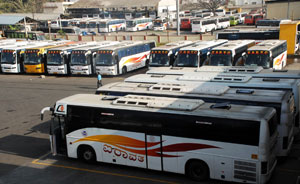
ksrtcRepresentatives of the unions, including the KSRTC Staff and Workers' Federation (KSWF) and the Akhila Karnataka Rajya Raste Sarige Noukarara Mahamandali, had a two-hour-long discussion with Chief Minister Siddaramaiah and Transport Minister Ramalinga Reddy.

The leaders of the unions refused to accept Siddaramaiah's offer to enhance the quantum of hike in salary from 8% to 10%. The chief minister appealed to them to give up the strike, but the leaders did not agree.

The government had recently announced a 8% salary hike for employees of the four STCs - KSRTC, BMTC, NEKRTC and NWKRTC. Terming the hike as meagre,' the unions have given a call for an indefinite strike from July 25, demanding enhancement in the hike.

The unions are demanding 35% hike in the salaries. Besides, they have listed 41 various demands including extension of medical benefits to dependents of employees, hike in daily allowance (bata) for drivers and conductors to Rs 300, increase in the repast allowance to at least Rs 100 and opening of subsidised canteen in all depots.

H V Anantha Subbarao, general secretary, KSWF, told Deccan Herald that they had no deliberate intention to cause trouble to lakhs of passengers by keeping around 23,000 buses off the road, but it was inevitable as the government did not fulfil their salary hike demand.

Subbarao said they were ready to hold talks again with the chief minister before Monday and they have told Transport Minister Ramalinga Reddy to persuade Siddaramaiah for another round of talks.

Advance booking continues

The state-run transport corporations (STCs) such as the KSRTC, NEKRTC and NWKRTC have not stopped advance booking of tickets for Monday, despite the strike call.

An official in the KSRTC said booking cannot be stopped because the unions have given a strike call. Amount will be refunded to the passengers in case of a strike, the official said.

Comments

aharkul
 - 
Saturday, 23 Jul 2016

these people need always high salary apart from incentive. Now they are getting good salary and incentive with other benefits like medical, subsidized food in their respective depot canteen so on. But still not happy.

Add new comment

  • Coastaldigest.com reserves the right to delete or block any comments.
  • Coastaldigset.com is not responsible for its readers’ comments.
  • Comments that are abusive, incendiary or irrelevant are strictly prohibited.
  • Please use a genuine email ID and provide your name to avoid reject.
News Network
June 2,2020

Mangaluru, Jun 2: Karnataka-Kerala border at Talapady is yet to be opened for traffic despite lifting lockdown. Only those, who have registered on ‘Seva Sindhu’ portal, are given one-time permission to enter the district.

With the relaxation of the lock-down many, especially the labour class, were anticipating free movement. However, both the States have not allowed free movement of vehicles. Hundreds of people from bordering villages of Kerala arrive in Mangaluru for work and likewise many from bordering villages of Mangaluru too work in Kasargod district.

It has become a routine for the labourers of both the States living in border villages to daily assemble at the check post in the morning and return after the authorities refuse free movement.

Comments

Add new comment

  • Coastaldigest.com reserves the right to delete or block any comments.
  • Coastaldigset.com is not responsible for its readers’ comments.
  • Comments that are abusive, incendiary or irrelevant are strictly prohibited.
  • Please use a genuine email ID and provide your name to avoid reject.
Agencies
May 8,2020

Washington D.C., May 8: The prime time for brain development in a child's life is the first year, where the infant spends most of the time asleep. It is the time when neural connections form and sensory memories are encoded.

However, when sleep is disrupted, as occurs more often among children with autism, brain development may be affected, too.

New research led by the University of Washington finds that sleep problems in a baby's first 12 months may not only precede an autism diagnosis but also may be associated with altered growth trajectory in a key part of the brain, the hippocampus.

The study, which was published in the American Journal of Psychiatry, researchers report that in a sample of more than 400 taken of 6- to 12-month-old infants, those who were later diagnosed with autism were more likely to have had difficulty falling asleep.

It also states that this sleep difficulty was associated with altered growth trajectories in the hippocampus.

"The hippocampus is critical for learning and memory, and changes in the size of the hippocampus have been associated with poor sleep in adults and older children.

As many as 80 per cent of the children with autism spectrum disorder have sleep problems," said Annette Estes, director of the UW Autism Center and senior author of the study.

"In our clinical experience, parents have a lot of concerns about their children's sleep, and in our work on early autism intervention, we observed that sleep problems were holding children and families back," added Estes, who is also a UW professor of speech and hearing sciences.

"It could be that altered sleep is part-and-parcel of autism for some children. One clue is that behavioural interventions to improve sleep don't work for all children with autism, even when their parents are doing everything just right. This suggests that there may be a biological component to sleep problems for some children with autism," said Estes.

To consider links among sleep, brain development, and autism, researchers at the IBIS Network looked at MRI scans of 432 infants, surveyed parents about sleep patterns, and measured cognitive functioning using a standardized assessment.

At the outset of the study, infants were classified according to their risk for developing autism: Those who were at higher risk of developing autism -- about two-thirds of the study sample -- had an older sibling who had already been diagnosed.

Infant siblings of children with autism have a 20 per cent chance of developing autism spectrum disorder -- a much higher risk than children in the general population.

In the current study, 127 of the 432 infants were identified as "low risk" at the time the MRI scans were taken because they had no family history of autism.

They later evaluated all the participants at 24 months of age to determine whether they had developed autism. Of the roughly 300 children originally considered "high familial risk," 71 were diagnosed with autism spectrum disorder at that age.

Problems with sleep were more common among the infants later diagnosed with an autism spectrum disorder, as were larger hippocampi. No other subcortical brain structures were affected, including the amygdala, which is responsible for certain emotions and aspects of memory, or the thalamus, a signal transmitter from the spinal cord to the cerebral cortex.

The authors note that while parents reported more sleep difficulties among infants who developed autism compared to those who did not, the differences were very subtle and only observed when looking at group averages across hundreds of infants.

Sleep patterns in the first years of life change rapidly as infants transition from sleeping around the clock to a more adult-like sleep/wake cycle. Until further research is completed, Estes said, it is not possible to interpret challenges with sleep as an early sign of increased risk for autism.

Comments

Add new comment

  • Coastaldigest.com reserves the right to delete or block any comments.
  • Coastaldigset.com is not responsible for its readers’ comments.
  • Comments that are abusive, incendiary or irrelevant are strictly prohibited.
  • Please use a genuine email ID and provide your name to avoid reject.
News Network
April 21,2020

Apr 21: An 80-year-old COVID-19 patient has died in Karnataka's Kalaburagi district, taking the death toll in the state to 17, Medical Education Minister K Sudhakar said on Tuesday.

The elderly person was suffering from Parkinson's disease for the last three years and died at a hospital on Monday, the minister said in a tweet.

"The person had developed fever on Sunday and was admitted to the hospital. The patient passed away yesterday at 9 am. Last night at 9 pm the death report came, which confirmed that the person was COVID-19 positive," Sudhakar tweeted.

The total number of COVID-19 infections in the state has crossed the 400-mark, according to last evening's bulletin by the Karnataka health department.

Comments

Add new comment

  • Coastaldigest.com reserves the right to delete or block any comments.
  • Coastaldigset.com is not responsible for its readers’ comments.
  • Comments that are abusive, incendiary or irrelevant are strictly prohibited.
  • Please use a genuine email ID and provide your name to avoid reject.