Businessman from Udupi among three killed in Mumbai serial mishap

[email protected] (CD Network)
July 20, 2016

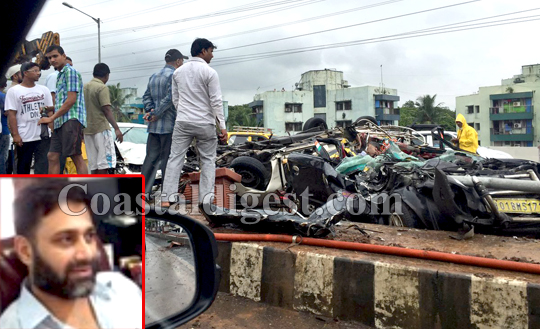
Udupi, Jul 20: At least three people including a businessman from coastal Karnataka were killed and two others injured in a serial mishap occurred on the Eastern Freeway at Trombay in Mumbai on Tuesday.

mumbaih

The deceased were identified as Abdul Hameed (45), son of Mahmoud Hasan from Shirva in Udupi, and two people from Maharashtra-Jaswant (40) and Vijay Kumar. Abdul Hameed was driving the Innova.

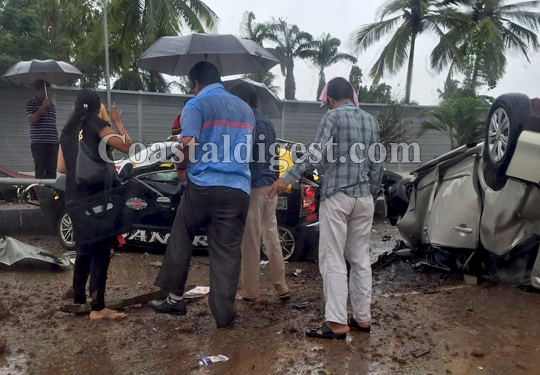
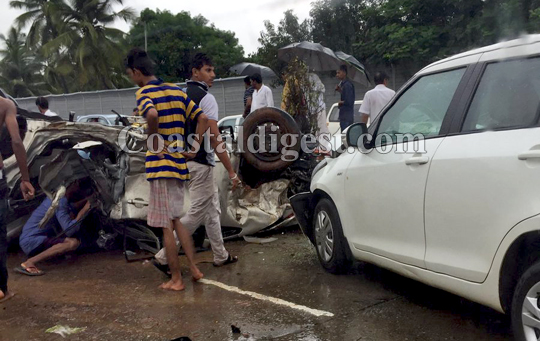
The incident, involving a white Maruti Swift Dzire, golden Toyota Innova and a black and yellow taxi, occurred around 8:50 am near the Wadala exit.

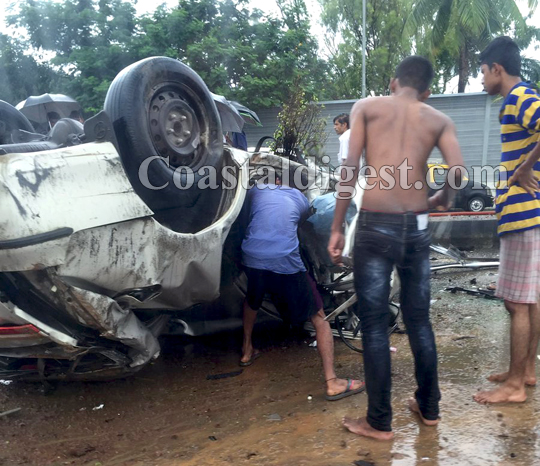
Eye witnesses claimed that the driver of the Innova lost control of the vehicle and rammed into the Taxi. Following which, it toppled on the road the Dzire crashed into the Innova.

Bystanders immediately came to the rescue of those who were injured and removed them from the debris. Traffic police was alerted about the incident around 9:15 am.

The accident led to massive traffic chaos and vehicles on Eastern Freeway diverted from RCF colony to Chembur. Entry from Deonar circle was closed for several hours.

Traffic police had to use cutters to remove the bodies and rescue the injured.

An official from RCF police station confirmed that the accident occurred after the Innova driver lost control of the vehicle at high speed. He was travelling towards Chembur, when he rammed his car into the Dzire and crossed over to the opposite side. The taxi was travelling in the first lane of the northbound road towards CST.

Two passengers from the Swift Dzire, who were injured during the accident, were rushed to Shatabdi hospital in Chembur.

mumbai3

mumbai2

mumbai4

Comments

Haris
 - 
Thursday, 21 Jul 2016

Inna llillahi wa inna elaihi rajiwoon

Ahamad Gulam beary
 - 
Wednesday, 20 Jul 2016

Inna lillahi wa inna ilahi raajiuoon

Mahfodh
 - 
Wednesday, 20 Jul 2016

Verily, we come from ALLAH and to him shall we return. May the Almighty forgive the short coming of the deceased and grant him a place in the paradise. Ameen

Isn't the life too short? Have we prepared enough to leave? The question we need to ask ourselves.

imtiaz
 - 
Wednesday, 20 Jul 2016

inna lillahi wa inna ilaihi raajiwoon.. May Allah forgive their sins and give strength to their families to bear the pain of their loss.....

Add new comment

  • Coastaldigest.com reserves the right to delete or block any comments.
  • Coastaldigset.com is not responsible for its readers’ comments.
  • Comments that are abusive, incendiary or irrelevant are strictly prohibited.
  • Please use a genuine email ID and provide your name to avoid reject.
coastaldigest.com web desk
January 3,2020

Mangaluru, Jan 3: S Cube Art Gallery has successfully concluded its prestigious assignment from Airports Authority of India (AAI) to beautify Mangaluru Airport with artistic works. AAI had invited tenders for various jobs to be executed in the airport premises. S Cube Art Gallery had made a competitive bid which was subsequently followed up with presentation before selection panel and award of contract. S Cube Art Gallery bagged the contract for six works in two sectors out of the total four sectors for which the tender had been called.

The themes presented by S Cube Art Gallery showcase the Tulu culture and heritage of the people of Coastal Karnataka. The six themes selected are:

1. ‘Human Hand Flying Paper Plane’ – fibre glass and steel sculpture work installed in the circle in the outer precincts of the airport. This is a larger than life sculpture signifying the dreams and aspirations of the air travelers. Artist: Harish Kodialbail, Mangalore

2. ‘Kambala’ – fibre glass sculpture installed at the exit area of the airport. This sculpture is meant to introduce ‘Kambala’, the iconic folk sport of the region to the visitors and tourists. Artist: Harish Kodialbail, Mangalore

3. ‘Fisherman with Boat’ - fibre glass and steel sculpture installed at the entrance to departures lounge of the airport. It symbolizes the fishing culture of the coastal region depicting the soaring aspirations, life of courage and adventure as well as the daily struggles of the fisher folk. Artist: Harish Kodialbail, Mangalore

4. ‘Tiger Dance’ - fibre glass and steel sculpture installed at the arrivals lounge of the airport. This work depicts the world famous ‘Mangalore Pilivesha’ showing tiger dancers in various typical postures to the visiting tourists. Artist: Harish Kodialbail, Mangalore

5. ‘Folk Art Forms’ – six individual terracotta sculptures with Tulunadu cultural themes installed alongside the domestic and international corridors of the airport. Artist: Venki Palimaru, Udupi

6. ‘Jain Miniature Paintings’ – Jain miniature paintings (18x6 feet) – Two works of acrylic on canvas displayed on the wall on either sides of the exit area. The work was conceived after referring to authentic traditional Jain paintings in Moodbidri Jain Mutt and Shravanabelagola Mutt. Artist: Reshma S. Shetty, Mangalore

The total value of the contract was Rs. 56 lakhs. The work was completed over a period of six months and concluded in the month of July, 2019.  S Cube Art Gallery is grateful to the Airports Authority of India for giving the opportunity to participate in this project and showcase the artistic talents of the region.

Comments

Add new comment

  • Coastaldigest.com reserves the right to delete or block any comments.
  • Coastaldigset.com is not responsible for its readers’ comments.
  • Comments that are abusive, incendiary or irrelevant are strictly prohibited.
  • Please use a genuine email ID and provide your name to avoid reject.
coastaldigest.com news network
May 13,2020

Mangaluru, May 13: Karnataka revised its standard operating procedure (SOP) for international passengers to allow pregnant women, children and senior citizens to entre home quarantine if they test negative for covid-19. 

The development comes after former minister and Mangaluru MLA U T Khader urged the government to follow the Kerala model in handling the repatriates and take extra care of pregnant women and senior citizens at Mangaluru and Bengaluru Airports.

Passengers will be initially dived into two categories. Category A includes passengers symptomatic on arrival while Category B passengers are those asymptomatic on arrival. 

While category A passengers will be directly shifted to covid-19 hospital, category B passengers will be sent to 14-day institutional quarantine.

If there are pregnant women, children below 10 years of age and senior citizens in category B, they will remain in institutional quarantine until they obtain a negative report (after throat swab testing for covid-19). It may take one or two days to get the throat swab testing report. 

Comments

Add new comment

  • Coastaldigest.com reserves the right to delete or block any comments.
  • Coastaldigset.com is not responsible for its readers’ comments.
  • Comments that are abusive, incendiary or irrelevant are strictly prohibited.
  • Please use a genuine email ID and provide your name to avoid reject.
Media Release
February 14,2020

Veteran journalist P. Sainath has said that the nation is in a crisis. And this crisis is not limited to just the rural area. It has become a national crisis at various areas such as agriculture, education, economy, job creation etc.

He was delivering the endowment lecture on the topic ‘Indian democracy at the post-liberalization and post-truth era’ at Media Manthan 2020 organized by the PG department of journalism and mass communication at St Aloysius College (Autonomous). 

Mr Sainath said that the many policies adopted in the 90s led to India becoming unusually unequal. Referring to the speech Ambedkar had made at the Constituent Assembly while handing over the draft of the Constitution, Mr Sainath said, “Ambedkar had warned about the weakness of Indian democracy that liberty without equality allows the supremacy of a few over the multitude. Liberty, equality and fraternity must be kept together as we cannot have one without the other.” 

Mr Sainath stated that the agrarian crisis was no longer about the loss of productivity, employment or about farmer suicide; it was a societal, civilizational crisis. Commenting on the lopsided policies such as cow-slaughter ban, he explained how cow slaughter ban had adversely affected many industries due to their interdependency. While Muslims who slaughtered cows were rendered helpless, the cattle traders who were mostly OBCs lost their earnings as the cattle prices crashed. An important industry like Kolhapur sandals industry in Maharashtra went bankrupt as a result of the cow slaughter ban in Maharashtra. He said the policymakers had no idea how the rural industries were interconnected. Demonetisation too devastated the rural economy as 98 percent of rural transactions happen through cash. 

Mr Sainath also spoke about the crisis of inequality which affects the Dalits and the Adivasis far more than anyone else as 90 percent of the rural households take home less than Rs 10,000/- per month. “Women are yet another group whose labour is never counted in the gross domestic product. Women and girls globally do unpaid work which amounts to about 12.5 billion working hours per year. Monetarily speaking, this is worth 10.8 trillion dollars,” Mr Sainath added. 

Speaking about the crisis of jobs Mr Sainath said that major companies were laying off employees just to create more profits for the investors and the adoption of artificial intelligence in the industry would further destroy millions of jobs.

Rector of St Aloysius College Institutions Fr Dionysius Vaz SJ, Principal Dr (Fr) Praveen Martis SJ, HOD of Journalism and Mass Communication department Dr (Fr) Melwyn Pinto SJ were present.

‘Veerappan and Vijay Mallya’s business models are interesting!’

Addressing the gathering during his endowment lecture on Friday, Mr Sainath made an interesting comment on the so called ‘revenue model’. “Whenever I visit IIMs and IITs for lectures on my PARI project, the students there ask me what my revenue model for my project is. I tell them that I do not have a revenue model. In fact, journalism does not begin with a revenue model. Gandhiji, Ambedkar, Bhagat Singh were all great journalists. But they did not have a revenue model,” Mr Sainath said.

On a lighter note, he said that the best revenue model that he liked was that of forest brigand Veerappan and liquor baron Vijay Mallya. “Veerappan ruled the forest for forty years and from the top ministers to the villagers he could dictate terms and liver royally. Similarly, Mallya’s revenue model was to steal the banks and run away abroad and live like a king,” Mr Sainath added.

Journalism is not and can never be a business. It is a calling, he opined. While newspaper can be a business, television can be a business, journalism per se cannot be reduced to a business. “Unfortunately today, journalists are recruited on a contract basis and they have no bargaining power; and there are no unions to fight for their cause. Hence, they are at the mercy of the corporate media houses for their survival and are made to write stories that cannot be called journalism,” Mr Sainath said.

Answering a question as to the pressures he faced as a journalist, he said that external pressures from the government or others could be very well handled. It is the internal pressures from once own media house that journalists find it difficult to manage.


 

Comments

Add new comment

  • Coastaldigest.com reserves the right to delete or block any comments.
  • Coastaldigset.com is not responsible for its readers’ comments.
  • Comments that are abusive, incendiary or irrelevant are strictly prohibited.
  • Please use a genuine email ID and provide your name to avoid reject.