


Campaign to promote peace, humanity in Dakshina Kannada

[email protected] (CD Network | Suresh)
August 19, 2016

Mangaluru, Aug 19: The Jamaat-e-Islami Hind will be holding a nation-wide campaign on Peace and Humanity' between August 21 and September 4 to address the onslaught of communal fascism in India.
woodladsPM

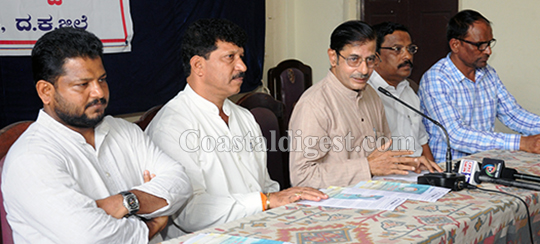
Dakshina Kannada district unit of the JIH too has planned a series of programmes as part of this campaign. The members of the reception committee of the campaign, comprising of prominent persons of the society, on Friday through a press conference urged the people of the district to join hands together to strengthen communal harmony in the region.

Addressing media persons Dr Satyanarayana Mallipatna, an academician and honorary president of the district level reception committee, said that the Dakshina Kanand was passing through a period of turmoil.

“Innocents are being attacked and killed for political reasons. This development is damaging the reputation of the coastal district,” he lamented and called upon the people to establish peace in the society.
1peace“Indian society is pluralistic in nature. The diversity that exists in India in terms of religion, culture and language is highly unique. People of our district should realise this and uphold unity and brotherhood,” he said.

Stating that the main target of the campaign was the youth of the country, he said that the new generation should be standard-bearers of brotherhood, peace, friendship and mutual support and cooperation.

He said that as part of the campaign taluk level goodwill forums will be formed. Besides following programmes will be conducted in the district:

1. Individual visit and distribution of folders and broachers at a wide range. 2. Speech competition for high school students. 3. Essay competition for college students. 4. Street play. 5. Competition of making documentary film. 6. Rural level programmes in all over district. 7. Childrens rally. 8. Multi language kavigoshti. 9. Distribution of two sadhbhavana award at district level. 10. On august 30 symposium at town hall, Mangaluru.

Committee president Prasad Rai Kallimar, vice president Sanjeeva Poojary, general secretary Muhammad Kunhi, and Umar UH were present at the press meet.

Meanwhile, release issued by the JIH stated that the goal of the campaign is to bring about some firm and perceptible changes in society.

“While the objective of this campaign is also to appeal and rouse the conscience of the country, but beyond that our goal is to ensure the establishment of a string of institutions right from the community level to the local level and the promotion of necessary practices to help consistently counter this menace of communal hatred,” it said.

Comments

Roshan Mangloori
 - 
Saturday, 20 Aug 2016

Mr.Viren you can call Muslims as Kafirs for not believing in Hindu gods.Kafir means one who denies.Must understand with context.

Satyameva jayate
 - 
Saturday, 20 Aug 2016

Viren ...kaafir is not a bad word..ha ha....learn it well yaar....still you dont know anything about IslAm....if you want to know the meaning.....ask in a real leading manner...we will teach you....

First ban saffron groups and viren's brothers in dk and see.....then all will be well..

Sinan
 - 
Friday, 19 Aug 2016

A timely campaign. All muslim oranisations of coastal Karnataka should join hands with JIH in this cause.

Viren Kotian
 - 
Friday, 19 Aug 2016

How can an organisation like Jamat-E-Islami, which calls those who go to temples as \Kaafirs\" promote peace and humanity in Dakshina Kannada?"

Add new comment

  • Coastaldigest.com reserves the right to delete or block any comments.
  • Coastaldigset.com is not responsible for its readers’ comments.
  • Comments that are abusive, incendiary or irrelevant are strictly prohibited.
  • Please use a genuine email ID and provide your name to avoid reject.
News Network
June 20,2020

Bengaluru, Jun 20: The Karnataka Health Department has issued guidelines on the admission of COVID-19 patients in private hospitals after clinical assessment, mandating that the district surveillance officer (DSO) should be first informed to initiate further procedures, an official said on Friday.

"A health team sent by the DSO should visit the home or hospital where the patient is staying. The team should conduct a rapid assessment of his or her health condition," said Karnataka's Additional Chief Secretary Jawaid Akhtar.

In the rapid health condition assessment, the team should first check the patient's body temperature, followed by SpO2 (oxygen saturation) level and confirm if there are any comorbidities such as hypertension, diabetes, tuberculosis, HIV, cancer, stroke etc.

Depending on the health condition of patients, Akhtar said, two categories have been made.

"Those who have body temperature greater than 37.5 degrees Celsius, SpO2 level below 94 percent, elderly (above 60 years) and suffering from known comorbid conditions should be taken to a dedicated Covid hospital (DCH)," he said.

"All other patients, even if older but not suffering from co-morbidities, those below 60 and suffering from co-morbidities and asymptomatic cases should be taken to a dedicated Covid health centre (DCHC) or a private hospital as opted by the patient," he added.

Private hospitals have been asked to pitch in due to the rising number of cases in Karnataka. Currently, there are 2943 active cases in the state after 337 cases were reported on Friday.

"The patients are assessed clinically and evaluated at DCHCs or private hospitals with appropriate diagnostic tests. After evaluation, if the patients are asymptomatic, they are shifted to a COVID Care Centre (CCC) for further management," said Akhtar.

CCCs are expected to be equipped with ventilated rooms, pulse oximeters, handheld thermal scanners and blood pressure apparatus.

A nurse has to be present round the clock for every 50 patients and should visit each patient twice a day for assessment whereas the medical officer has to visit the CCC once a day. He should also be available on call in case of an emergency.

Staff serving food and others should wear personal protective equipment and an N-95 mask. Explaining the procedures at DCHCs, Akhtar said general examinations for medical conditions like body temperature, BP, pulse, oxygen saturation and urine output should be in place.

Investigations such as complete blood count, fasting blood sugar, random blood sugar, liver function tests, renal function tests, ECG and chest X-ray facilities should be available.

"DCHCs should ensure that above examinations are over in an orderly timeline of 24 hours and depending on the examination, the patient is continued to be lodged at the DCHC or sent to DCH or CCC," said the senior officer.

Likewise, the discharge policy should be done as per the protocols issued by the Health Department from time to time.

The Karnataka government is yet to fix an upper limit on the cost of treating COVID-19 patients in private hospitals. While reports indicated that this could be capped at Rs 5200 per day, health officials are yet to specify this is the case. Private hospitals in the state have asked the government to take a collaborative approach in deciding the fixed cap on treatment cost.

Comments

Add new comment

  • Coastaldigest.com reserves the right to delete or block any comments.
  • Coastaldigset.com is not responsible for its readers’ comments.
  • Comments that are abusive, incendiary or irrelevant are strictly prohibited.
  • Please use a genuine email ID and provide your name to avoid reject.
coastaldigest.com news network
February 5,2020

Bengaluru, Jan 5: B S Yediyurappa-led Karnataka cabinet has finally decided to resume supply of subsidised rice and wheat to students of welfare institutions and hostels including those run by religious mutts under the Dasoha Scheme’s welfare programme. The supply was stopped over two months ago.

“Cabinet has decided to continue supply of subsidised foodgrains (rice and wheat) for the benefit of 37,700 children under the Dasoha scheme in 351 welfare institutions for the next one year at the cost of Rs 18 crore,” said J C Madhuswamy, Law and Parliamentary Affairs Minister. Under this scheme, institutions that provide free accommodation and food for students are entitled to avail 10 kg rice and 5 kg wheat per student every month at subsidised rates. But following a central government directive in November, the state government had stopped supply to private institutions since December.

Hours before the cabinet meeting, Khader addressed a press conference and said, “This government is snatching away food from children by stalling the supply of foodgrains. Institutions like Suttur Mutt, Siddaganga Mutt that have worldwide fame for their service are being inconvenienced by this,” Khader said.

Finding itself in a fix, especially in a matter that involves mutts, the cabinet was quick to restore the supply. “Foodgrains were being supplied to 183 government-run institutions and 281 institutions run by private entities. As per a central government directive, supply to private institutions was stopped but the decision was made by the previous government,” Shashikala Jolle, Women and Child Development Minister, said.

Comments

Add new comment

  • Coastaldigest.com reserves the right to delete or block any comments.
  • Coastaldigset.com is not responsible for its readers’ comments.
  • Comments that are abusive, incendiary or irrelevant are strictly prohibited.
  • Please use a genuine email ID and provide your name to avoid reject.
News Network
June 22,2020

Bengaluru, June 22: Even as the covid-19 positive cases are steadily increasing in Karnataka, an expert has claimed that community transmission has begun in Bengaluru and cases could keep rising over the next two months.

“If you look at the natural course of this virus across countries around the world, it is about six months. Now we’re in the fourth month. This will go on for another two months. It also sounds like this is the beginning of the peak. There is also a possibility of the number of cases going up from now on. Even across India, cases are increasing,” says Dr CN Manjunath, director of Sri Jayadeva Institute of Cardiovascular Sciences and Research and State Task Force member.

Besides the increase in number of cases, the virus is advancing silently, stealthily. A lot of people who are testing positive are asymptomatic. In areas like Padarayanapura, Nanjangud and many places in north Karnataka, there have been positive cases who have not had any contact with infected individuals. Some cases recorded in Bengaluru over the last two to three days have not had any contact with Covid-positive people.

Dr Manjunath adds: “We are in community transmission. This will happen because nature is ahead of everything. We have to take all possible precautionary measures at our command. This has to happen. Only then some kind of herd immunity will be developed.”

“We are expanding the guidelines of testing to include a large number of people to be tested. Now, according to the Indian Council for Medical Research (ICMR) guidelines, only symptomatic Influenza like Illness (ILI) or Severe Acute Respiratory Infection (SARI), or a person coming in contact with an infected person are being tested.

But since we have crossed 100 days in Karnataka from the first reported case and we’re getting cases with no travel history or contact with a Covid-positive person, we have to start random testing across the sub-group population. Only then will we understand the burden of the disease and what precautions need to be taken,” he says.

Comments

Add new comment

  • Coastaldigest.com reserves the right to delete or block any comments.
  • Coastaldigset.com is not responsible for its readers’ comments.
  • Comments that are abusive, incendiary or irrelevant are strictly prohibited.
  • Please use a genuine email ID and provide your name to avoid reject.