Campaign to promote peace, humanity in Dakshina Kannada

[email protected] (CD Network | Suresh)
August 19, 2016

Mangaluru, Aug 19: The Jamaat-e-Islami Hind will be holding a nation-wide campaign on Peace and Humanity' between August 21 and September 4 to address the onslaught of communal fascism in India.

woodladsPM

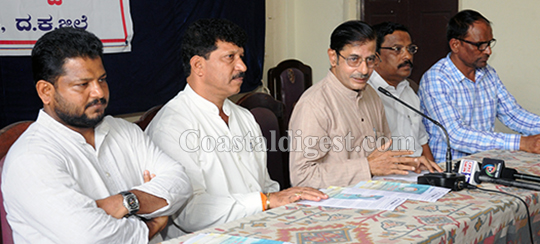
Dakshina Kannada district unit of the JIH too has planned a series of programmes as part of this campaign. The members of the reception committee of the campaign, comprising of prominent persons of the society, on Friday through a press conference urged the people of the district to join hands together to strengthen communal harmony in the region.

Addressing media persons Dr Satyanarayana Mallipatna, an academician and honorary president of the district level reception committee, said that the Dakshina Kanand was passing through a period of turmoil.

“Innocents are being attacked and killed for political reasons. This development is damaging the reputation of the coastal district,” he lamented and called upon the people to establish peace in the society.

1peace“Indian society is pluralistic in nature. The diversity that exists in India in terms of religion, culture and language is highly unique. People of our district should realise this and uphold unity and brotherhood,” he said.

Stating that the main target of the campaign was the youth of the country, he said that the new generation should be standard-bearers of brotherhood, peace, friendship and mutual support and cooperation.

He said that as part of the campaign taluk level goodwill forums will be formed. Besides following programmes will be conducted in the district:

1. Individual visit and distribution of folders and broachers at a wide range. 2. Speech competition for high school students. 3. Essay competition for college students. 4. Street play. 5. Competition of making documentary film. 6. Rural level programmes in all over district. 7. Childrens rally. 8. Multi language kavigoshti. 9. Distribution of two sadhbhavana award at district level. 10. On august 30 symposium at town hall, Mangaluru.

Committee president Prasad Rai Kallimar, vice president Sanjeeva Poojary, general secretary Muhammad Kunhi, and Umar UH were present at the press meet.

Meanwhile, release issued by the JIH stated that the goal of the campaign is to bring about some firm and perceptible changes in society.

“While the objective of this campaign is also to appeal and rouse the conscience of the country, but beyond that our goal is to ensure the establishment of a string of institutions right from the community level to the local level and the promotion of necessary practices to help consistently counter this menace of communal hatred,” it said.

Comments

Roshan Mangloori
 - 
Saturday, 20 Aug 2016

Mr.Viren you can call Muslims as Kafirs for not believing in Hindu gods.Kafir means one who denies.Must understand with context.

Satyameva jayate
 - 
Saturday, 20 Aug 2016

Viren ...kaafir is not a bad word..ha ha....learn it well yaar....still you dont know anything about IslAm....if you want to know the meaning.....ask in a real leading manner...we will teach you....

First ban saffron groups and viren's brothers in dk and see.....then all will be well..

Sinan
 - 
Friday, 19 Aug 2016

A timely campaign. All muslim oranisations of coastal Karnataka should join hands with JIH in this cause.

Viren Kotian
 - 
Friday, 19 Aug 2016

How can an organisation like Jamat-E-Islami, which calls those who go to temples as \Kaafirs\" promote peace and humanity in Dakshina Kannada?"

Add new comment

  • Coastaldigest.com reserves the right to delete or block any comments.
  • Coastaldigset.com is not responsible for its readers’ comments.
  • Comments that are abusive, incendiary or irrelevant are strictly prohibited.
  • Please use a genuine email ID and provide your name to avoid reject.
Agencies
February 20,2020

India ranked 77th on a sustainability index that takes into account per capita carbon emissions and ability of children in a nation to live healthy lives and secures 131st spot on a flourishing ranking that measures the best chance at survival and well-being for children, according to a UN-backed report.

The report was released on Wednesday by a commission of over 40 child and adolescent health experts from around the world. It was commissioned by the World Health Organization (WHO), UN Children's Fund (UNICEF) and The Lancet medical journal.

In the report assessing the capacity of 180 countries to ensure that their youngsters can survive and thrive, India ranks 77th on the Sustainability Index and 131 on the Flourishing Index, it said.

Flourishing is the geometric mean of Surviving and Thriving. For Surviving, the authors selected maternal survival, survival in children younger than 5 years old, suicide, access to maternal and child health services, basic hygiene and sanitation, and lack of extreme poverty.

For Thriving, the domains were educational achievement, growth and nutrition, reproductive freedom, and protection from violence.

Under the Sustainability Index, the authors noted that promoting today's national conditions for children to survive and thrive must not come at the cost of eroding future global conditions for children's ability to flourish.

The Sustainability Index ranks countries on excess carbon emissions compared with the 2030 target. This provides a convenient and available proxy for a country's contribution to sustainability in future.

The report noted that under realistic assumptions about possible trajectories towards sustainable greenhouse gas emissions, models predict that global carbon emissions need to be reduced from 39·7 giga­ tonnes to 22·8 gigatonnes per year by 2030 to maintain even a 66 per cent chance of keeping global warming below 1·5°C.

It said that the world's survival depended on children being able to flourish, but no country is doing enough to give them a sustainable future.

"No country in the world is currently providing the conditions we need to support every child to grow up and have a healthy future," said Anthony Costello, Professor of Global Health and Sustainability at University College London, one of the lead authors of the report.

"Especially, they're under immediate threat from climate change and from commercial marketing, which has grown hugely in the last decade," said Costello – former WHO Director of Mother, Child and Adolescent health.

Norway leads the table for survival, health, education and nutrition rates - followed by South Korea and the Netherlands. Central African Republic, Chad and Somalia come at the bottom.

However, when taking into account per capita CO2 emissions, these top countries trail behind, with Norway 156th, the Republic of Korea 166th and the Netherlands 160th.

Each of the three emits 210 per cent more CO2 per capita than their 2030 target, the data shows, while the US, Australia, and Saudi Arabia are among the 10 worst emitters. The lowest emitters are Burundi, Chad and Somalia.

According to the report, the only countries on track to beat CO2 emission per capita targets by 2030, while also performing fairly – within the top 70 – on child flourishing measures are: Albania, Armenia, Grenada, Jordan, Moldova, Sri Lanka, Tunisia, Uruguay and Vietnam.

"More than 2 billion people live in countries where development is hampered by humanitarian crises, conflicts, and natural disasters, problems increasingly linked with climate change," said Minister Awa Coll-Seck from Senegal, Co-Chair of the commission.

The report also highlights the distinct threat posed to children from harmful marketing.

Evidence suggests that children in some countries see as many as 30,000 advertisements on television alone in a single year, while youth exposure to vaping (e-cigarettes) advertisements increased by more than 250 per cent in the US over two years, reaching more than 24 million young people.

Studies in Australia, Canada, Mexico, New Zealand and the US – among many others – have shown that self-regulation has not hampered commercial ability to advertise to children.

Children's exposure to commercial marketing of junk food and sugary beverages is associated with purchase of unhealthy foods and overweight and obesity, linking predatory marketing to the alarming rise in childhood obesity, it said.

The number of obese children and adolescents increased from 11 million in 1975 to 124 million in 2016 – an 11-fold increase, with dire individual and societal costs, the report said.

To protect children, the authors call for a new global movement driven by and for children.

Specific recommendations include stopping CO2 emissions with the utmost urgency, to ensure children have a future on this planet; placing children and adolescents at the centre of global efforts to achieve sustainable development, the report said.

New policies and investment in all sectors to work towards child health and rights; incorporating children's voices into policy decisions and tightening national regulation of harmful commercial marketing, supported by a new Optional Protocol to the UN Convention on the Rights of the Child, it said.


Comments

Add new comment

  • Coastaldigest.com reserves the right to delete or block any comments.
  • Coastaldigset.com is not responsible for its readers’ comments.
  • Comments that are abusive, incendiary or irrelevant are strictly prohibited.
  • Please use a genuine email ID and provide your name to avoid reject.
News Network
July 15,2020

Kochi, Jul 15: Alisha P Shaji, a commerce student from Kerala's Kochi scored 499 out of 500 in the Central Board of Secondary Education (CBSE) class 12 results declared on Monday, wants to pursue a career in economics.

While talking to news agency on Tuesday, she said that she never joined coaching classes.

"I was surprised after knowing the unexpected result. I never expected this, I expected close to 98 per cent. I had five subjects to write but I could attempt only three as two were postponed. I am sad that I could not attempt them, but I am happy that I scored 100 in those subjects. In future, I want to pursue a degree in economics," she said.

"My friends, family and teachers are very supportive and I am thankful to them. I never went to tuitions. I used to study four to five hours a day," she added.

Alisha further said that she wants to give the message that it is okay to start late, but continuity is key to achieve good results.
CBSE on Monday had declared the results for Class 12 examinations 2020.

As per CBSE, with 88.78 per cent pass percentage this year for Class 12, the pass percentage has increased by 5.38 per cent. Last year, the pass percentage was 83.40 per cent. 

Comments

Add new comment

  • Coastaldigest.com reserves the right to delete or block any comments.
  • Coastaldigset.com is not responsible for its readers’ comments.
  • Comments that are abusive, incendiary or irrelevant are strictly prohibited.
  • Please use a genuine email ID and provide your name to avoid reject.
News Network
May 17,2020

Bengaluru, May 17: Left to itself, Karnataka will look to spring back towards normalcy under Lockdown 4.0 as the state government is on standby to resume public transport services from May 18, if the Centre allows it. 

Though KSRTC and BMTC have been preparing for resumption of services, officials in the two corporations told DH that they cannot make a move till the government makes a decision.

Transport Commissioner N Shivakumar said the department will take a decision based on the state government's orders. "The government will take a call on buses as well as taxi and other transport services," he said.

Senior officials in the state government said Deputy Chief Minister and Transport Minister Laxman Savadi has written to Union Minister for Road Transport and Highways Nitin Gadkari seeking a nod for resumption of the services. 

Transport Secretary Gaurav Gupta has written a separate letter to his counterpart in the Union government requesting permission to operate public transport. "The state government wants the services to open. The official has listed out the steps the corporations will take to ensure social distancing other steps that will be taken to check spread of Coronavirus," a source said.

The B S Yediyurappa administration has been bullish on easing lockdown restrictions. 

If the Centre empowers the states to define Lockdown 4.0, Karnataka is likely to do away with the red-orange-green zoning of districts and allow public services to resume, except in COVID-19 containment zones. The government is also likely to redefine its containment strategy by micromanaging localities where COVID-19 cases are reported, without letting life in an entire district get affected. 

The government has already shown willingness to allow hotels and gyms to open after May 17 subject to social distancing norms and restrictions. In fact, the government has proposed to allow the resumption of all economic activities in standalone establishments. The government, however, is not keen on opening malls, theatres, diners and establishments that have centralized air conditioning. 

“Everything depends on the Centre,” Deputy Chief Minister CN Ashwath Narayan said. “Our only stand is that the red zone should be treated at par with the other zone when it comes to relaxation.” 

Comments

Add new comment

  • Coastaldigest.com reserves the right to delete or block any comments.
  • Coastaldigset.com is not responsible for its readers’ comments.
  • Comments that are abusive, incendiary or irrelevant are strictly prohibited.
  • Please use a genuine email ID and provide your name to avoid reject.