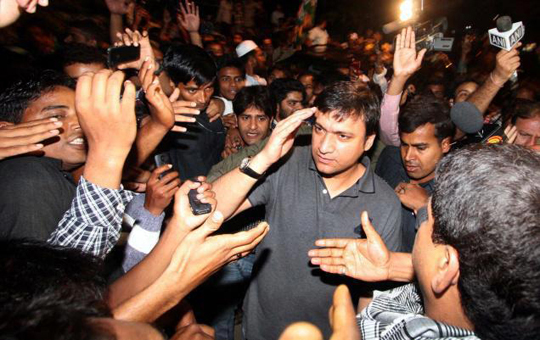
Can win 50 MP seats with votes of 'brethren', says Owaisi, BJP cries foul

Agencies
July 4, 2017

Hyderabad, Jul 4: AIMIM MLA Akbaruddin Owaisi stoked a controversy when he claimed his brother and party chief Asaduddin Owaisi could help the outfit win 50 seats in Parliament with the votes of "our brethren", remarks that BJP dubbed as "hate speech".

Owaisi

Owaisi was also purportedly shown in the video, which has gone viral, criticising the Modi government for the recent killing of Muslims.

He referred to the killings of Mohammed Akhlaq, Pehlu Khan and 15-year-old Junaid Khan and asked "if it is a crime to wear a cap, grow your beard and be a Muslim".

"There is no need for the sympathy, support of anybody. Our brother (his brother and MIM president Asaduddin Owaisi) can win 50 parliament seats for the party with the votes of our brethren," Akbaruddin, the MLA from Chandrayangutta in Hyderabad, was heard saying in the video.

Hitting out at the VHP and Bajrang Dal, he said: "Jitna ye mulkterahai, utna ye mulkmerabhihai". (This country is mine as much as it is yours).

It was not immediately clear where and when Akbaruddin Owaisi made the alleged speech.

Responding to Akbaruddin's alleged comments which were seen as appealing to Muslim sentiments, BJP spokesperson Krishna Saagar Rao alleged the MLA made a hate speech which could "incite" people.

Wondering why the TRS government in the state had not filed charge-sheet in the case of hate speech made earlier by Akbaruddin Owaisi, the BJP leader demanded that a police case be registered against him.

BJP would approach the Election Commission seeking cancellation of MIM's recognition, he said.

Comments

Fayaz
 - 
Friday, 7 Jul 2017

Terrorist grup tried to kill the innocent muslim guy..

s
 - 
Tuesday, 4 Jul 2017

anything a muslim says is hate?

Add new comment

  • Coastaldigest.com reserves the right to delete or block any comments.
  • Coastaldigset.com is not responsible for its readers’ comments.
  • Comments that are abusive, incendiary or irrelevant are strictly prohibited.
  • Please use a genuine email ID and provide your name to avoid reject.
News Network
July 25,2020

New Delhi, Jul 25: India reported a spike of 48,916 coronavirus cases on Saturday, according to the Union Ministry of Health and Family Welfare.

The total COVID-19 positive cases stand at 13,36,861 including 4,56,071 active cases, 8,49,431 cured/discharged/migrated. With 757 deaths in the last 24 hours, the cumulative toll reached 31,358.

Maharashtra has reported 3,57,117 coronavirus cases, the highest among states and Union Territories in the country.

A total of 1,99,749 cases have been reported from Tamil Nadu till now, while Delhi has recorded a total of 1,28,389 coronavirus cases.

According to the Indian Council of Medical Research (ICMR), 4,20,898 samples were tested for coronavirus on Friday and overall 1,58,49,068 samples have been tested so far.

Comments

Add new comment

  • Coastaldigest.com reserves the right to delete or block any comments.
  • Coastaldigset.com is not responsible for its readers’ comments.
  • Comments that are abusive, incendiary or irrelevant are strictly prohibited.
  • Please use a genuine email ID and provide your name to avoid reject.
Agencies
June 15,2020

New Delhi, Jun 15: Average temperature of India experienced a rise of 0.7 degree Celsius, along with decline in rainfall, significant increase in frequency of very severe cyclonic storms and droughts in over a decade due to human activities, the Ministry of Earth Sciences in its research report said.

The contentions were made in a report issued by the ministry on the impact of climate change. It will be published by Union Minister Harsh Vardhan on June 19.

According to the report, "Since the middle of the twentieth century, India witnessed rise in temperature; decrease in monsoon; rise in extreme temperature and rainfall, droughts, and sea levels; and increase intensity of severe cyclones.

The report, prepared by researchers of the Centre for Climate Change Research, a cell under The Ministry's Indian Institute of Tropical Meteorology, Pune, further stated that there is compelling scientific evidence that human activities have influenced these changes in regional climate.

India's average temperature has risen by around 0.7 degrees Celsius during 1901-2018, it said, adding that the rise is largely on account of GHG-induced warming and partially offset by forcing due to anthropogenic aerosols.

It states that the average temperature over India is projected to rise by 4.4 degrees Celsius, while the intensity of heat waves is likely to increase by 3-4 times by the end of the century.

In the 30-year period between 1986 and 2015, temperatures of the warmest day and the coldest night of the year have risen by about 0.63 degrees Celsius and 0.4 degree Celsius.

According to the report, by the end of the century, the temperatures of the warmest day and the coldest night are projected to rise by approximately 4.7 degrees Celsius and 5.5 degrees Celsius, respectively.

Alarmingly, sea surface temperature of the tropical Indian Ocean has also risen by one degrees Celsius on average during 1951-2015.

"The frequency of very severe cyclonic storms during the post-monsoon season has increased significantly (+1 event per decade) during the last two decades (2000-2018)," it added.

This came in the backdrop of Cyclone 'Amphan' and 'Nisarga' which made landfalls on May 20 and June 3 and killed several people, flattened villages, and destroyed farms.

"This is the first-ever climate change assessment report for India. This report will be very useful for policy makers, researchers, social scientists, economists, and students," said M. Rajeevan, secretary, the Ministry of Earth Sciences.

Besides this, the report also highlighted various other unnerving data on climate change in the country. Both the frequency and extent of droughts have increased significantly during 1951-2016.

The overall decrease of seasonal "summer monsoon rainfall" during the last 6-7 decades has led to an increased propensity for droughts over India.

"In particular, areas over central India, southwest coast, southern peninsula and north-eastern India have experienced more than 2 droughts per decade, on average, during this period. The area affected by drought has also increased by 1.3 per cent per decade over the same period."

The Hindu Kush Himalayas (HKH) also experienced a temperature rise of about 1.3 degree Celsius during 1951-2014.

Several areas of the Himalayas have experienced a declining trend in snowfall and also retreat of glaciers in recent decades. By the end of the twenty-first century, its annual mean surface temperature is projected to increase by about 5.2 degree Celsius.

The summer monsoon precipitation from June to September over India has also declined by around 6 per cent from 1951 to 2015, with notable decreases over the Indo-Gangetic Plains and the Western Ghats, the report further states.


Comments

Add new comment

  • Coastaldigest.com reserves the right to delete or block any comments.
  • Coastaldigset.com is not responsible for its readers’ comments.
  • Comments that are abusive, incendiary or irrelevant are strictly prohibited.
  • Please use a genuine email ID and provide your name to avoid reject.
Agencies
June 20,2020

New Delhi, Jun 20: After Prime Minister Narendra Modi said there are no foreign incursions into India, China has once again claimed that Galwan valley of Ladakh union territory is located on the Chinese side of the Line of Actual Control (LAC).

In an official statement on the step-by-step account of the Galwan face-off where 20 Indian soldiers were killed, China's foreign ministry spokesperson Zhao Lijian has said the Galwan valley is located on the Chinese side of the LAC in the west section of the China-India boundary.

"For many years, the Chinese border troops have been patrolling and on duty in this region," Zhao said alleging that since April this year, the Indian border troops have unilaterally and continuously built roads, bridges and other facilities at the LAC in the Galwan Valley.

China has lodged representations and protests on multiple occasions but India has gone even further to cross the LAC and make provocations, Zhao said.

By the early morning of May 6, the Indian border troops, who had crossed the LAC by night and trespassed into China's territory, built fortification and barricades, which impeded the patrol of Chinese border troops, Zhao said adding that they deliberately made provocations in an attempt to unilaterally change the status quo of control and management.

The Chinese border troops, he said, were "forced to take necessary measures to respond to the situation on the ground and strengthen management and control in the border areas."

In order to ease the situation, China and India have stayed in close communication through military and diplomatic channels, he said. "In response to the strong demand of the Chinese side, India agreed to withdraw the personnel who crossed the LAC and demolish the facilities, and so they did.

On June 6, the border troops of both countries held a commander-level meeting and reached consensus on easing the situation. The Indian side, he said, promised that they would not cross the estuary of the Galwan river to patrol and build facilities and the two sides would discuss and decide phased withdrawal of troops through the meetings between commanders on the ground.

"Shockingly, on the evening of June 15, India's front-line troops, in violation of the agreement reached at the commander-level meeting, once again crossed the Line of Actual Control for deliberate provocation when the situation in the Galwan Valley was already easing, and even violently attacked the Chinese officers and soldiers who went there for negotiation, thus triggering fierce physical conflicts and causing casualties."

"The adventurous acts of the Indian army have seriously undermined the stability of the border areas, threatened the lives of Chinese personnel, violated the agreements reached between the two countries on the border issue, and breached the basic norms governing international relations," the spokesperson said.

Beijing, he said, hopes that India will work with China, follow faithfully the important consensus reached between the two leaders, abide by the agreements reached between the two governments, and strengthen communication and coordination on properly managing the current situation through diplomatic and military channels, and jointly uphold peace and stability in the border areas.

Comments

Add new comment

  • Coastaldigest.com reserves the right to delete or block any comments.
  • Coastaldigset.com is not responsible for its readers’ comments.
  • Comments that are abusive, incendiary or irrelevant are strictly prohibited.
  • Please use a genuine email ID and provide your name to avoid reject.